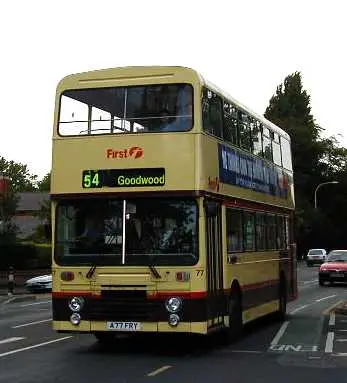
The Dennis Dominator was Dennis’s first rear-engined double-decker bus chassis, launched in 1977. It marked the company’s return to bus building after the last Lolines were made in 1967, and it was offered with an unusually wide choice of engines, gearboxes and axles.
Dennis Dominator at a glance
| Maker | Dennis, Guildford |
|---|---|
| Launched | 1977 |
| Type | rear-engined double-decker bus chassis |
| Radiator | at the front, not beside the engine |
| Standard engine | Gardner 6LXB |
| Optional engines | Rolls-Royce Eagle, Cummins L10, Gardner 6LXCT, DAF |
| Standard gearbox | Voith DIWA |
| Axles | drop-centre or hub-reduction |
| Largest customer | South Yorkshire PTE, 318 buses |
| Leicester City Transport | 123 buses, 1977–1989 |
| Final buses | four in 1996 |
Based on one source, the English Wikipedia article on the Dominator.
History of the Dennis Dominator
Back into the bus market
Dennis had been out of bus manufacturing since the last Lolines were built in 1967. The Dominator of 1977 brought the company back as a builder of rear-engined double-deckers, and to some extent it was seen as a successor to the Daimler and Leyland Fleetline. It was a bespoke design with numerous options, and it differed from the Fleetline in one visible way: the radiator sat at the front of the bus rather than at the offside of the engine compartment.
Engines and axles
The Dominator was intended to be sold mainly with a Gardner 6LXB engine, a Voith DIWA transmission and a drop-centre rear axle, but buyers could also have a hub-reduction rear axle and a choice of engines including the Rolls-Royce Eagle, the Cummins L10, the turbocharged Gardner 6LXCT and units from DAF.
South Yorkshire and the municipal fleets
The largest British customer was South Yorkshire PTE, which took 318 buses, among them a trolleybus built in 1985 for test and evaluation. Many had Rolls-Royce Eagle engines and hub-reduction axles. Most carried Alexander RH bodywork delivered between 1981 and 1987, though some were bodied by East Lancs and Northern Counties. The SYPTE buses replaced Daimler Fleetlines, Leyland Atlanteans and Volvo Ailsa B55s, some dating from the early 1970s, and the final Sheffield batch of 20 had coach seats for regionwide express services under the Fastline brand. The engineering was good enough that the last South Yorkshire Dominators stayed in service in Doncaster until July 2006. Leicester City Transport bought 123 between 1977 and 1989, mainly with East Lancs bodies and seven with Marshall bodies, all out of public service by 2005. Central Scottish and Western Scottish took Alexander low-height RL bodywork from 1981, while Greater Manchester Transport and its successor GM Buses used Northern Counties bodies, Warrington Borough Transport East Lancs, Merseyside Transport Willowbrook and Alexander RH, and London Transport three Northern Counties buses for its Alternative Vehicle Evaluation programme in the mid-1980s.
Single-deck versions and the end
A single-deck Dominator was built too. In 1978 Darlington Corporation ordered an extended-wheelbase chassis for 11-metre coachwork, bodied by Marshall with two doors and 46 seats and shown on the Dennis stand at the 1978 Motor Show at the National Exhibition Centre as the Camair 80; Darlington took ten, designated SD103A, and repeated the order in 1981 with eight more coded SD128A. Hartlepool bought six with East Lancs bodies seating 43. After bus deregulation in 1986 production became sporadic: eight buses in 1992, three in 1993 for a cancelled Strathclyde Buses order later sold to Mayne Coaches, none in 1994 or 1995, and a final four in 1996 for London & Country with East Lancs bodywork. London Pride Sightseeing ran 24 second-hand Dominators, all but four converted to open top, until 2005.
Design and features
- Front radiator: a layout that set the Dominator apart from the Daimler Fleetline it replaced in many fleets.
- Wide choice: Gardner, Rolls-Royce, Cummins and DAF engines, two axle types and several gearboxes.
- Municipal favourite: large fleets at South Yorkshire, Leicester, Manchester, Merseyside and Warrington.
- Long life: South Yorkshire examples worked until July 2006, almost thirty years after launch.
Dennis Dominator versions
- Double-deck Dominator (1977–1996): the standard chassis with Alexander, East Lancs, Northern Counties, Marshall or Willowbrook bodies.
- Single-deck SD103A (1978–1979): ten for Darlington Corporation with Marshall Camair 80 bodywork.
- Single-deck SD128A (1981): eight repeat buses for Darlington.
- Hartlepool single-deckers: six with East Lancs bodies and 43 seats.
- Trolleybus (1985): one built for South Yorkshire PTE for evaluation.
The Dominator came after the Dennis Loline and was eventually replaced as a double-decker by the Dennis Dragon-derived range, while the Dennis Lance took over the single-deck work. More are in the Dennis collection.
Video: The last Dennis Dominator, N715TPK
Video on YouTube.
Sources
- Dennis Dominator, English Wikipedia: launch, engines, operators, production