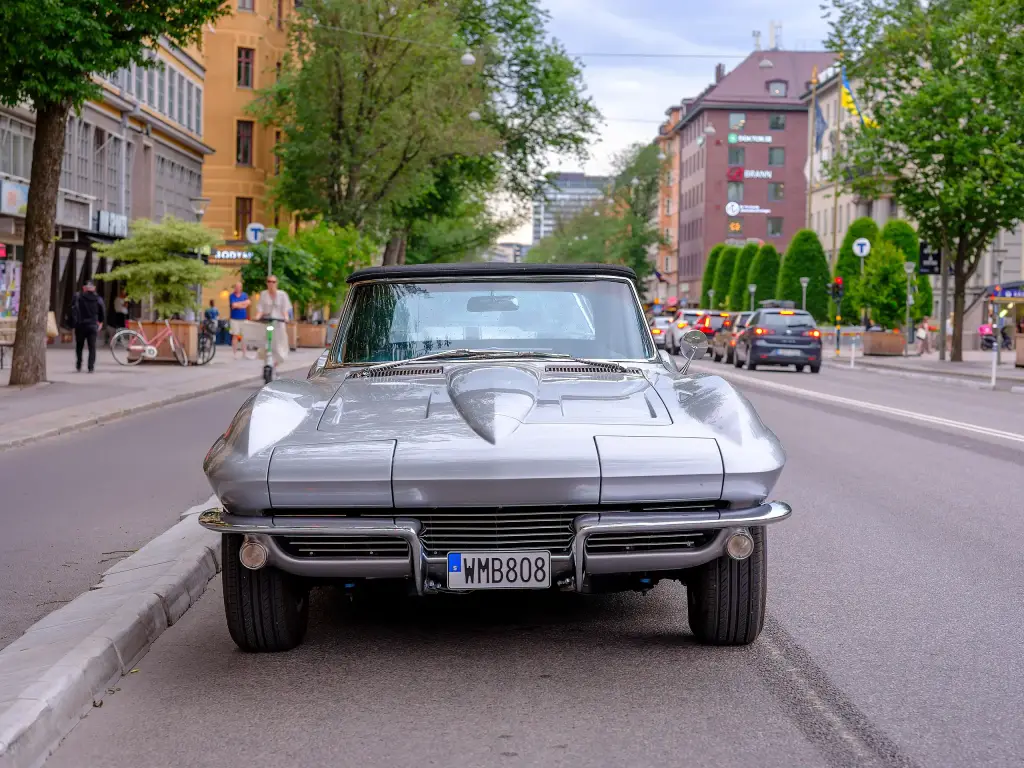
The Chevrolet Corvette is the longest-running American sports car, in production since June 1953 and now in its eighth generation. It has always been a two-door, two-seat car with a fibreglass or composite body, and since 2019 it has been mid-engined.
Chevrolet Corvette at a glance
| Production | since 30 June 1953 |
|---|---|
| Generations | C1 to C8 |
| Layout | Front mid-engine to 2019, rear mid-engine from C8 |
| Body | Fibreglass, later composite |
| First model | 300 hand-built Polo White convertibles for 1953 |
| First engine | 235 cu in Blue Flame six, 150 hp |
| First V8 | 265 cu in, optional from 1955 |
| 1957 option | Ramjet fuel injection, 283 hp |
| Assembly | Flint, then St. Louis, and Bowling Green since 1981 |
History of the Chevrolet Corvette
The Corvette appeared as a show car at the General Motors Motorama in New York in January 1953, where Chevrolet’s general manager admitted it was six months to a year from production readiness. Interest was strong enough for production to begin on 30 June 1953. The first cars were convertibles with hand-laid fibreglass bodies, and only 300 were built for 1953, all in Polo White. For 1954 the colour choice widened and 3,640 cars were made. From 1953 to 1955 the only engine was the 235 cu in Blue Flame six with 150 hp, giving the car looks that its performance did not match.
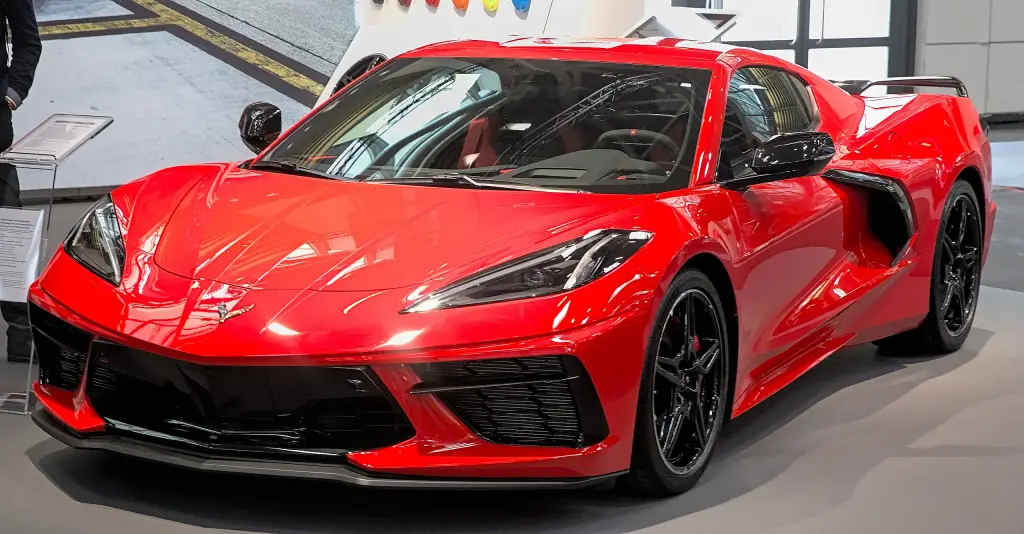
The 1955 model offered a 265 cu in V8, cutting the 0–60 mph time by about three seconds, and although only 700 cars were built that year because of unsold 1954 stock, almost all buyers chose the V8. A new body with side coves came for 1956, and midway through 1957 Chevrolet added Ramjet fuel injection, one of the first mass-produced American engines to make one horsepower per cubic inch. Power windows, a hydraulically assisted convertible top and, late in 1957, a four-speed manual joined the options list. The 1958 car had quad headlamps and a new dashboard, the 1961 car a tapered tail with four round lights that lasted until 2014, and 1962 brought the 327 cu in engine with up to 360 hp from fuel injection; that year was also the last for the solid rear axle and the convertible-only body.
The second generation of 1963 introduced the Sting Ray name and independent rear suspension, and the model has since run through the C3, C4, C5, C6 and C7 generations with front mid-mounted engines and, from the C8 of 2019, a rear mid-engine layout. Early cars were built in Flint, Michigan and then St. Louis, Missouri, and since 1981 in Bowling Green, Kentucky, where the National Corvette Museum stands. In 1953 the car was named after the corvette, a small and manoeuvrable warship.
Design and features
- Fibreglass body: used from the very first car because it was cheap to tool for small volumes.
- Fuel injection: the 1957 Ramjet option made the Corvette the first American mass-produced engine at one horsepower per cubic inch.
- Four round tail lights: introduced in 1961 and kept, with interruptions, until 2014.
- Mid-engine: the C8 of 2019 moved the engine behind the driver for the first time.
Chevrolet Corvette versions
- C1 (1953–1962): the solid-axle roadster with the six and then the small-block V8.
- C2 Sting Ray (1963–1967): the coupé and convertible with independent rear suspension.
- C3 to C7: the long run of front mid-engined cars.
- C8 (2019 onwards): the rear mid-engined generation.
The Corvette was Chevrolet’s halo model above the Chevrolet Camaro and shared its early fuel-injection technology with the Bel Air. More cars are in the Chevrolet collection.
Video: 2014 Chevrolet Corvette Stingray Z51
Video by Saabkyle04 on YouTube.
Sources
- Chevrolet Corvette, English Wikipedia: history, generations, engines, assembly