The Chevrolet Cruze was General Motors’ global compact car from 2008 until 2023. Designed and engineered mainly by GM Korea on the Delta II platform, it replaced the Chevrolet Cobalt, the Optra and the Holden Astra in one stroke and was built on four continents.
Chevrolet Cruze at a glance
| Production | 2008–2023 |
|---|---|
| Class | Compact car |
| Platform | GM Delta II, front-wheel drive |
| Developer | GM Korea with Opel, GM North America and Holden |
| Development | 27 months, about 4 billion dollars, 221 prototypes |
| Body structure | 65 percent high-strength steel |
| Body styles | Sedan, five-door hatchback from 2011, wagon from 2012 |
| Suspension | MacPherson struts front, torsion beam rear |
| Replaced | Chevrolet Cobalt, Optra and Holden Astra |
| Built in | South Korea, United States, China, Argentina and others |
History of the Chevrolet Cruze
Before the global Cruze there was another car of the same name: from 2001 to 2008 General Motors sold a small Suzuki Ignis-based crossover as the Chevrolet Cruze in Japan and as the Holden Cruze in Australia and New Zealand. It was designed and engineered by Holden from the 1999 YGM1 concept, came with 1.3- or 1.5-litre engines and front-wheel drive, with all-wheel drive optional, and was marketed as a light SUV.
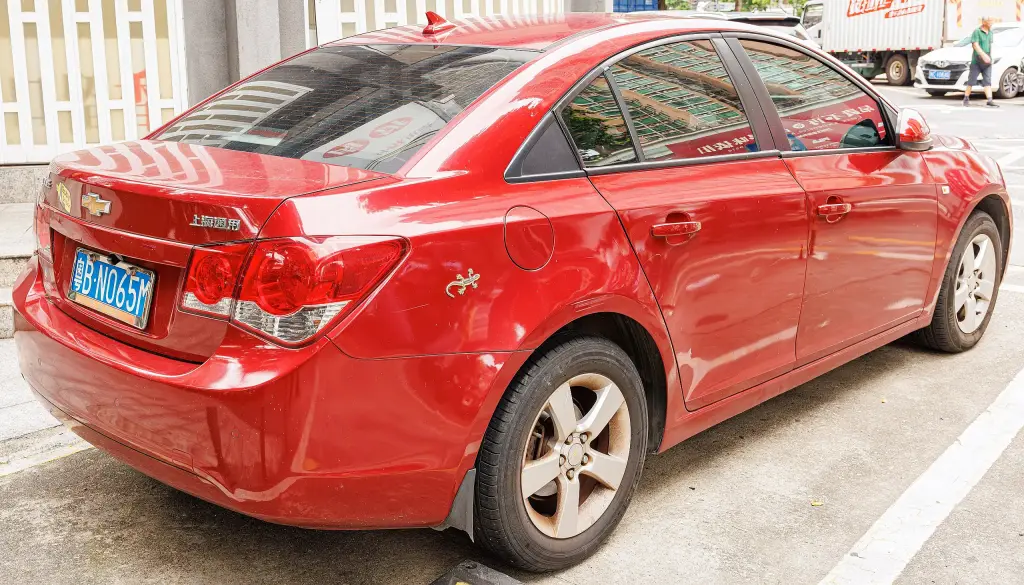
The car that most people mean by Cruze arrived in 2008 with the internal code J300. It was developed under a global programme led by GM Korea with Opel engineering, and replaced the Chevrolet Cobalt, the Daewoo Lacetti and the Holden Astra at once. The programme ran 27 months and cost about four billion dollars, with 221 prototypes tested in seven countries. The body was 65 percent high-strength steel, the front suspension used MacPherson struts and the rear a torsion beam axle, a deliberate choice to avoid the cost of a multi-link set-up. Mark Reuss of GM North America called the car ‘everything for us’ when production started in Ohio. In South Korea it was first sold in 2008 as the Daewoo Lacetti Premiere, taking the Chevrolet name in 2011 when the Daewoo brand ended.
A five-door hatchback, designed and developed by Holden, was shown as a concept at Paris in 2010 and went on sale in Europe in 2011, and a station wagon followed in 2012. Production was wound down as buyers moved to SUVs: South Korea ended in 2018 as part of GM Korea’s restructuring and with it the supply of the Holden Astra sedan, the United States and Mexico in 2019, China in 2020, and Argentina in 2023. In China the car was replaced by the Monza, which is sold in Mexico as the Cavalier.
Design and features
- Global programme: one car replaced the Cobalt, the Optra and the Holden Astra.
- High-strength steel: 65 percent of the body structure, with a torsion beam rear axle to keep costs down.
- Three body styles: sedan, hatchback and wagon.
- Quiet cabin: an isolated four-point engine mount and triple-layer door seals were part of the design.
Chevrolet Cruze versions
- Cruze sedan (2008): the original J300 car, first sold in Korea as the Daewoo Lacetti Premiere.
- Hatchback (2011): the five-door developed by Holden.
- Station wagon (2012): the estate version for Europe and other markets.
- Earlier Cruze (2001–2008): the unrelated Suzuki Ignis-based crossover.
The Cruze replaced the Chevrolet Cobalt and the Chevrolet Lacetti and sat above the smaller Chevrolet Aveo. More cars are in the Chevrolet collection.
Video: Chevrolet Cruze test
Video by ADAC on YouTube.
Sources
- Chevrolet Cruze, English Wikipedia: development, platform, body styles, production end