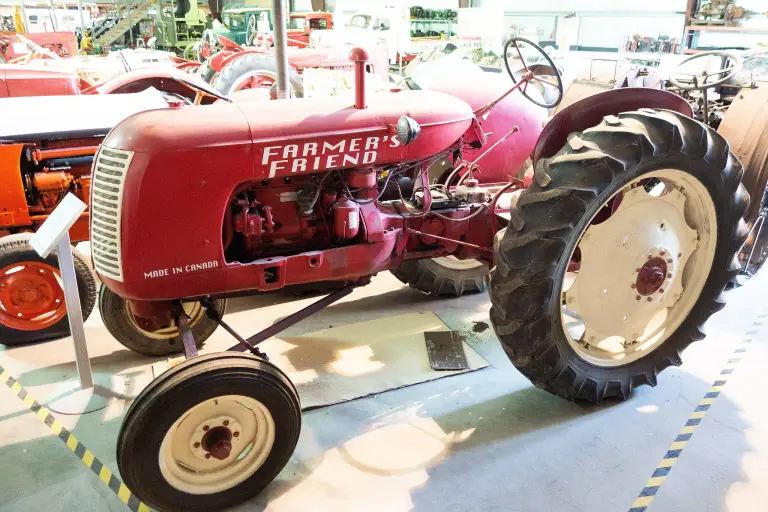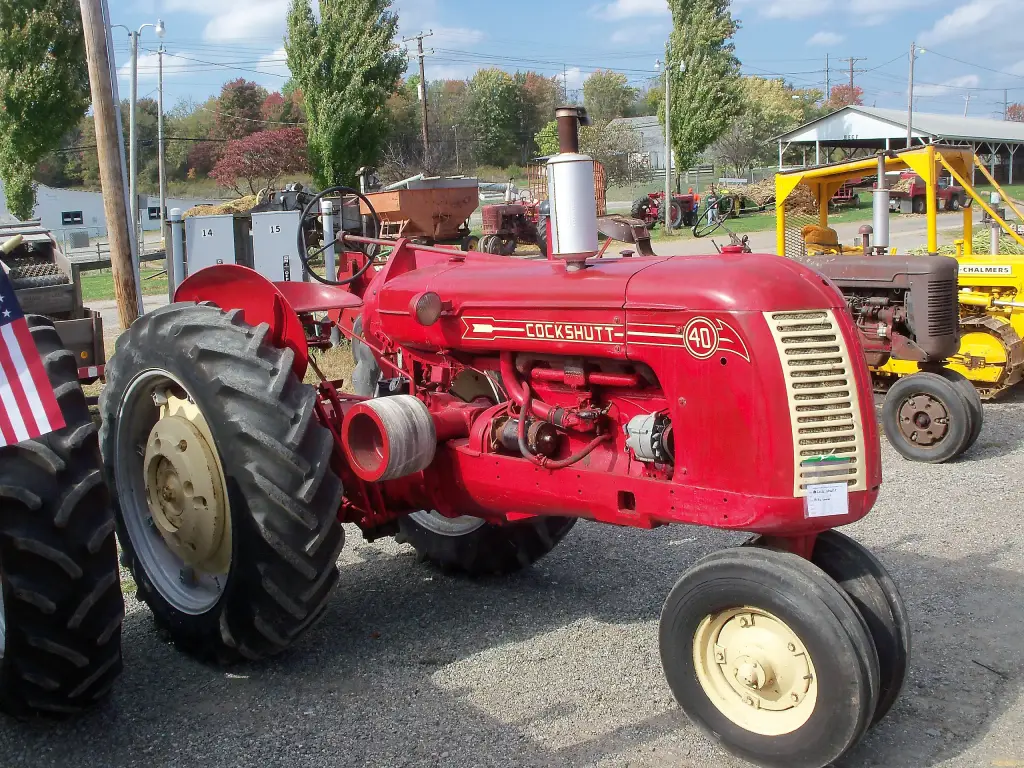
The Cockshutt 40 was the second tractor produced by the Cockshutt Plow Company, built at Brantford, Ontario, from 1949 to 1958. A heavier machine than the Cockshutt 30 and rated for four plows, it used a six-cylinder engine and was sold in the United States as the CO-OP E4.
Cockshutt 40 at a glance
| Maker | Cockshutt Plow Company, Brantford, Ontario |
|---|---|
| Production | 1949–1958 (14,929 built with derivatives) |
| Type | row-crop tractor, four plows |
| Engine | Buda six-cylinder, 230 cu in (3,800 cc) |
| Fuel | petrol; diesel from 1950; kerosene and LP gas from 1953 |
| Power take-off | optional live PTO |
| Engines after 1953 | Perkins and Hercules |
| Perkins diesel version | Cockshutt 40D4 (1954–1957), Golden Eagle (1956–1957) |
| Front axles | narrow double or single wheels, fixed or adjustable wide axle |
| US equivalent | CO-OP E4, painted all-orange |
| Price, 1955 | CA$2,626 base; more than CA$3,600 fully optioned |
| Successor | Cockshutt 35 with a Hercules four-cylinder (1955–1958) |
Based on one source: the English Wikipedia article on the Cockshutt 40, which includes a section on the Cockshutt 35.
History of the Cockshutt 40
Having developed the medium-sized Cockshutt 30, Cockshutt moved up with the heavier 40, which used a six-cylinder engine and was rated for four plows. It was scaled up from the 30 with many of the same features, including an optional live power take-off that kept machinery running at constant speed whether the tractor was in motion or stationary — at the time still a novelty. The rounded styling again came from the Canadian architect Charles Brooks.
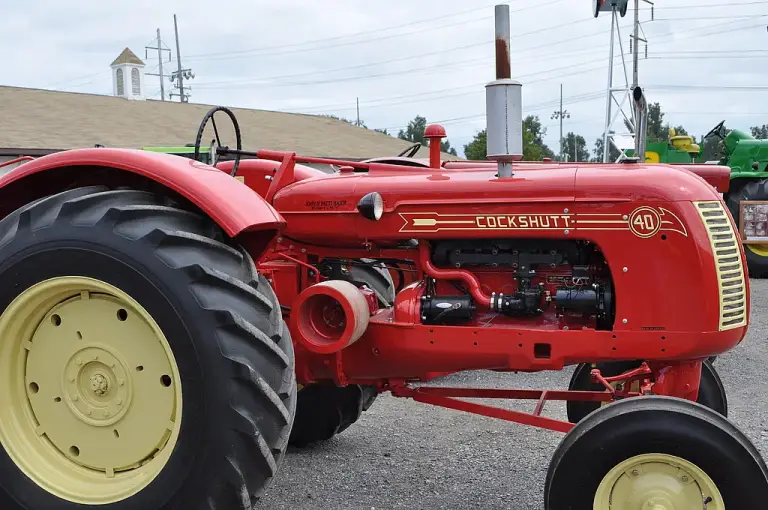
A 230-cubic-inch (3,800 cc) six-cylinder from the American Buda Engine Company was fitted, supplemented by a diesel version in 1950; kerosene and LP gas options followed in 1953. Models were offered with narrow double or single front wheels, a wide standard fixed axle or an adjustable wide row-crop axle, and the tractor could also drive belt-connected machinery. 14,929 Cockshutt 40s and derivatives were built at Brantford from 1949 to 1958. The base price in 1955 was CA$2,626, and a fully optioned 40 could cost more than CA$3,600.
Engines and derivatives
When competitor Allis-Chalmers acquired Buda in 1953, Cockshutt turned to Perkins and Hercules engines. The 40s with Perkins four-cylinder diesels were sold as the Cockshutt 40D4 from 1954 to 1957 and as the Golden Eagle in 1956 and 1957; the 40D4 later became the basis for the Cockshutt 560. In the United States the 40 was rebranded all-orange as the CO-OP E4, and it was also sold through the Gambles department store chain, though unlike the 30 it was never branded in the Gambles Farmcrest line. The Cockshutt 50 was developed with Model 40 transmission components and running gear but was substantially heavier and more powerful.
The Cockshutt 35
The 35 was developed to take a four-cylinder engine from the Hercules Engine Company in place of the 40’s Buda units, once Buda belonged to a competitor and Cockshutt needed an independent supplier. It used the basic Model 40 frame with a four-cylinder 198-cubic-inch (3,240 cc) Hercules GO198 petrol engine and a six-speed transmission; the 35L was a low-profile standard tractor with a fixed axle width. The 1956 Black Hawk version was a promotional model for the United States, marking Cockshutt’s acquisition of the Black Hawk line of tillage accessories from the Ohio Cultivator Company, with no functional changes. The Golden Arrow of 1957 added a three-point hitch with draft and depth control and was built in 135 examples; the Cockshutt 550 descended from it. 1,985 Cockshutt 35s and derivatives were built at Brantford from 1955 to 1958; a Deluxe 35 Blackhawk cost CA$2,640 in 1958 and a fully optioned model about CA$3,000.
Design and features
- Six-cylinder power: a 230-cubic-inch Buda, with diesel from 1950.
- Four-plow rating: the heavy tractor of the early Brantford range.
- Live PTO: optional, and still a novelty when the 40 appeared.
- Independent engines: Perkins and Hercules units after Buda passed to Allis-Chalmers.
- Four-cylinder successor: the Cockshutt 35 on the basic Model 40 frame.
Cockshutt 40 versions
- Cockshutt 40 (1949–1958): the standard six-cylinder tractor.
- Cockshutt 40D4 (1954–1957): Perkins four-cylinder diesel, basis of the 560.
- Golden Eagle (1956–1957): the Perkins-engined 40 under a promotional name.
- CO-OP E4: American equivalent, painted all-orange.
- Cockshutt 35 (1955–1958): Hercules-engined successor, with 35L, Black Hawk and Golden Arrow versions.
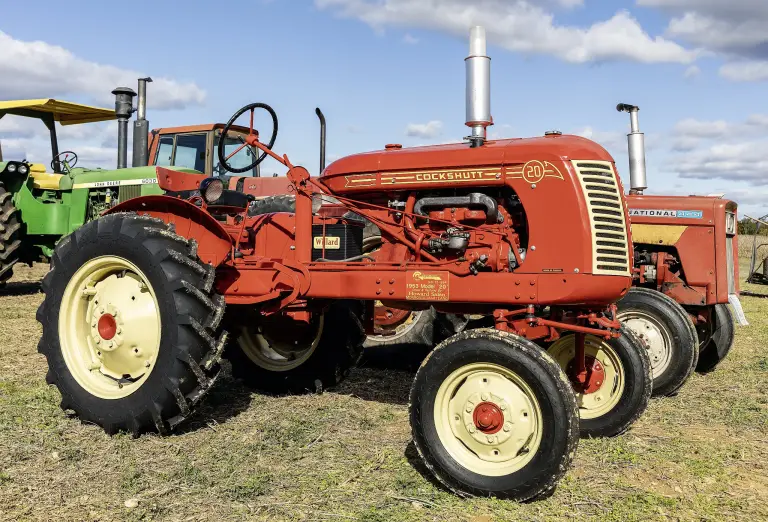
The 40 followed the Cockshutt 30 and sat above the small Cockshutt 20; more of the Canadian range is in the Cockshutt collection.
Sources
- Cockshutt 40, English Wikipedia: production, engines, derivatives, section on the Cockshutt 35