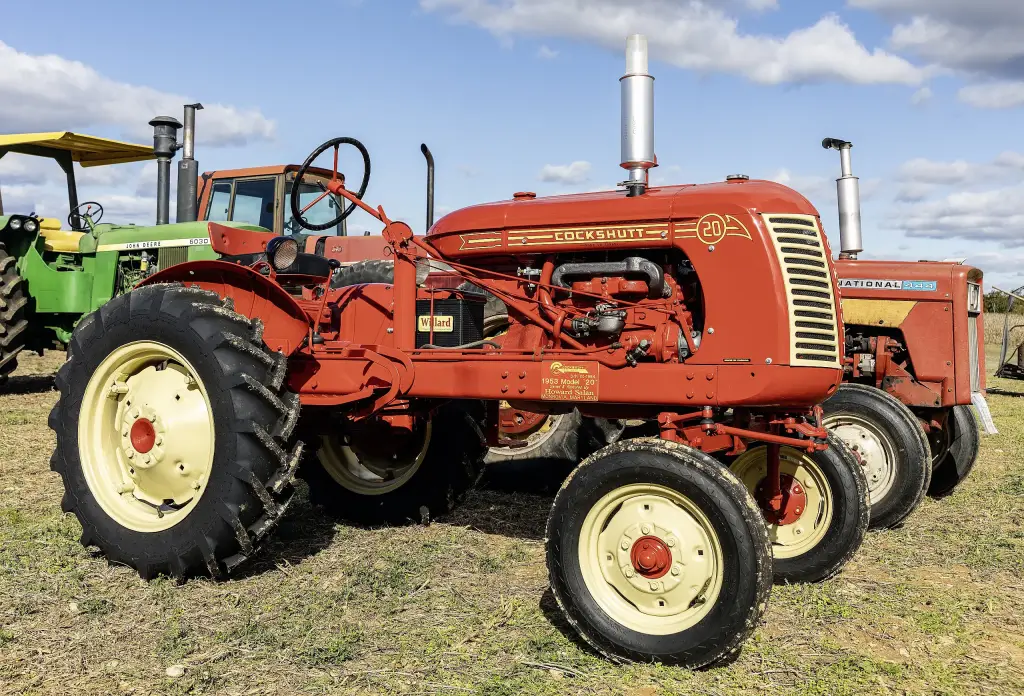
The Cockshutt 20 was the third tractor produced by the Cockshutt Plow Company, made at Brantford, Ontario, from 1951 to 1958. A small two-plow row-crop tractor for general farm work, it was scaled down from the medium Cockshutt 30 and sold in the United States as the CO-OP E2.
Cockshutt 20 at a glance
| Maker | Cockshutt Plow Company, Brantford, Ontario |
|---|---|
| Production | 1951–1958 (about 4,000 built from 1952) |
| Type | row-crop tractor, two plows |
| Engine, early | Continental four-cylinder, 124 cu in (2,030 cc) |
| Engine, later | Continental four-cylinder, 140 cu in (2,300 cc) |
| Fuel | petrol; distillate version from 1953 |
| Power take-off | transmission-driven, no live PTO |
| Front axles | narrow double front wheels or wide adjustable row-crop axle |
| Styling | Charles Brooks |
| US equivalent | CO-OP E2, painted all-orange |
| Price, 1956 | CA$1,656 base; more than CA$2,600 fully optioned |
| Special versions | Deluxe Black Hawk (1956), Little Chief |
Based on one source: the English Wikipedia article on the Cockshutt 20.
History of the Cockshutt 20
Cockshutt had already developed the medium-sized Cockshutt 30 and the heavier Cockshutt 40 when it turned to a smaller machine. The 20 arrived in 1951 as a two-plow tractor for general use on smaller farms, a scaled-down version of the 30 with many of the same features but without the live power take-off fitted to the larger Cockshutts.
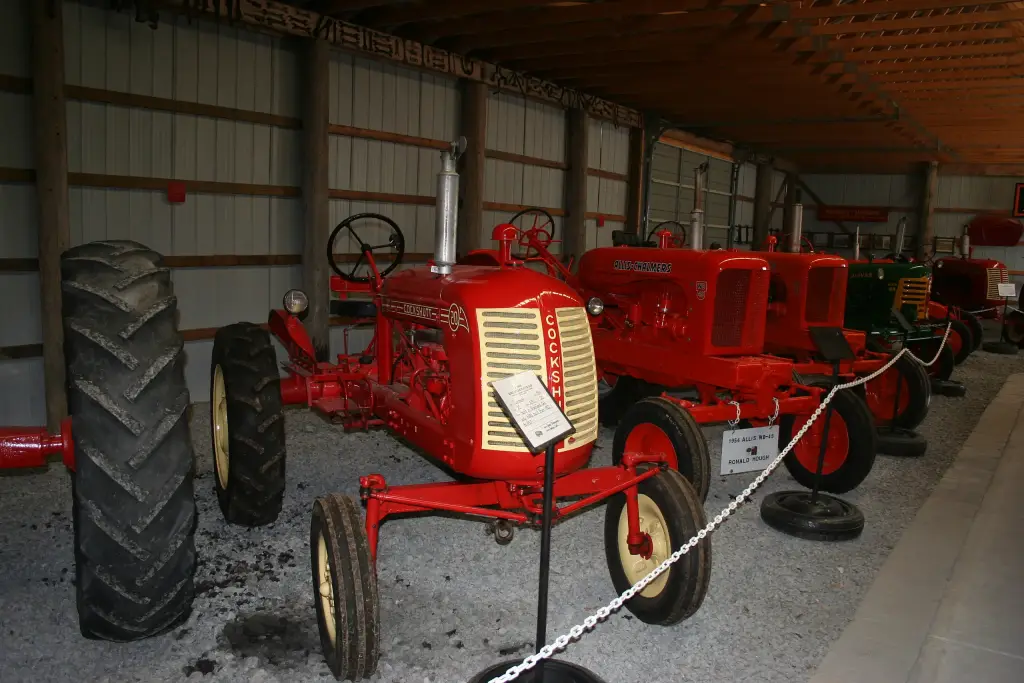
The tractor was styled in the same streamlined manner as the 30 by the Canadian architect Charles Brooks, whose rounded sheet metal gave the Brantford range a family look. A Continental Motors four-cylinder engine of 124 cubic inches (2,030 cc) was used at first; when early production models proved underpowered it was replaced by a Continental unit of 140 cubic inches (2,300 cc). A distillate version joined the range in 1953.
Versions and the American market
Models were built with narrow double front wheels or with a wide adjustable row-crop front axle. In 1956 the Model 20 Deluxe Black Hawk was offered with refinements and a mostly cream-coloured paint scheme with a red chassis. At the request of the United States distributor a version with an offset engine, similar to the Farmall A and C tractors, was also sold as the Little Chief. In the United States the standard tractor was sold all-orange as the CO-OP E2.
About 4,000 Cockshutt 20s and derivatives were built at Brantford from 1952 to 1958. The base price in 1956 was CA$1,656, while a fully optioned 20 could cost more than CA$2,600.
Design and features
- Small size: a two-plow tractor for general work, the smallest of the Brantford line.
- Brooks styling: the streamlined sheet metal shared with the Cockshutt 30.
- Continental power: a 124-cubic-inch engine at first, enlarged to 140 cubic inches.
- Choice of axles: narrow double front wheels or a wide adjustable row-crop axle.
Cockshutt 20 versions
- Cockshutt 20 (1951–1958): the standard row-crop tractor.
- Distillate version (1953): for cheaper fuel.
- Deluxe Black Hawk (1956): cream paint with a red chassis and extra refinements.
- Little Chief: offset-engine version for the United States distributor.
- CO-OP E2: American equivalent, painted all-orange.
The 20 sat below the Cockshutt 30 and the six-cylinder Cockshutt 40; more of the Canadian range is in the Cockshutt collection.
Sources
- Cockshutt 20, English Wikipedia: production, engines, versions, prices