The Cockshutt 30 was the first production tractor manufactured in Canada. Built by the Cockshutt Plow Company at Brantford, Ontario, from 1946 to 1957, it introduced the live power take-off and turned a firm that had imported rebranded American tractors into a full-line agricultural manufacturer.
Cockshutt 30 at a glance
| Maker | Cockshutt Plow Company, Brantford, Ontario |
|---|---|
| Production | 1946–1957 (37,328 built with derivatives) |
| Type | row-crop tractor, two or three plows |
| Engine | Buda four-cylinder, 153 cu in (2,510 cc) |
| Fuel | petrol; diesel and LP gas added later |
| Notable | first production tractor with a live power take-off |
| Front axles | narrow double or single wheels, fixed or adjustable wide axle |
| Row-crop spacing | 56 to 84 in (140 to 210 cm), in 2 in (5.1 cm) steps |
| Styling | Charles Brooks |
| US equivalents | CO-OP E3, Gambles Farmcrest 30 |
| Price, 1955 | CA$2,022 base; more than CA$3,000 fully optioned |
Based on one source: the English Wikipedia article on the Cockshutt 30.
History of the Cockshutt 30
Until the late 1940s the Cockshutt Plow Company sold tractors imported from the United States and rebranded under its own name, buying machines from Oliver and Allis-Chalmers. From 1939 the company studied designs for a tractor of its own, and the work accelerated as the Second World War and war-related production drew to a close. A particular need was identified for a power take-off that would keep full power whether the tractor was moving or not, driven through its own clutch.
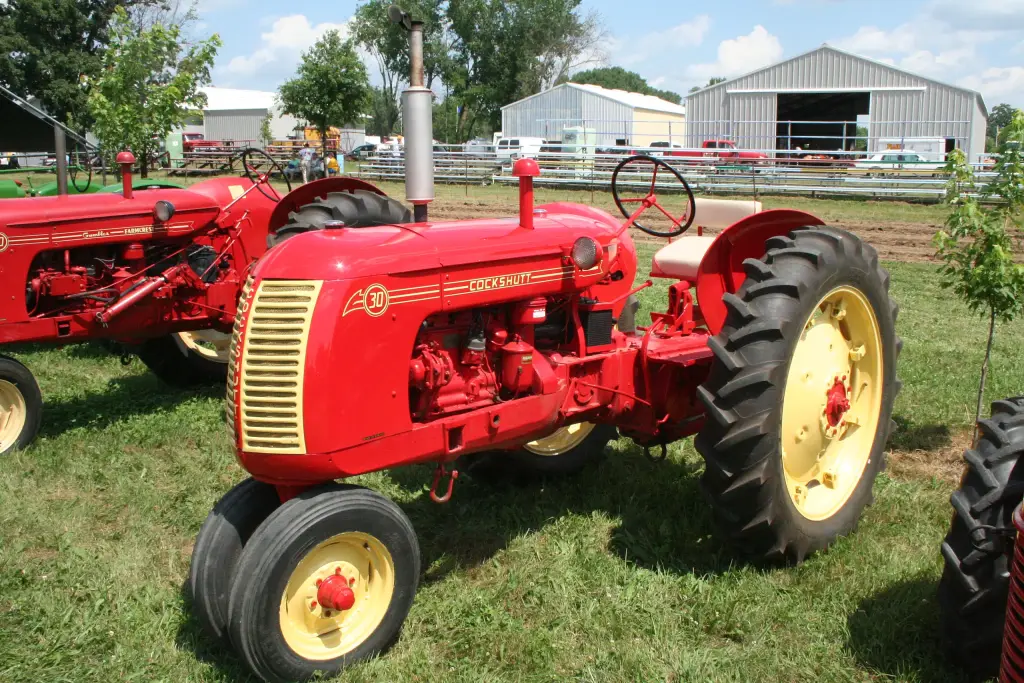
The Cockshutt 30 was the result and the first Canadian-produced tractor. The live power take-off was built into it, and the term “live” PTO itself was originated by Cockshutt engineers. The tractor was styled in a streamlined manner close to the early styled Oliver tractors by the Canadian architect Charles Brooks, and its engines, 153-cubic-inch (2,510 cc) four-cylinders, came from the American Buda Engine Company. Diesel and LP gas versions were offered in later years.
On the farm
The 30 reached the market in 1947, rated for two or three plows. Besides the optional live PTO it could drive belt-connected machinery. Buyers could have narrow double or single front wheels, a wide standard fixed front axle or an adjustable wide row-crop axle, the row-crop wheel spacing moving in 2-inch (5.1 cm) steps from 56 to 84 inches (140 to 210 cm).
Derivatives
In the United States the tractor was resold all-orange as the CO-OP E3 and, without significant changes to paint or styling, through the Gambles department store chain as the Gambles Farmcrest 30. Its competitors included the Farmall H, the Oliver 70, the John Deere Model A and the Minneapolis-Moline ZTU. 37,328 Cockshutt 30s and derivatives were built at Brantford from 1946 to 1957; the base price in 1955 was CA$2,022, and a fully optioned 30 could cost more than CA$3,000.
Design and features
- First Canadian tractor: the first production tractor manufactured in Canada.
- Live PTO: full power to the implement whether the tractor moved or stood still.
- Buda engines: a 153-cubic-inch four-cylinder, later with diesel and LP gas options.
- Many axle choices: row-crop, standard and adjustable wide front ends.
- Brooks styling: the rounded body that set the look of the Brantford range.
Cockshutt 30 versions
- Cockshutt 30 (1946–1957): the standard row-crop tractor.
- Diesel and LP gas: alternative fuels added in later years.
- CO-OP E3: American equivalent, painted all-orange.
- Gambles Farmcrest 30: sold through the Gambles stores, Cockshutt colours and styling.
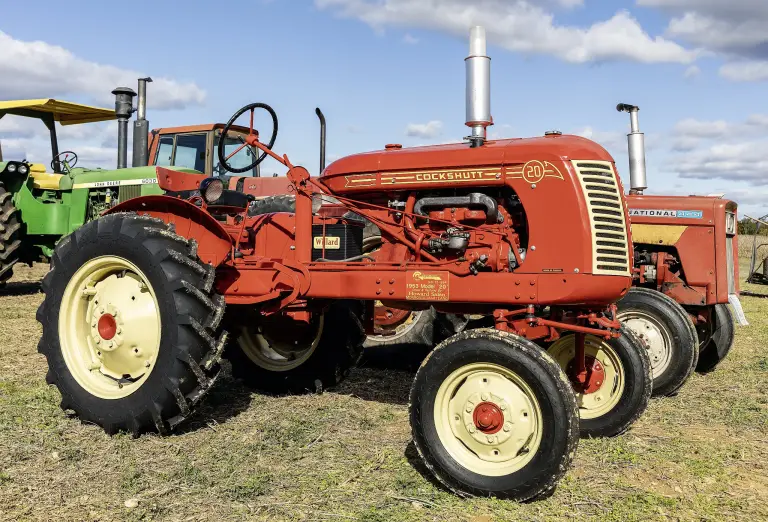
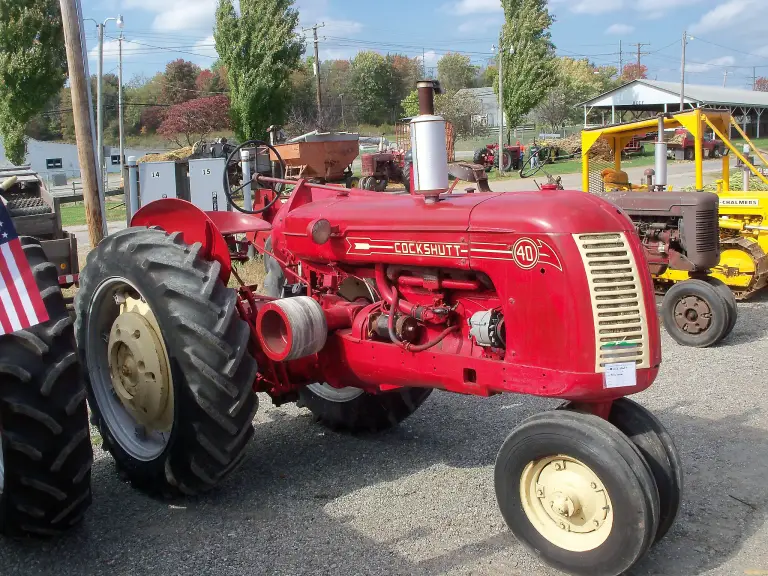
The 30 was the middle of the early range, between the small Cockshutt 20 and the six-cylinder Cockshutt 40; more of the Canadian range is in the Cockshutt collection.
Sources
- Cockshutt 30, English Wikipedia: history, live PTO, engines, prices, derivatives