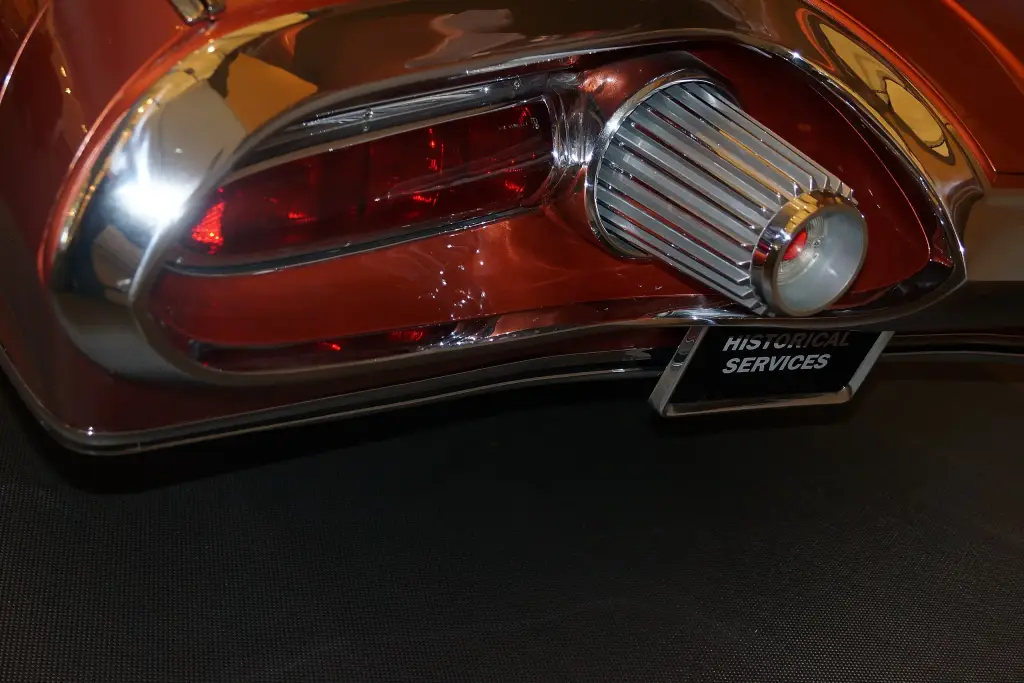
The Chrysler Turbine Car was an experimental two-door hardtop coupé built in 1963 and 1964 with a gas turbine instead of a piston engine. Carrozzeria Ghia built the bodies in Italy and Chrysler finished the cars in Detroit: fifty-five were made, and after a public user programme of more than a million miles, all but nine were destroyed.
Chrysler Turbine Car at a glance
| Built | 1963–1964 |
|---|---|
| Total | five prototypes and fifty production cars |
| Body | two-door hardtop coupé by Carrozzeria Ghia |
| Styling | Elwood Engel and Chrysler studios |
| Engine | Chrysler A-831 turbine |
| Fuel | could run on many fuels |
| Transmission | TorqueFlite |
| Colour | “turbine bronze”, roughly root beer |
| User programme | October 1963 to January 1966 |
| Drivers | 203 in 133 cities |
| Distance | over one million miles |
| Survivors | nine, two kept by Chrysler |
History of the Chrysler Turbine Car
From aircraft to cars
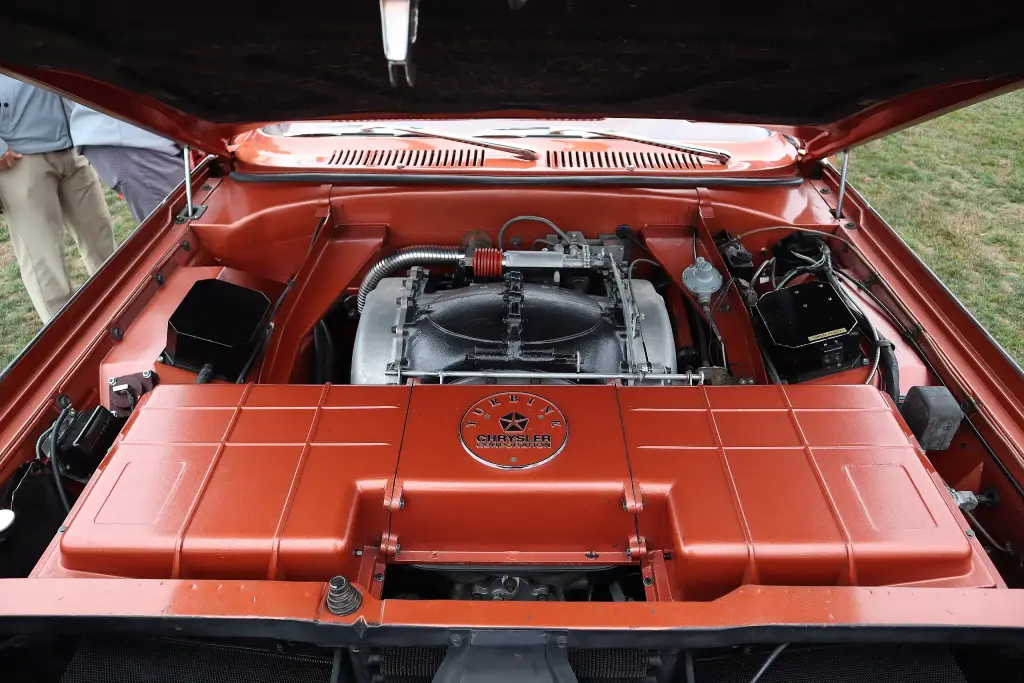
Chrysler began research into turbine engines for aviation in the late 1930s under executive engineer George Huebner, and after the Second World War he and a small team including Bud Mann and Sam B. Williams began exploring turbines for cars. The appeal was simple: turbine engines have fewer moving parts than piston engines and can run on a variety of fuels. By the mid-1950s, according to the historian Charles K. Hyde, Chrysler led the way in gas turbine research, though General Motors and Rover also built turbine cars after the war. After improving the design, notably with a regenerator to solve heat exchange, the team mated a turbine to an otherwise standard 1954 Plymouth Belvedere and claimed the engine had 20 per cent fewer parts and weighed 200 lb less than a comparable piston unit; the car was shown to more than 500 reporters at the Chelsea Proving Grounds on 16 June 1954.
Proving it on the road
A 1956 Plymouth followed, and Huebner drove it 3,020 miles from New York to Los Angeles in four days, shadowed by a 14-person convoy but needing only two minor non-engine repairs. The success doubled the programme’s size and moved it to a larger Detroit facility. A second-generation engine in a 1959 Plymouth averaged 19.4 mpg from Detroit to Woodbridge, New Jersey, against 13 mpg for the first-generation unit on the 1956 trip. In 1961 Chrysler named Lynn Townsend president and unveiled the third-generation CR2A, the first Chrysler turbine to be officially named and the first designed with costs and production methods in mind; Huebner said it would act as its own torque converter, produce 140 hp and cut the acceleration lag from nine seconds to 1.5. Third-generation turbines went into a 2.5-ton 1960 Dodge truck and the Turboflite concept, and refined CR2A units in a 1962 Dodge Dart and Plymouth Fury covered New York to Los Angeles and Los Angeles to San Francisco. By February 1962 Chrysler had taken its turbine fleet to 90 cities in North America, Europe and Mexico, giving rides to almost 14,000 people.
The Turbine Car and its public
The Turbine Car itself was styled by Elwood Engel and Chrysler studios, with bodywork by Ghia and final assembly in Detroit, and came in a signature metallic “turbine bronze” roughly the colour of root beer, with power brakes, power steering and a TorqueFlite transmission. Its A-831 engines could run on many fuels, needed less maintenance and lasted longer than piston engines, but cost much more to build. From October 1963 to January 1966 Chrysler ran a user programme with 203 drivers in 133 cities who covered more than a million miles. It exposed the problems — a complicated starting procedure, unimpressive acceleration, poor fuel economy and noise — and the advantages of durability, smoothness and low maintenance. Chrysler then reclaimed the cars and destroyed all but nine: two kept by the company, six in American museums and one in Jay Leno’s collection. The turbine programme ended in 1979, mainly because the engines could not meet emissions rules, used too much fuel and because of a condition attached to a government loan.
Design and features
- Turbine power: the A-831 engine with far fewer moving parts than a piston engine.
- Multi-fuel ability: the turbine could run on a wide range of fuels.
- Ghia bodywork: Italian-built panels on a car styled by Elwood Engel.
- Public trial: 203 ordinary drivers covered more than a million miles in the cars.
- Rarity: of 55 built, only nine survive.
Chrysler Turbine Car versions
- Prototypes (1963): five cars preceding the production run.
- Production cars (1964): fifty cars for the public user programme, all in turbine bronze.
The Turbine Car came from the same engineering culture as the Airflow and sat alongside the Imperial in Chrysler’s experiments with new technology. More cars are in the Chrysler collection.
Video: 1963 Chrysler Turbine: Ultimate Edition
Video by Jay Leno’s Garage on YouTube.
Sources
- Chrysler Turbine Car, English Wikipedia: programme history, engineering, user programme
- Chrysler Turbine Car, Wikimedia Commons: photographs