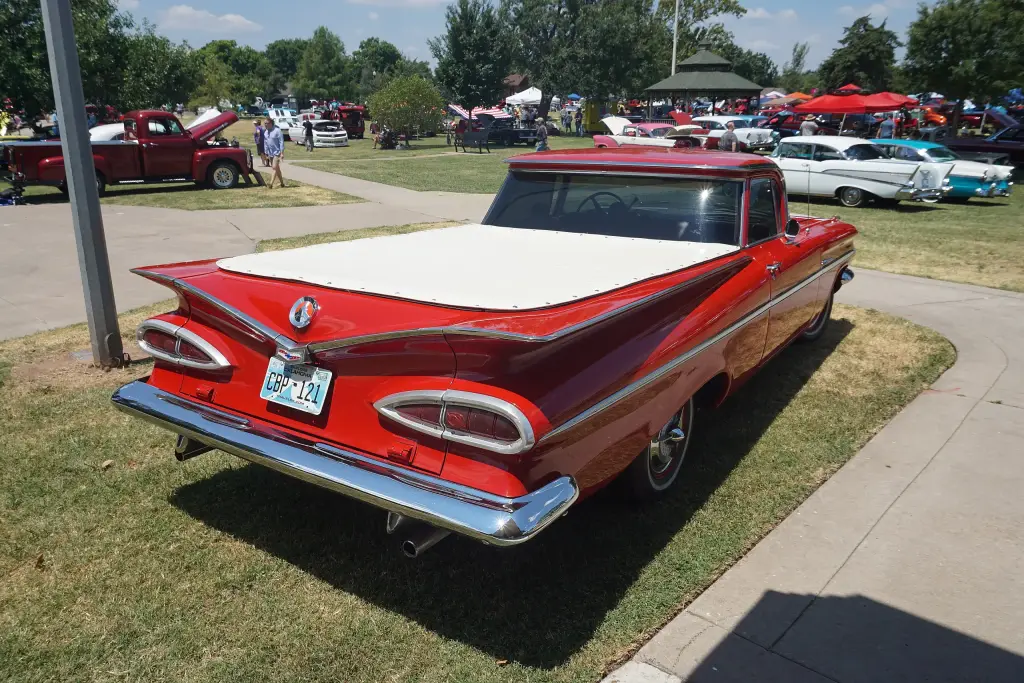
The Chevrolet El Camino is a coupé utility vehicle that Chevrolet produced in 1959 and 1960, and from 1964 to 1987. Unlike a standard pickup truck it was adapted from the standard two-door Chevrolet station wagon platform, with the cab and cargo bed built into the body.
Chevrolet El Camino at a glance
| Produced | 1959 and 1960; 1964 to 1987 |
|---|---|
| Platforms | 1959–1960 full-size Biscayne B-body; 1964–1977 Chevelle; 1978–1987 GM G-body |
| Built, 1959 | 22,246 |
| Built, 1960 | 14,163, after which it was dropped for a time |
| Rival | Ford Ranchero, introduced in 1957 |
| 1959 payload | 650 to 1,150 lb (290 to 520 kg) |
| 1959 box capacity | almost 33 cubic feet (0.93 m³) |
| Badge-engineered sister | GMC Sprint from 1971, renamed Caballero in 1978 |
| 1968 Super Sport | SS-396 with a 325 or 350 bhp Turbo-Jet 396; a 375 bhp L78 was also offered |
This page is based on English Wikipedia only (a trusted source), so the facts were not cross-checked against a second source.
History of the Chevrolet El Camino
Ford Australia produced the first coupé utility in 1934, after a farmer’s wife wrote asking for “a vehicle to go to church in on a Sunday and which can carry our pigs to market on Mondays”; the designer Lew Bandt developed it. Holden produced a Chevrolet coupé utility in 1935, and Studebaker built the Coupé Express from 1937 to 1939. The body style did not reappear on the American market until Ford launched the Ranchero in 1957, and Chevrolet responded with the El Camino for 1959.
1959–1960
The first El Camino was based on the new Brookwood two-door station wagon, itself based on the redesigned full-size Chevrolet of 1959. It was highly stylised and initially sold 50% more briskly than the more conservative Ranchero, some 22,000 to 14,000. It could be had with any full-size Chevrolet drivetrain, including a 283 Turbo-Fire V8, 348 Turbo-Thrust V8s with up to 335 bhp, and fuel-injected 283s of 250 or 290 bhp. Hot Rod tested a 315 bhp triple-carburettor 348 with a four-speed and clocked about seven seconds to 60 mph. A total of 22,246 were made for 1959. In 1960 orders fell by a third to 14,163, while Ford sold 21,027 Rancheros, now based on the compact Falcon, and Chevrolet dropped the model.
The Chevelle years
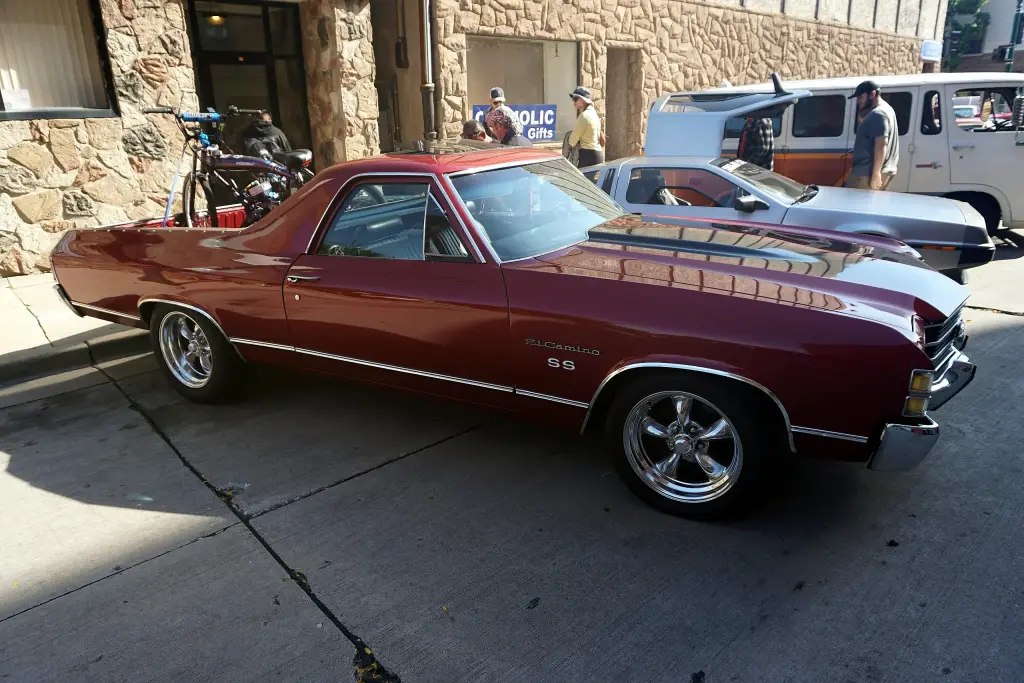
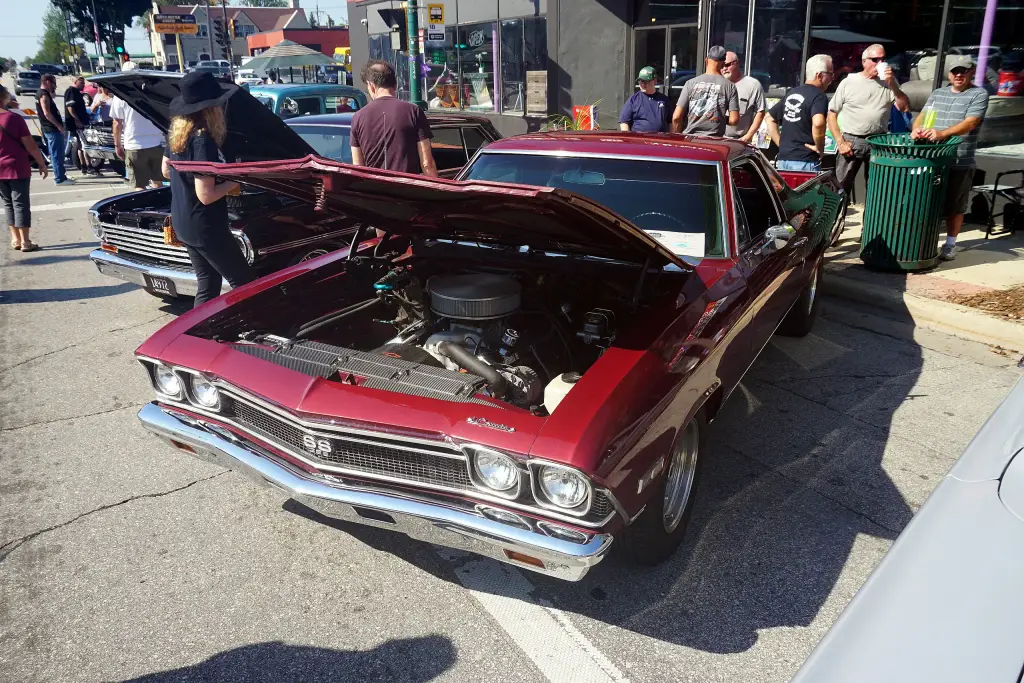
Production resumed for 1964 on the Chevelle platform. There was no factory El Camino Super Sport until 1968, though many owners have cloned 1967 SS 396s using Chevelle badges. In 1968 Chevrolet introduced a longer El Camino on the Chevelle’s 116-inch wheelbase, with Malibu trim, and a new Super Sport SS396 with a 325 or 350 bhp Turbo-Jet 396; the 375 bhp L78 with solid lifters and an 800 cfm Holley returned to the options list. A 350 V8 was used for the first time in 1969.
The El Camino was redesigned for 1973 and was the largest generation, with front disc brakes standard. The base engine was a 307 V8 of 115 hp; options ran up to a 454 with 245 hp. The El Camino Classic was added in 1974. GMC’s badge-engineered version, the Sprint, appeared in 1971 and was renamed Caballero in 1978. The final generation, from 1978 to 1987, used the G-body platform.
Design and features
- Body: a station-wagon platform with the cab and bed in one body, unlike a normal pickup.
- Engines: from small-block V8s to the SS 396, with big-block options in the 1970s.
- Sister model: the GMC Sprint and Caballero.
Chevrolet El Camino versions
- 1959–1960: the full-size first generation.
- 1964–1967: the Chevelle-based second generation.
- 1968–1972: the longer car with the SS396 version.
- 1973–1977: the largest El Camino, with the Classic trim.
- 1978–1987: the G-body final generation.
More Chevrolets are in our Chevrolet collection, including the Chevrolet Corvette and the Chevrolet Corvair.
Sources
- Chevrolet El Camino, English Wikipedia: background, generations, engines and production figures