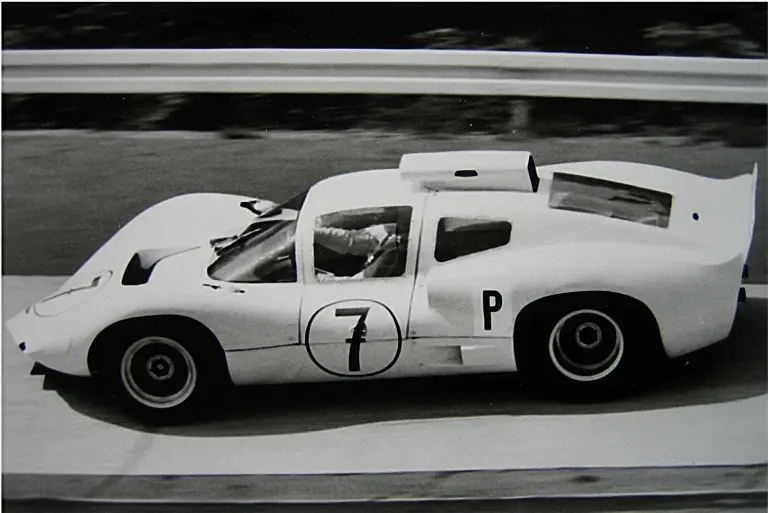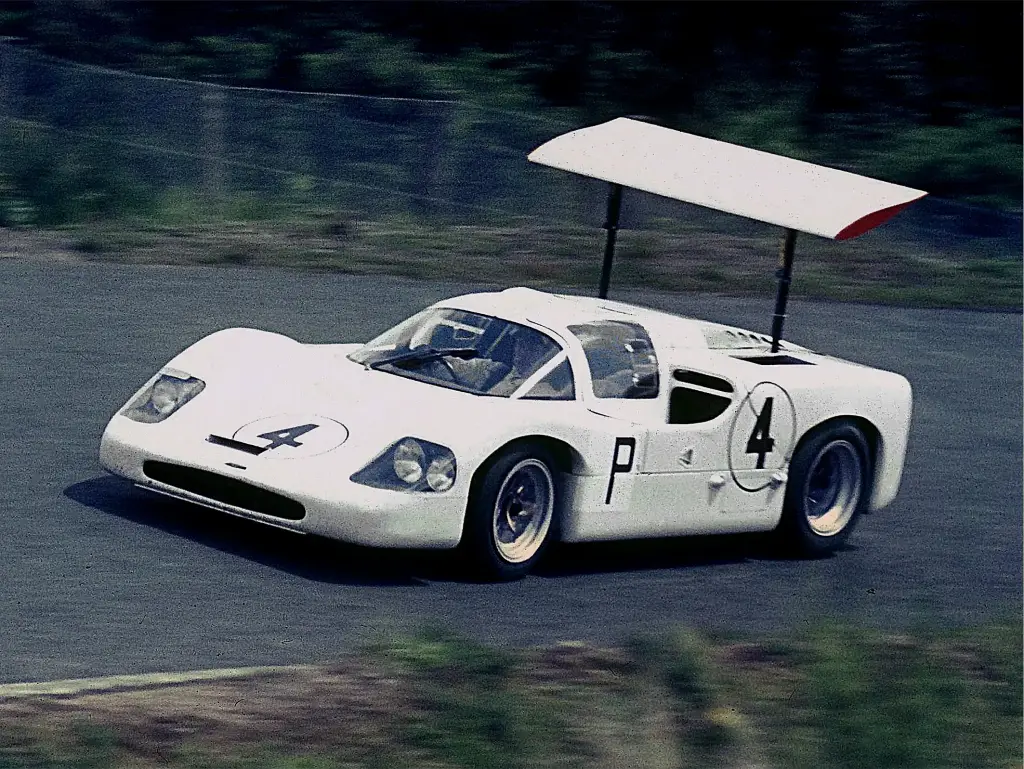
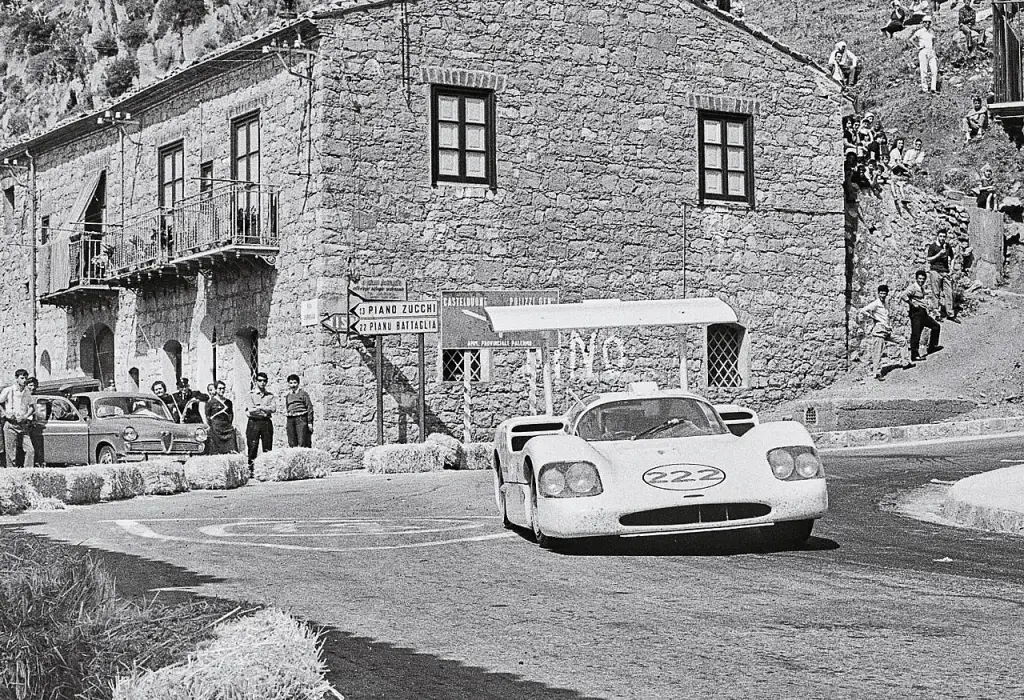
The Chaparral 2F is a Group 6 prototype designed by Jim Hall and Hap Sharp and built by their company Chaparral Cars. It competed in the 1967 World Sportscar Championship, and its best result was first place at the BOAC 500, driven by Phil Hill and Mike Spence.
Chaparral 2F at a glance
| Designers | Jim Hall and Hap Sharp |
|---|---|
| Builder | Chaparral Cars |
| Class | Group 6 prototype |
| Season | 1967 World Sportscar Championship |
| Best result | 1st, BOAC 500 |
| Drivers | Phil Hill and Mike Spence |
| Engine | Chevrolet “Porcupine” 427 big-block V8, aluminium block |
| Power | 526 hp (392 kW; 533 PS) at 6,000 rpm |
| Carburettors | Weber 58IDM |
| Transmission | Chevrolet three-speed automatic transaxle |
| Chassis | fiberglass semi-monocoque |
| Aerodynamics | high rear wing on the suspension uprights, Venturi-like nose, side-mounted radiators |
| Built from | the third original Chaparral 2 chassis |
Based on one source: the English Wikipedia article on the Chaparral 2F.
History of the Chaparral 2F
Hall’s aerodynamic programme
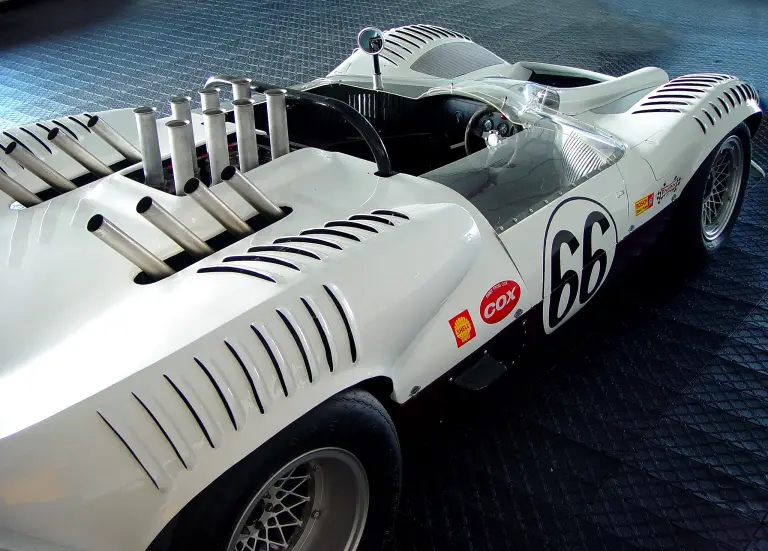
Aerodynamics were barely understood in 1960s racing. Jim Hall, a mechanical engineering graduate of the California Institute of Technology, saw that an aircraft wing turned upside down could press a car onto the road instead of lifting it. He worked this out in the winter of 1963, when the front of his first Chaparral 2 was lifting at speed: changes to the bodywork that produced downforce cut lap times sharply. The private track next to his workshop let him develop the idea faster than other teams could. In 1965 a small adjustable rear wickerbill went onto the 2C, worked by a third pedal in the cockpit, making it the first racing car with active aerodynamics; on the 2E of 1966 the wing moved to struts high above the rear of the chassis.
From 2D to 2F
With the 2E winning in Can-Am, Hall put the wing onto the closed endurance car. The third original Chaparral 2 chassis was converted into a single 2F, and another 2D was rebuilt as a 2F during the 1967 season. The new car did not carry over the 2E’s aluminium tube frame: Hall and Sharp kept the fiberglass semi-monocoque and the Venturi-like nose with side-mounted radiators, which freed the nose to act as a miniature Venturi tunnel and gave the car balance between front and rear downforce.
The Chevrolet connection
General Motors never ran a factory Chaparral programme, but its engineers supplied parts and used Hall’s track for testing. Among those parts was the transmission of the 2F, a Chevrolet three-speed automatic transaxle that replaced the Cooper and Colotti manual gearboxes used before. The engine was Chevrolet’s aluminium-block “Porcupine” 427 big-block V8, fitted with Weber 58IDM carburettors and tuned to 526 hp at 6,000 rpm, far beyond the output of the production 427. The rear wing struts were attached to the suspension uprights so that downforce acted directly on the tires and shifted the weight bias rearwards. The 2F, like the 2E, helped set the direction of Formula One design at the end of the 1960s, when Colin Chapman and others adopted wings of their own.
Design and features
- High rear wing: mounted on the suspension uprights so that its downforce loaded the tires directly.
- Big-block power: a 427 Chevrolet V8 of 526 hp, well above production tune.
- Venturi nose and side radiators: an early use of ground effect, with the radiators moved out of the nose.
- Automatic transaxle: a Chevrolet three-speed unit instead of the earlier manual gearboxes.
- Influence: a pointer to the winged Formula One cars that followed.
Chaparral 2F versions
- 2F (1967): the works car built from the third Chaparral 2 chassis.
- Converted 2D: a second 2F made from a 2D during the 1967 season.
- Related 2E: the Can-Am sibling that first carried the high wing.
- Related 2C: the earlier car with the driver-adjustable rear wickerbill.
The closed car the 2F grew out of is the Chaparral 2D, and the first of the line is the Chaparral 2A. The story of the company is in the Chaparral Cars article, and more cars are in the Chaparral collection.
Video: Jim Hall Chaparral 2F
Video by Paul Zimmermann on YouTube.
Sources
- Chaparral 2F, English Wikipedia: design, 1967 season, engine and chassis details, aerodynamic background