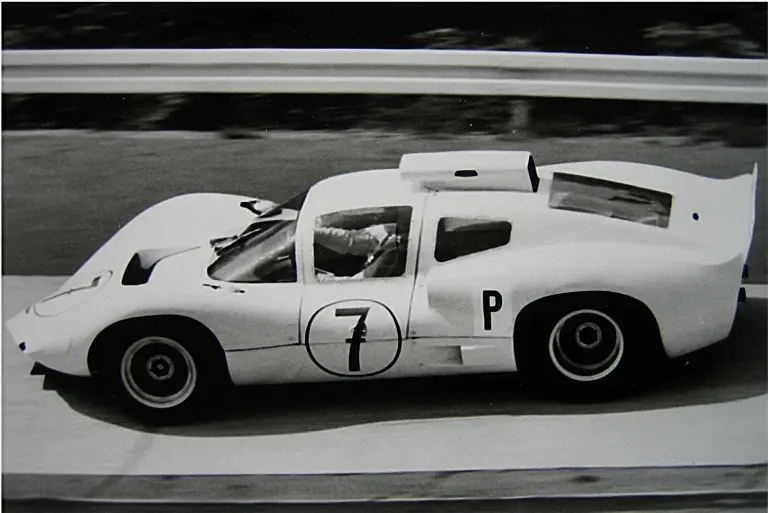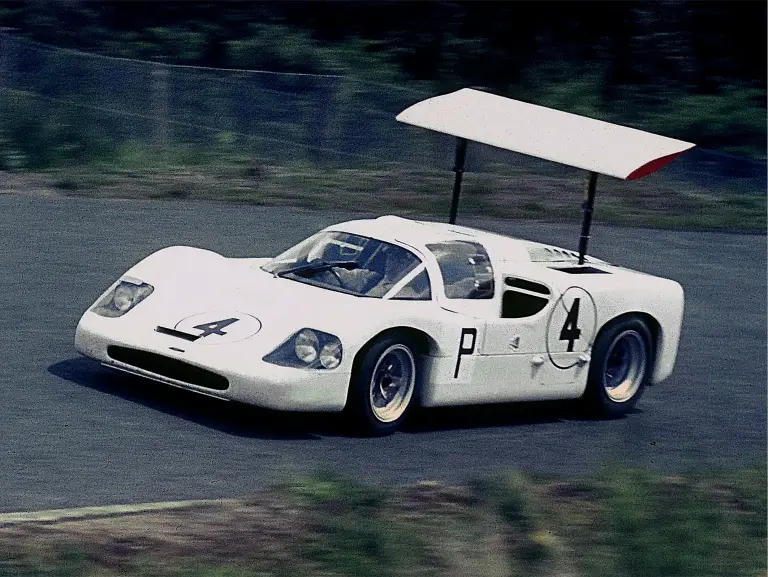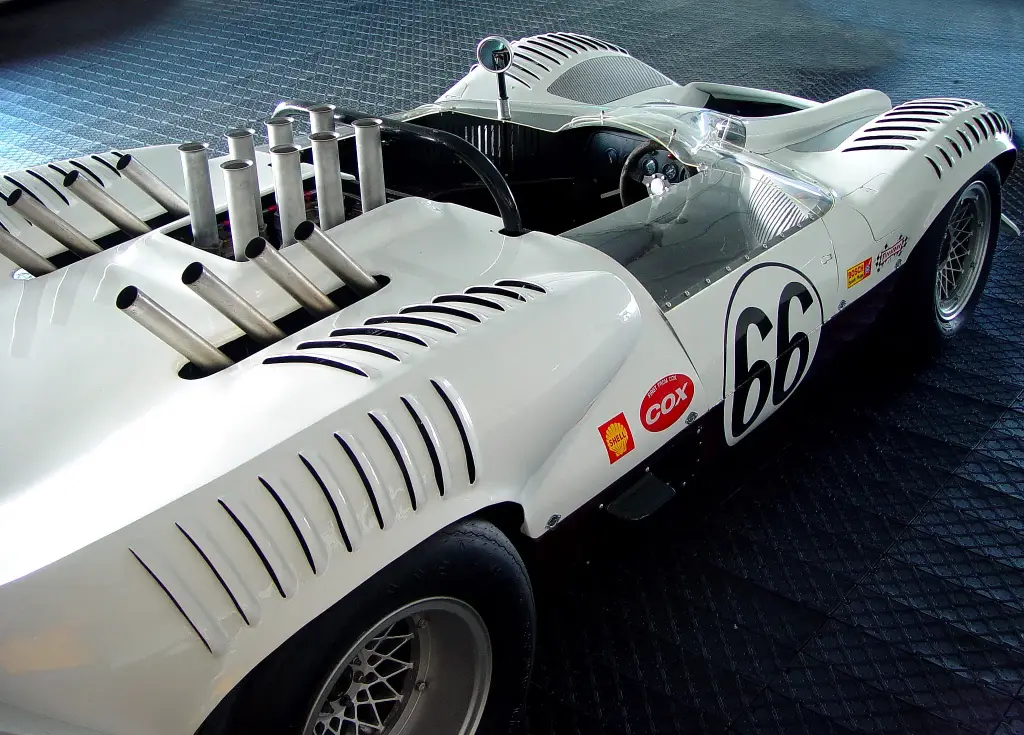
The Chaparral 2A was a sports prototype race car designed and developed by Jim Hall and Hap Sharp and built by their company Chaparral. It competed in the World Sportscar Championship between 1963 and 1965, and its best result was a win at the 1965 12 Hours of Sebring.
Chaparral 2A at a glance
| Builders | Jim Hall and Hap Sharp, Chaparral Cars |
|---|---|
| Class | sports prototype |
| Raced | 1963–1965 |
| Championship | World Sportscar Championship |
| Best result | 1st, 1965 12 Hours of Sebring |
| Other win | 1965 Double 500 km, Bridgehampton |
| Body and chassis | fiberglass |
| Rear bodywork | concave tail in the manner of Wunibald Kamm |
| Aerodynamics | early add-on devices to cure a light front end at speed |
| Automatic transmission | developed with help from General Motors |
| Family | first of the Chaparral 2 series |
The English Wikipedia article on the 2A is short, so the background on its bodywork and development comes from the English Wikipedia article on Chaparral Cars.
History of the Chaparral 2A
A car built around experiments
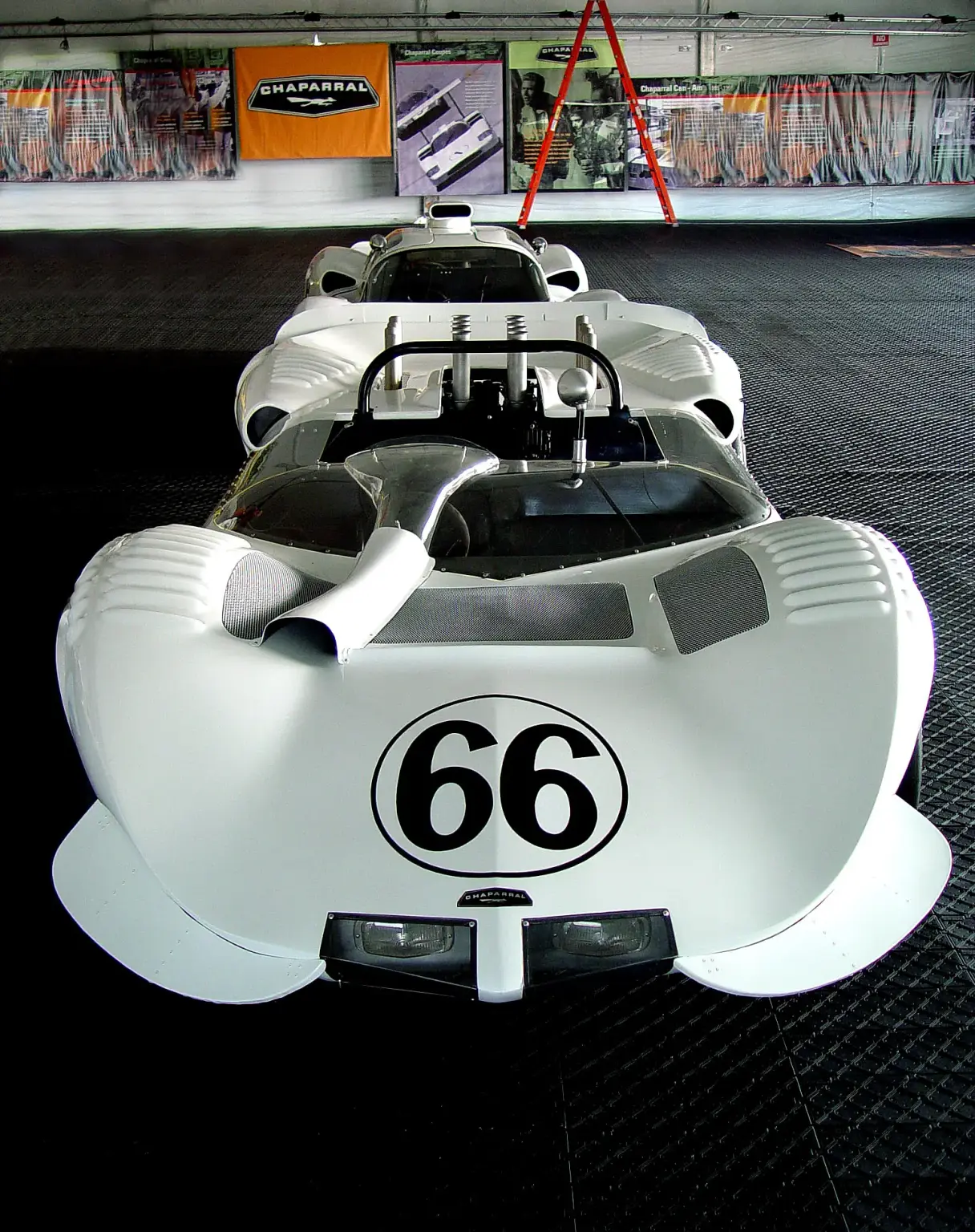
The 2A is the Chaparral 2 as it was originally raced, and it is very difficult to separate its versions, because new ideas were tested on the car continually. As first built it had a conventional sharp-edged nose to cut through the air and a concave tail that recalled the theories of Wunibald Kamm. Aerodynamic appendages began to appear almost immediately, not as a fashion but to cure a problem: at speed the front end went light, which hurt steering accuracy and the driver’s confidence.
Wins in the wet and on the shore
The car was first raced in late 1963 and grew into one of the most competitive sports cars of its time. In 1965 it won the 12 Hours of Sebring in pouring rain on one of the roughest tracks in North America, and it took another first place at the Double 500 km at Bridgehampton. In the middle of the decade the 2 series became a regular winner in the Can-Am championship as well.
The 2A in the 2 series
The 2A was the beginning of a line that changed shape as it went: the cars that most people call the 2B were raced through the end of 1965, and the 2C that followed was a smaller car on a Chevrolet-designed aluminium chassis. The fiberglass body of the first cars was an unusual choice for a racing chassis, and the close resemblance between the early Chaparrals and the Chevrolet Corvette GS-II research model has long been read as evidence of how much engineering help Hall and Sharp received from General Motors.
Design and features
- Fiberglass construction: the Chaparral 2 used fiberglass for its body and chassis at a time when aluminium was the norm.
- Kamm tail: a concave rear end copied from the aerodynamic theories of Wunibald Kamm.
- Quick development: wings and spoilers were tried on the 2A almost from its first races to settle a nervous front end.
- Endurance pace: a win at Sebring in the rain showed the car was quick over twelve hours, not only in short races.
Chaparral 2A versions
- 2A (1963): the original sharp-nosed car with the Kamm tail.
- 2A with aero aids: the same car with the first add-on devices for front-end stability.
- 2B (to 1965): the much-modified later shape of the same line, raced to the end of 1965.
- 2C: the smaller aluminium-chassis car that followed, with the first in-car adjustable rear wing.
The closed-roof member of the same family was the Chaparral 2D, and the winged endurance car that came after it was the Chaparral 2F. The story of the company is in the Chaparral Cars article, and more cars are in the Chaparral collection.
Video: Very Loud Chaparral 2 Replica on track
Video by BenGVideos on YouTube.
Sources
- Chaparral 2A, English Wikipedia: design, racing career, wins
- Chaparral Cars, English Wikipedia: 2-series background, bodywork, aerodynamics