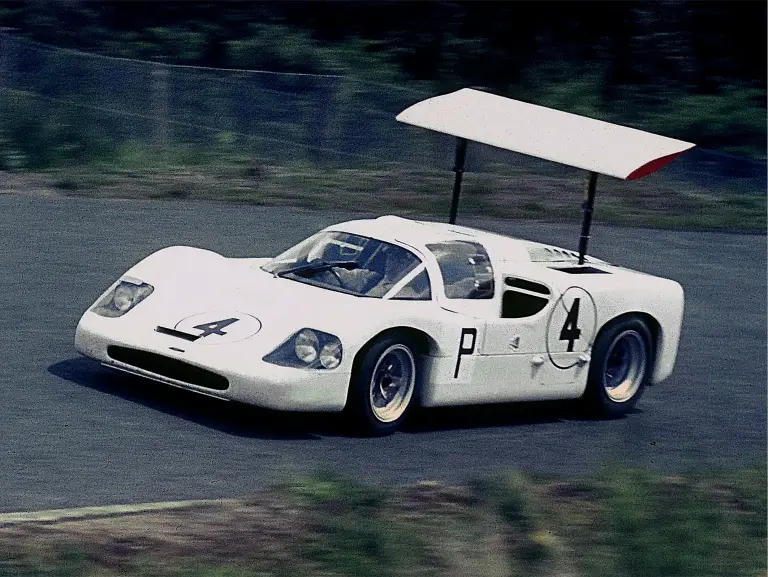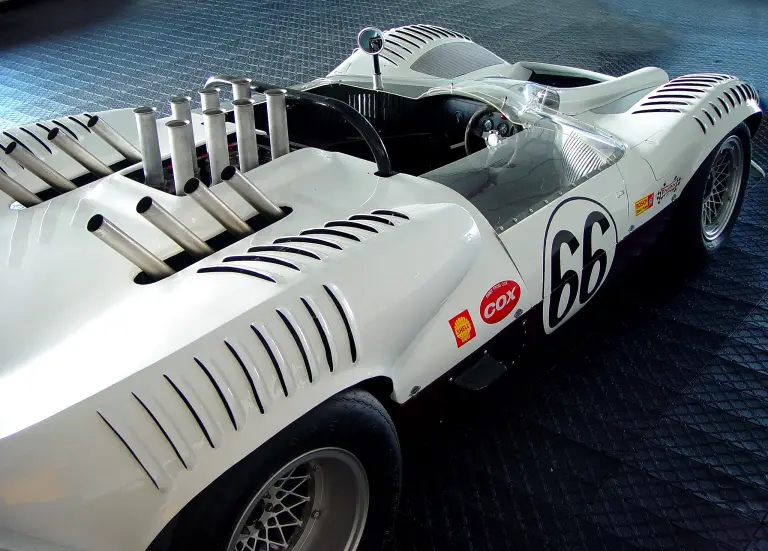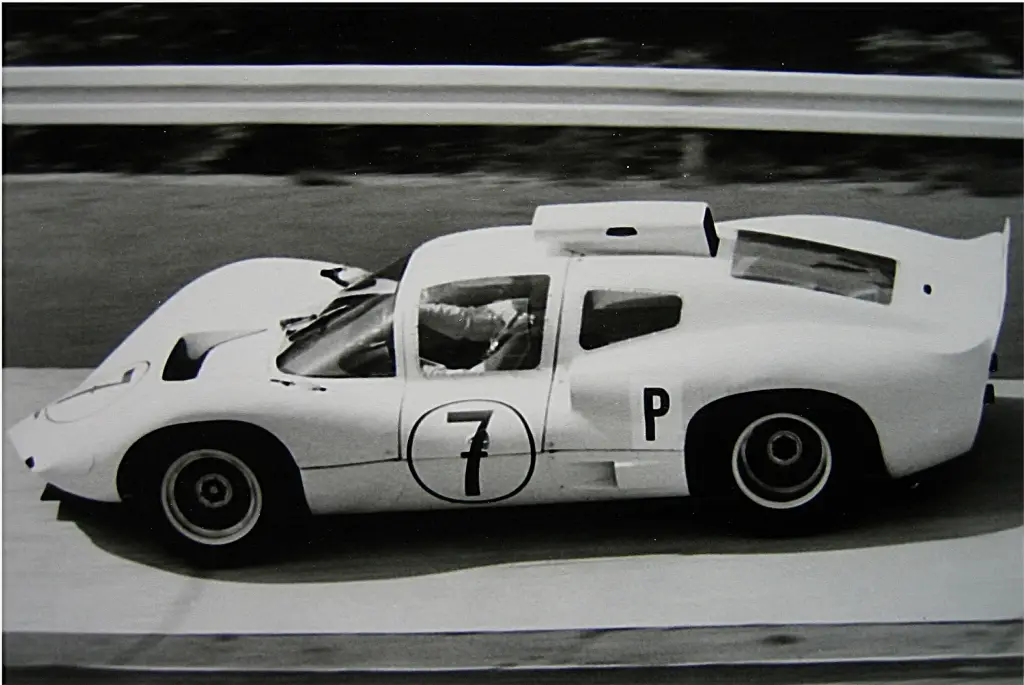
The Chaparral 2D was a Group 6 sports prototype designed and developed by Jim Hall and Hap Sharp and built by Chaparral. It campaigned in the FIA World Sportscar Championship in 1966 and 1967, and famously won the 1966 1000 km Nürburgring with Jo Bonnier and Phil Hill.
Chaparral 2D at a glance
| Builders | Jim Hall and Hap Sharp, Chaparral Cars |
|---|---|
| Class | Group 6 sports prototype |
| Raced | 1966–1967 |
| Championship | FIA World Sportscar Championship |
| Best result | 1st, 1966 1000 km Nürburgring |
| Drivers at the Nürburgring | Jo Bonnier and Phil Hill |
| Engine | 327 cu in (5.36 L) aluminium-alloy Chevrolet V8 |
| Power | 420 hp (310 kW; 430 PS) |
| Weight | 924 kg (2,037 lb) |
| Body | closed cockpit, first of the 2 series |
| Le Mans 1966 | withdrawn after 111 laps |
| Successor | Chaparral 2F |
The English Wikipedia article on the 2D is short; details of the engine, the weight and the later conversion to the 2F come from the English Wikipedia article on Chaparral Cars.
History of the Chaparral 2D
Why a closed car
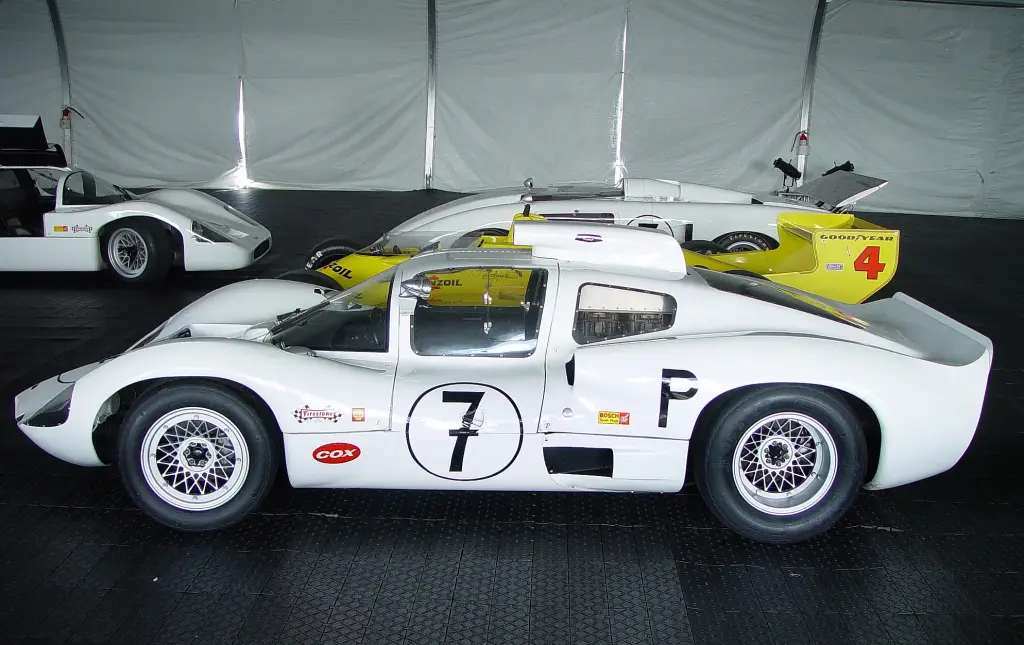
Until 1965 the Chaparral 2 had been an open sports car. Endurance races, though, lasted for six, twelve or twenty-four hours, and a roof changed both the aerodynamics and the comfort of the drivers. The 2D was the first closed-cockpit variant of the 2-series, designed for endurance racing in 1966. Its shape came out of the same workshop that was already experimenting with wings and ground effects, and it kept the compact Chevrolet V8 of the open cars, an aluminium 327-cubic-inch unit of 420 hp that pushed only 924 kg of car.
The Nürburgring, 1966
The 2D was often troubled by mechanical problems, and its single win came at the 1000 km Nürburgring in 1966, with Jo Bonnier and Phil Hill sharing the car. At Le Mans the same year it competed but withdrew after 111 laps. The result at the Nürburgring remained the high point of the model, and it is the race for which the car is remembered.
Into the 2F
The 2D did not end its life as a coupe. The third original Chaparral 2 chassis was converted into a single 2F, and a 2D was converted into a 2F later in the 1967 World Sportscar Championship season. That car carried the ideas of the programme further: the rear wing of the 2E, moved onto a closed body, and the side-mounted radiators and Venturi-like nose that Hall had developed on the Can-Am cars.
Design and features
- Closed cockpit: the first roofed Chaparral, made for long-distance races rather than sprints.
- Light and powerful: 420 hp in a car of only 924 kg.
- Chevrolet V8: an aluminium-alloy 327 cu in engine of the kind General Motors supplied to the team.
- Nürburgring winner: the 1966 1000 km race, shared by Bonnier and Hill.
Chaparral 2D versions
- 2D (1966): the original closed coupe with the 327 cu in engine.
- 2D at Le Mans: the 1966 entry that retired after 111 laps.
- 2D converted to 2F: a chassis rebuilt as a winged 2F during the 1967 season.
- 2F: the purpose-built successor with the large rear wing and the 427 V8.
The open car the 2D was derived from is the Chaparral 2A, and its winged successor is the Chaparral 2F. The history of the company is in the Chaparral Cars article, and more cars are in the Chaparral collection.
Video: Jim Hall and his famous #7 Chaparral 2D Race Car
Video by eryopsid on YouTube.
Sources
- Chaparral 2D, English Wikipedia: design, championship career, Nürburgring win
- Chaparral Cars, English Wikipedia: engine, weight, Le Mans, conversion to 2F