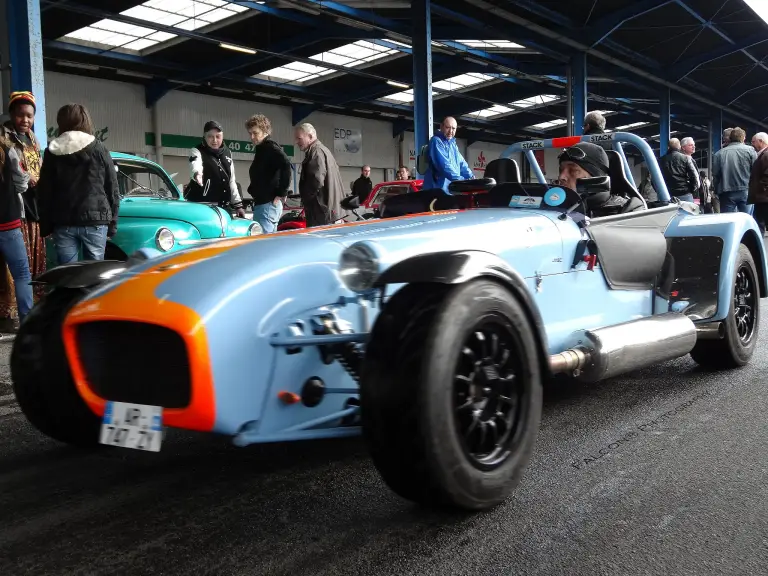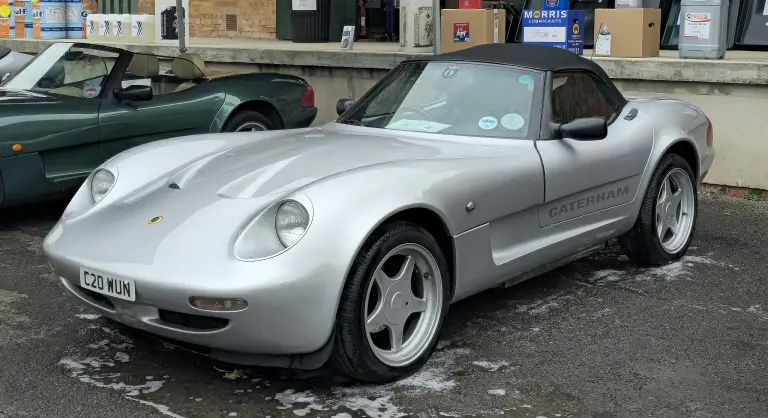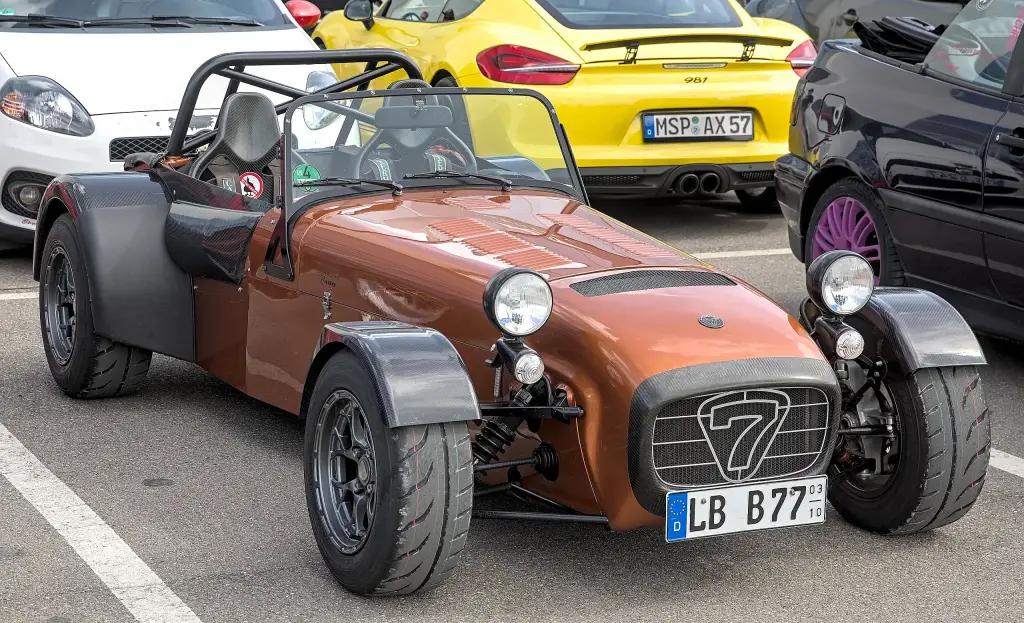
The Caterham Seven is a super-lightweight sports car built by Caterham Cars in the United Kingdom. It descends directly from the Lotus Seven, sold as a kit or factory-built car by Lotus from 1957 to 1972, and has stayed in production since Caterham bought the rights to the design.
Caterham Seven at a glance
| Based on | the Lotus Seven, sold from 1957 to 1972 |
|---|---|
| Rights bought | 1973, by Caterham Cars and Steel Brothers of New Zealand |
| Caterham’s own car | 1974, built from the Series 3 design |
| Chassis | steel space frame with stressed aluminium body panels |
| Rear axle | live axle until 2002, De Dion from the mid-1980s |
| SV chassis | 2000; 110 mm more cockpit width for 25 kg |
| Early engines | Lotus TwinCam, then Ford Crossflow |
| Cosworth BDR | from about 1983; 1600 cc with 140 bhp |
| 1700 BDR | from about 1986; 150 bhp |
| Top engine in 1990 | two-litre Vauxhall HPC, 165–175 bhp |
| CSR | October 2004, Cosworth Duratec with 200 or 260 bhp |
| Sold as | a kit or a factory-built car |
This article is based on one source, the English Wikipedia article on the Caterham 7.
History of the Caterham Seven
The Lotus Seven (1957)
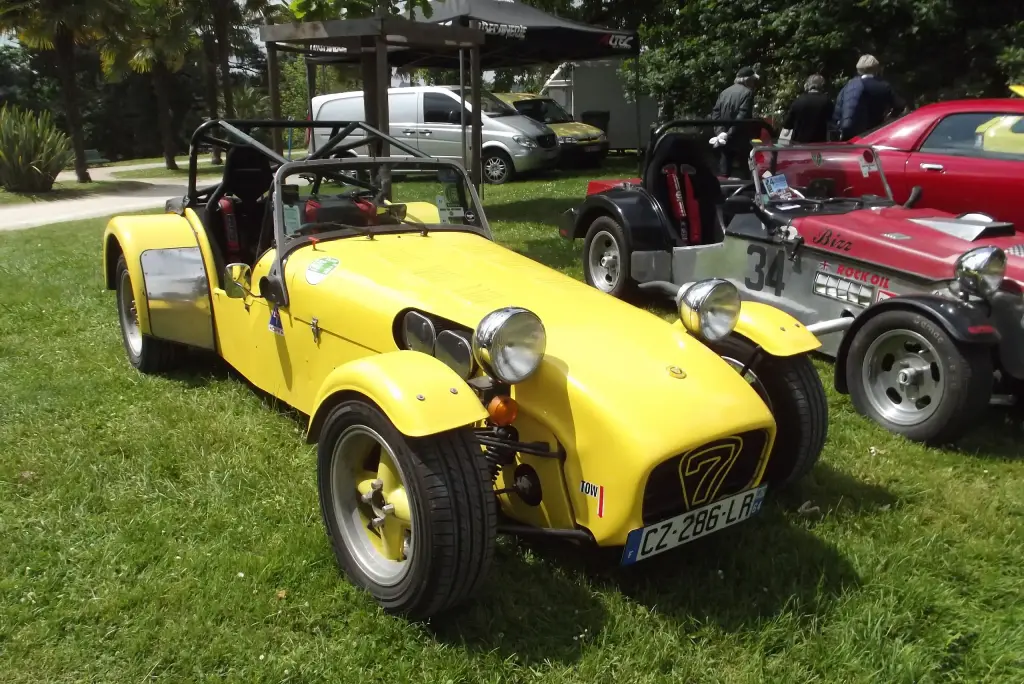
Colin Chapman had been a Royal Air Force pilot and studied structural engineering before founding Lotus Engineering Ltd. His design philosophy, “simplify, then add lightness”, produced the Lotus 7, which made its debut at the 1957 Earl’s Court Motor Show in London. It cost £1,036 including purchase tax, or £536 in kit form because no purchase tax was due on a kit, and it weighed 725 lb (329 kg). Fast and responsive, it was a car that performed well on the track and could still be driven legally on the road.
Caterham takes over (1973)
In 1973 Lotus decided to shed its kit-car image and concentrate on limited-series racing cars and up-market sports cars. As part of that plan it sold the rights to the Seven to its only remaining agents, Caterham Cars in England and Steel Brothers Limited in New Zealand. The car in production at the time was the Series 4, and when Caterham ran out of Lotus Series 4 kits in 1974 it introduced its own version of the Series 3 as the Caterham Seven. Today’s Roadsports and Superlights, in narrow-bodied chassis form, are the direct descendants of that car and therefore of the original Lotus 7.
The chassis
As on the Lotus Mark VI before it, the Seven uses an extremely light space-frame chassis with stressed aluminium body panels. The frame has been modified many times to strengthen it and to take different engines and suspensions, but the basic formula has stayed the same; the exception was the Series 4, which used steel for the cockpit and engine bay and glassfibre for the bodywork. Early cars had a live rear axle, first from various Fords and later from the Morris Ital. De Dion rear suspension arrived in the mid-1980s, and both layouts were offered until 2002, when the live axle was phased out, though it was later brought back for the 160/165, 170 and Super Seven 600 versions. Cars of the late 1990s and early 2000s, such as the Superlight, used adjustable double-wishbone front suspension with an anti-roll bar and a De Dion rear axle located by an A-frame and Watt’s linkage.
The SV chassis (2000)
The range was based exclusively on the Series 3 chassis until 2000, when Caterham released the SV, or Series V, chassis for buyers who could not fit comfortably in the Series 3 cockpit. The SV adds 110 mm (4.3 in) of width across the cockpit at a cost of 25 kg (55 lb). Both sizes were offered in the Superlight and the current 360, 420, 620 and Super Seven 2000, but only the S3 chassis is used for the 170 and Super Seven 600. The SV dimensions later became the basis of the CSR.
Engines
Early cars used the Lotus TwinCam, later manufactured by Vegantune, followed by Ford Crossflow engines. In 1977 Caterham took over the rights to build and develop the Twin Cam, had the big-valve version with twin Dell’Orto carburettors emissions tested, and had Vegantune build engines on reconditioned twin-cam heads for the Japanese market. Vegantune also developed the VTA, launched in 1983, which used Ford’s 1598 cc block with a new double-overhead-camshaft head and displaced 1.6 or 1.7 litres with 140 to 160 hp; about 40 were supplied, quality control was uneven, and Caterham switched to the Cosworth BDR or the single-cam 1700 Supersprint. The first BDR-engined Sevens appeared around 1983 with 140 bhp from 1600 cc, followed three years later by 1700 cc versions with 150 bhp. By 1990 the top engine was the two-litre Vauxhall HPC, as fitted to the Vauxhall Calibra, with 165 to 175 bhp.
Design and features
- Very low weight: a space frame and aluminium panels keep the Seven among the lightest sports cars on sale.
- Continuity: developed from the Series 3 Lotus Seven to the point that no part is the same as on the original.
- Two chassis sizes: the narrow S3 and, from 2000, the wider SV.
- Kit or complete: the car is still sold both as a kit and fully assembled.
Caterham Seven versions
- Seven (from 1974): Caterham’s own version of the Series 3 design.
- Superlight (late 1990s): adjustable double-wishbone front suspension and a De Dion rear axle.
- 160/165, 170 and Super Seven 600: S3 chassis with the live rear axle brought back.
- 360, 420, 620 and Super Seven 2000: offered on the S3 or the wider SV chassis.
- CSR (2004): a heavily redesigned Seven on SV-derived dimensions.
The Seven was joined in the 1990s by the more practical Caterham 21, and the range was later headed by the Seven CSR. More cars are in the Caterham collection.
Sources
- Caterham 7, English Wikipedia: history, chassis, engines, versions