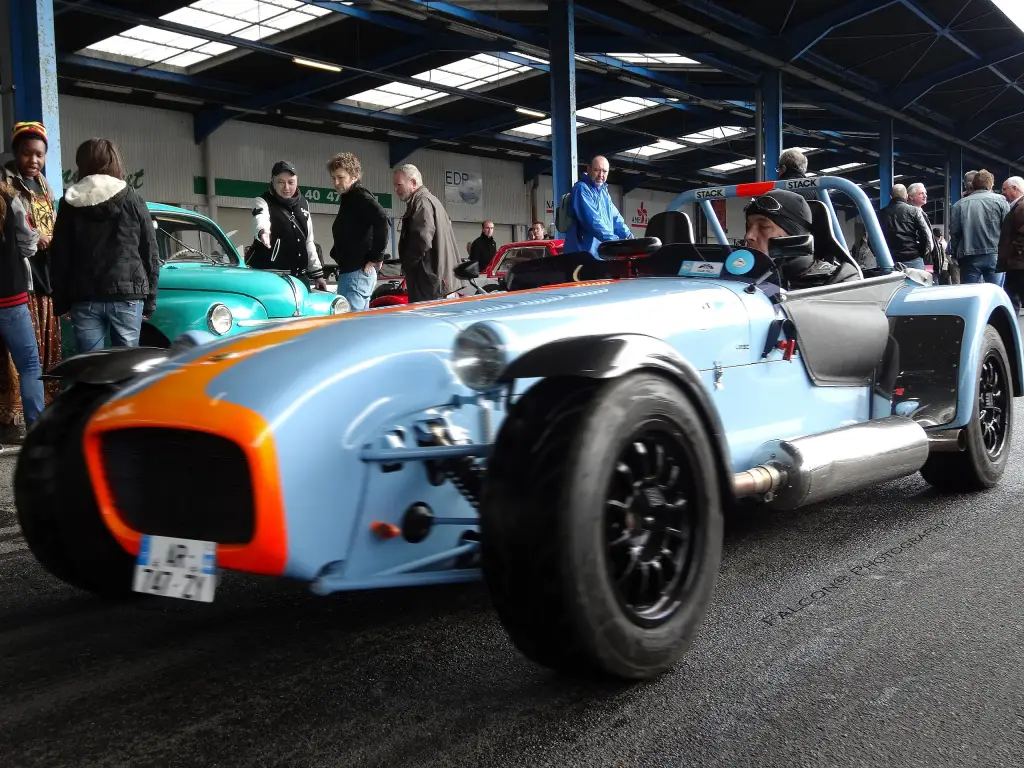
The Caterham Seven CSR is a sports car built by Caterham Cars in the United Kingdom. It is the most heavily modified Caterham, though it keeps the basic look of the Super Seven, and it comes with two versions of the same 2.3-litre Cosworth Duratec engine producing 200 or 260 bhp.
Caterham Seven CSR at a glance
| Introduced | October 2004 |
|---|---|
| Chassis basis | the wider SV dimensions, with extra tubular steel |
| Torsional stiffness | improved by 25% to 100% |
| Engines | 2.3-litre Cosworth Duratec, 200 or 260 bhp |
| 0–60 mph | 3.7 s with 200 bhp, 3.1 s with 260 bhp |
| Top speed | 155 mph with the 260 bhp engine |
| Weight | 575 kg |
| Power to weight | 410 bhp per ton in 260 bhp form |
| Cornering | 1.05 g on the skidpad |
| Braking | 70 mph to rest in 140 ft (43 m) |
| Aerodynamics | Cd 0.7, with 50 lb of lift at 100 mph |
| Suspension | redesigned front and rear, no De Dion axle |
The chassis work is described in the English Wikipedia article on the Caterham 7 CSR and in the Caterham 7 article.
History of the Caterham Seven CSR
A new chassis (2004)
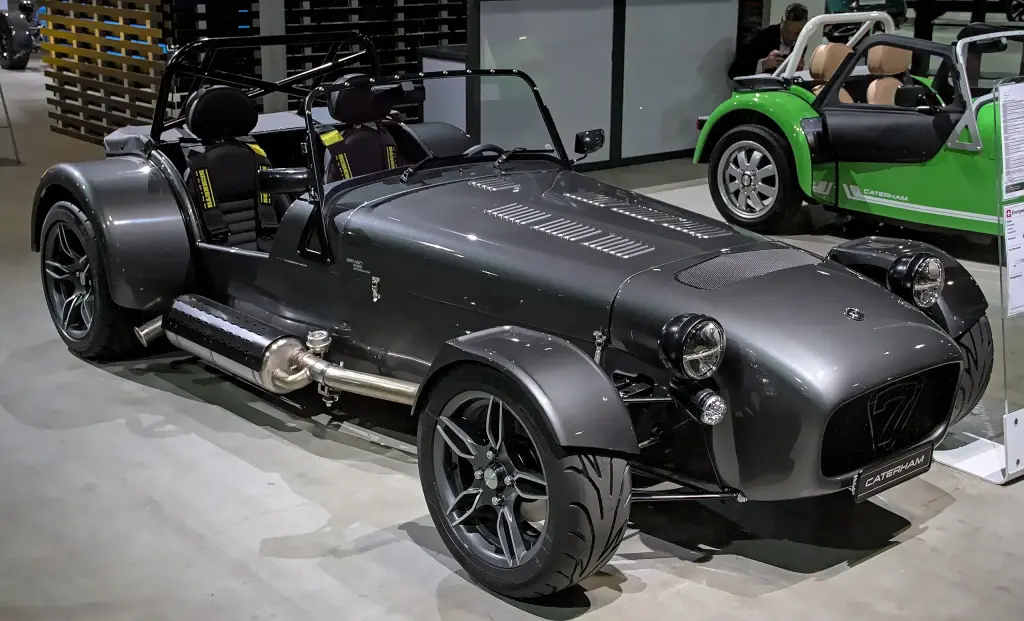
The CSR was released in October 2004 and is the most radical redesign of the car since the Seven was introduced, even though it keeps the main aesthetics of the Caterhams. Its basic dimensions came from the SV chassis, but the suspension was completely redesigned: the front suspension was brought inboard and uses pushrods, and the De Dion rear axle was replaced by a lighter, fully independent double-wishbone layout with new coil and damper units. Further chassis work lifted torsional stiffness by 25%. The overall strength of the frame was improved with new tubular steel, needed to support the heavy 2.3-litre Duratec engine; the weight grew, but the stiffness rose by somewhere between 25% and 100%. The CSR is also wider than earlier models, which helps handling.
The Cosworth engines
Both engines are based on the same Duratec block, though the modifications and output differ. The 260 bhp engine is heavily reworked by Cosworth: the cylinder head, block, crankshaft, connecting rods and pistons are upgraded, and a dry-sump system with an extra internal scavenge pump keeps the engine lubricated under hard cornering. Cosworth also gave the camshafts more radical timing, upgraded the exhaust, and replaced the inlet with a roller-barrel system that flows more air at full throttle than a butterfly inlet, with a custom chip to match. The 200 bhp engine uses the same block but is less heavily modified: it keeps the dry sump and the uprated cams and exhaust, has a larger but conventional inlet, and a milder chip upgrade.
On the road
At 575 kg (1,268 lb) the CSR is slightly heavier than other Caterhams but still follows Colin Chapman’s “add lightness” philosophy. On the skidpad its 1.05 g beats the 2007 Porsche 997 Turbo’s 0.94 g, the Ferrari F50’s 1.03 g and the Ferrari Enzo’s 1.01 g. From 70 mph it stops in 140 feet (43 m). The 260 bhp car has 410 bhp per ton; Car and Driver tested one to 60 mph in 3.6 seconds rather than the claimed 3.1, because a rev limiter set 300 rpm short of the redline cut fuel at 58 mph and forced an extra gear change. High-speed behaviour is weaker: all Caterhams have a drag coefficient of about 0.7, and the CSR still has 50 lb (23 kg) of lift at 100 mph, which blunts acceleration, top speed and stability.
Equipment
The CSR has no power brakes and no power steering, which makes it very responsive, and its clutch engages high for quick shifts. The flywheel is very light, so the engine revs quickly and heel-and-toe changes are easy.
Design and features
- Redesigned suspension: inboard front springs and dampers with pushrods, and a fully independent double-wishbone rear axle in place of the De Dion.
- Stiffer chassis: new tubular steel raised torsional stiffness by between 25% and 100%.
- Cosworth power: 200 or 260 bhp from the 2.3-litre Duratec, the stronger engine with a dry sump and roller-barrel inlets.
- Low weight: 575 kg and 410 bhp per ton in 260 bhp form.
Caterham Seven CSR versions
- CSR 200: the entry engine with 200 bhp and 0–60 mph in 3.7 seconds.
- CSR 260: the Cosworth-built engine with 260 bhp, 0–60 mph in 3.1 seconds and 155 mph.
- CSR chassis: the wider, stiffer layout that followed the SV dimensions.
The CSR is the most modified version of the Caterham Seven, the car that began as the Lotus Seven in 1957. The 1990s range also included the Caterham 21; more cars are in the Caterham collection.
Sources
- Caterham 7 CSR, English Wikipedia: engines, performance, chassis, equipment
- Caterham 7, English Wikipedia: release date, SV dimensions, suspension design