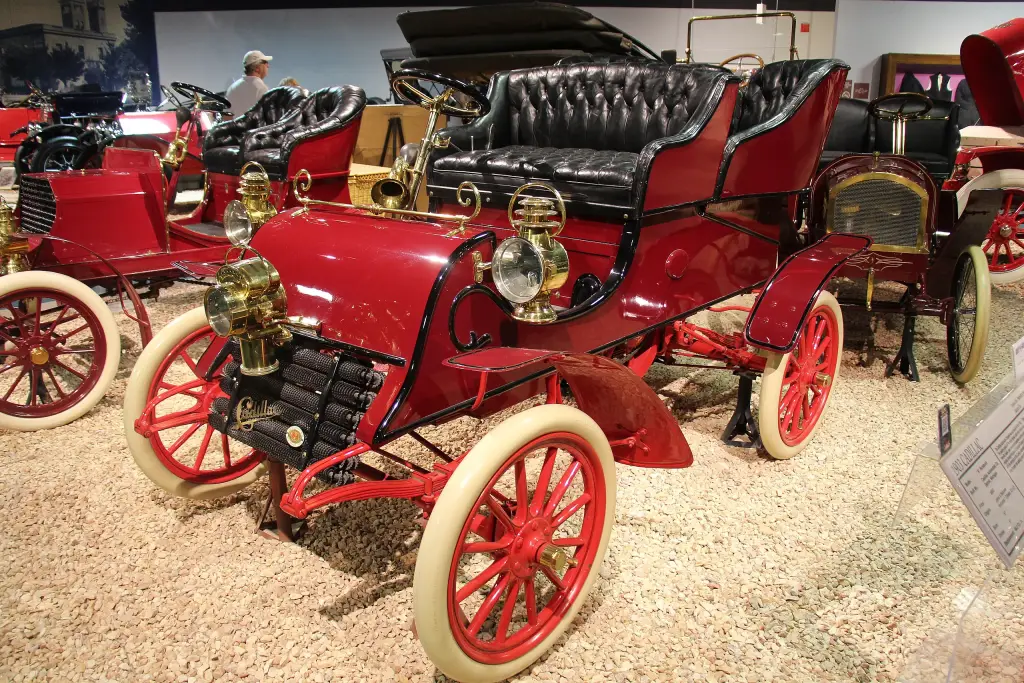
The first Cadillac automobiles were the 1903 model, built in the last quarter of 1902. They were two-seat horseless carriages powered by a reliable single-cylinder engine designed by Alanson Partridge Brush and built by the Leland and Faulconer Manufacturing Company of Detroit.
Cadillac Runabout at a glance
| Maker | Cadillac Automobile Company |
|---|---|
| First cars | late 1902, sold as 1903 models |
| Engine | single-cylinder, 98.2 cu in (1,609 cc), 6.5 to 9 hp |
| Engine name | Little Hercules, by Leland and Faulconer |
| Wheelbase, 1903 | 72 in (1,800 mm) |
| Wheelbase, 1904 Model B | 76 in (1,930 mm) |
| Price, 1903 runabout | $750 |
| Optional tonneau | $100, two extra seats |
| Built, 1903 | 2,497 |
| Bodies | two-seat runabout, four-seat tonneau, light delivery |
| Model B price | $900 |
Based on one source: the English Wikipedia article on the Runabout and Tonneau. The video attached to the old record is not about this car, so the article has none.
History of the Cadillac Runabout
Reformed as the Cadillac Automobile Company in August 1902, the firm began building runabouts and named them Cadillac after the city’s founder, Antoine Laumet de La Mothe, sieur de Cadillac. Three cars were finished for the New York Auto Show in January 1903; all three were sold at the show and by mid-week orders had been taken for a further 2,286 cars, each with a $10 deposit. Production began in March 1903 and 2,497 cars were built during the year.
The Little Hercules engine
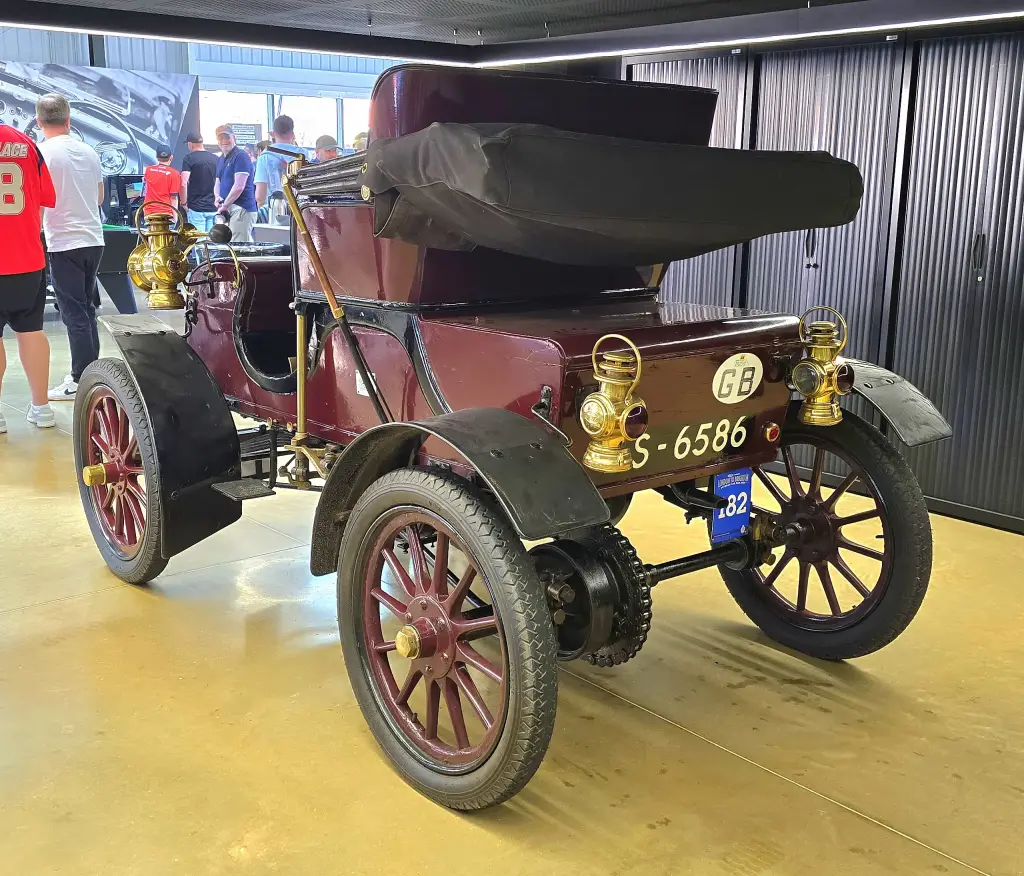
The engine was a single-cylinder unit of 98.2 cu in rated at 6.5 to about 9 hp depending on the model, with a horizontal cylinder pointing rearward, cast iron with a copper water jacket, and square bore and stroke of 5 inches. Its makers, Leland and Faulconer, called it Little Hercules. It used a patented variable-lift intake valve licensed from Alanson Partridge Brush, and the restrictions of that design pushed Cadillac to develop its own four-cylinder engine for later models. The 1903 car had a sloping false hood and radiator, chain drive through a planetary transmission and pedal brakes on the rear axle, supplemented by engaging reverse. Its 22-inch wooden wheels had 12 spokes.
Tonneau and Model B
A bolt-on rear-entrance tonneau with two more seats cost $100 and doubled the car’s capacity; a leather top and side curtains cost $50, a rubber top $300. The rear entrance let passengers step in from the pavement without walking in the mud. In January 1904 came the Model B, similar to the 1903 car but with a pressed-steel frame and axles, a longer 76-inch wheelbase, a detachable box-like front and a vertical radiator; all body styles lost as much as 70 pounds and prices rose $50 to $900. Only then did Cadillac start calling the earlier cars Model A to distinguish them from the new model.
Design and features
- Brush single-cylinder engine: simple, reliable and rated at 6.5 to 9 hp.
- Chain drive: a planetary transmission and chain final drive to the rear wheels.
- Bolt-on tonneau: a $100 option that turned the two-seater into a four-seater.
- Reputation for reliability: a Cadillac was the only single-cylinder car to finish the 1903 Sunrising Hill Climb, and took first in its class for reliability in the 1,000 Miles Reliability Trial.
Cadillac Runabout versions
- Model A runabout (1903): the two-seater at $750.
- Model A tonneau: the same car with the rear-entrance tonneau.
- Model B (1904-1905): pressed-steel frame, 76-inch wheelbase, $900.
- Light delivery: a commercial body listed in the catalogues.
The single-cylinder cars gave way to the four-cylinder Model Thirty and then to the V8 Type 51. More Cadillacs are in the Cadillac collection.
Sources
- Cadillac Runabout and Tonneau, English Wikipedia: first cars, engine, prices, Model B