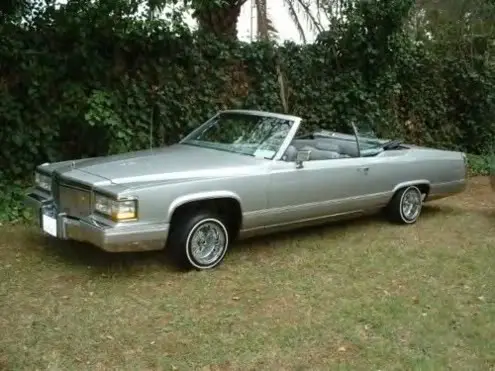
The Cadillac Commercial Chassis was a chassis built by Cadillac from 1931 to 1979 and sold as an incomplete vehicle, for coachbuilders to fit their own bodywork. It became the standard basis for hearses, ambulances and combination cars in North America.
Cadillac Commercial Chassis at a glance
| Maker | Cadillac, General Motors |
|---|---|
| Production | 1931-1979 |
| Type | incomplete rolling chassis for coachbuilders |
| Platform | GM D-body, exclusive to Cadillac |
| Derived from | Series 355, then Series 75 from 1936 |
| Wheelbase | up to 165 in (1940); 156 in in the 1950s and 1960s; 157.5 in in 1971-1976 |
| Typical bodies | funeral coach, ambulance, combination car, limousine |
| Frame | heavier-duty, with lower rear rails |
| Note | 16 cm longer wheelbase from 1960 |
| Last ambulances | 1979 |
| Famous example | Ecto-1 from Ghostbusters (1984) |
Based on one source: the English Wikipedia article on the Commercial Chassis. No free photographs of a commercial-chassis car were found in the candidates, so the article has no pictures.
History of the Cadillac Commercial Chassis
Cadillac built the Commercial Chassis as an incomplete vehicle: the rolling chassis carried all road controls and front body trim, air conditioning if specified, but no bodywork aft of the dashboard. Coachbuilders completed the car, and to help them Cadillac shipped front door shells and rear quarter panels separately from the chassis. The chassis was produced on the D platform, which was exclusive to Cadillac, and it was derived first from the Series 355 and from 1936 from the Series 75. From 1960 it had a 16 cm longer wheelbase than the equivalent sedan.
A frame made for the job
Unlike the factory-built Cadillac 75 limousine, the Commercial Chassis had a heavier-duty frame, and its rear frame rails sat lower than on a standard D-body to improve access to the rear cargo area. Before the Second World War it used the longest wheelbase of any GM sedan-based vehicle, reaching 165 inches in 1940. In the 1950s and 1960s the wheelbase was 156 inches, and the 1971-1976 chassis measured 157.5 inches. The powertrain was shared with the Series 75 throughout production.
Downsizing and the end
In the early 1970s federal design regulations pushed ambulance builders from commercial car chassis to cutaway van chassis and light trucks, and the requirements for ambulance bodies forced a change from wagon-type bodies to modular boxes. Funeral coach construction was not affected, but demand was low and the vehicles long-lived. For 1977 Cadillac downsized its full-size sedans, including the D-body, and the Commercial Chassis was downsized with them; the smaller hearses became much more expensive and sales fell sharply. Most funeral coach builders either closed or were sold and reorganised, among them Superior, Miller-Meteor and Hess & Eisenhardt. The last D-body ambulances were built in 1979.
Design and features
- Incomplete vehicle: no bodywork behind the dashboard, ready for a coachbuilder’s body.
- Heavy-duty frame: stronger than the standard D-body, with lower rear rails for loading.
- Long wheelbases: up to 165 inches before the war, and 157.5 inches in the early 1970s.
- Shared powertrain: the same engines as the Series 75 limousine.
Cadillac Commercial Chassis versions
- Funeral coach: the hearse, the most common body on the chassis.
- Ambulance: high-roof and wagon-type bodies, built until 1979.
- Combination car: a dual-purpose hearse and ambulance.
- Limousine: coachbuilt stretched bodies alongside the factory Series 75.
The Commercial Chassis was the working cousin of the big Fleetwood and of the Brougham, another favourite of coachbuilders. More Cadillacs are in the Cadillac collection.
Video: 1973 Cadillac Miller-Meteor Lifeliner hightop ambulance
Video by fmbjogger on YouTube.
Sources
- Cadillac Commercial Chassis, English Wikipedia: design, wheelbases, coachbuilders, discontinuation, Ecto-1