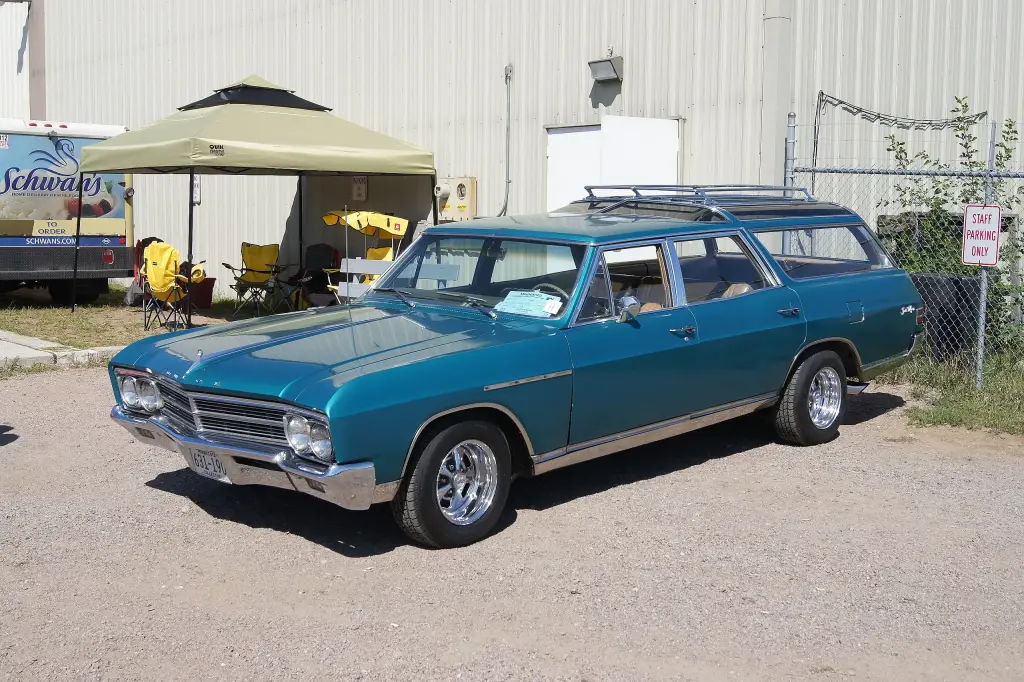
The Buick Sport Wagon was a mid-size station wagon built in three generations from 1964 to 1972. Its raised roof carried tinted glass skylights, and it was a stretched version of the Skylark wagon.
Buick Sport Wagon at a glance
| Maker | Buick, General Motors |
|---|---|
| Production | 1964–1967, 1968–1969, 1970–1972 |
| Class | mid-size station wagon |
| Platform | GM A-body |
| 1964 wheelbase | 120 in (3,048 mm) |
| 1968–69 wheelbase | 121 in (3,073 mm) |
| 1970–71 wheelbase | 116 in (2,946 mm) |
| 1964 engine | 225 cu in V6 standard, 300 cu in V8 optional |
| 1968 engines | 250 six, 350 or 400 V8 |
| Seats | up to nine with the third row |
| Sister cars | Oldsmobile Vista Cruiser, Pontiac Tempest Safari |
Based on one source, the English Wikipedia article on the Sport Wagon.
History of the Buick Sport Wagon
The Sport Wagon appeared on 4 February 1964 on the new GM A platform, with a 120-inch wheelbase — five inches longer than the other Skylark four-door models. Above the cargo area the roof was raised and surrounded by four tinted glass panels, an idea Buick had used on the GMC Scenicruiser bus in 1954. Three VentiPorts on each front fender marked it as a junior Buick.
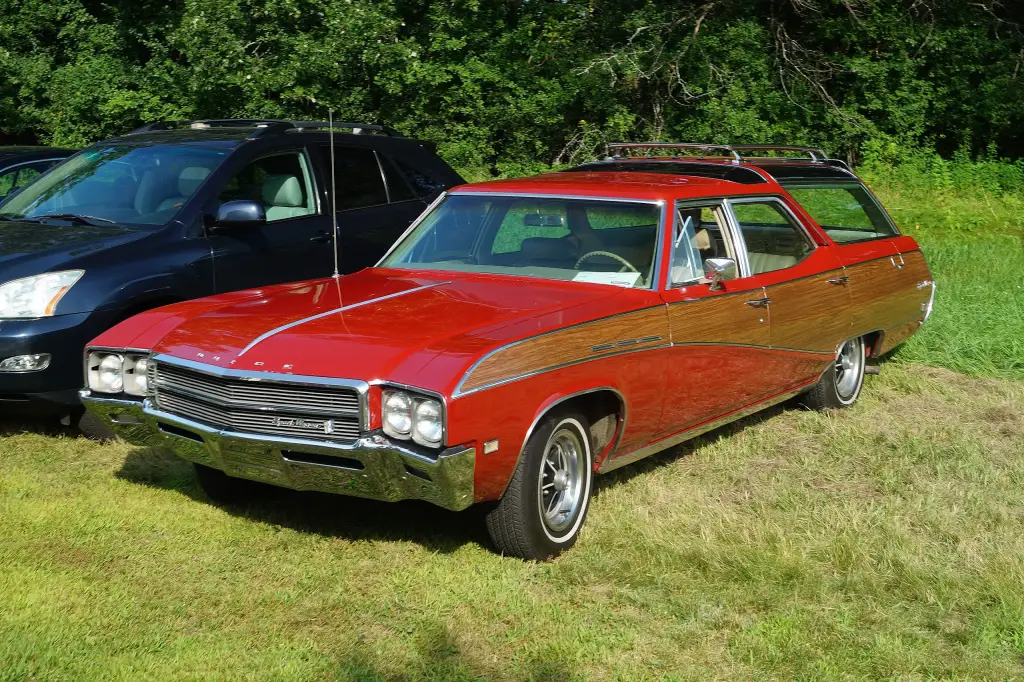
The standard engine was the 225-cubic-inch Buick V6 with a three-speed manual gearbox, or an optional two-speed Super Turbine 300 automatic; a 300-cubic-inch V8 was available. A forward-facing third row of seats was optional. Buyers chose between the standard and the more upmarket Custom trim, and from 1966 the Sport Wagon brought back simulated woodgrain, applied as DI-NOC vinyl. A nine-passenger Custom car listed at US$3,286.
The 1968 redesign brought an updated Sweepspear along the side, influenced by the restyled Riviera, and replaced the split main skylight with a single panel over the second row, keeping the lengthwise skylights over the cargo area. Wheelbase grew to 121 inches, which made the optional third row possible — something the smaller Special and DeLuxe wagons could not offer. The 1969 cars introduced a «Dual-Action» tailgate, optional on two-row models and standard on three-row cars, and the nine-passenger Custom cost US$3,869. Engines were a 250-cubic-inch Chevrolet six as standard, with the 350 Buick V8 or the 400 big-block from the GS.
For 1970 the mid-size Buicks were redesigned and the Sport Wagon became a deluxe trim of the cheaper Skylark wagon, the junior wagon below the full-size Estate Wagon, while the Special wagon was dropped. The skylights disappeared from 1970, and the car moved to the 116-inch wheelbase shared with four-door sedans. Engine choices stayed at the 250 six or the 350 V8.
No longer a standalone model after 1972, the name returned as a Sport Wagon package on the Century wagon from 1978 to 1980, with a different grille, special paint, sport wheels and a sport suspension.
Design and features
- Skylights: tinted glass panels in a raised roof over the cargo area.
- Long wheelbase: 120 or 121 inches, which allowed a third row of seats.
- Woodgrain: DI-NOC simulated panels from 1966.
- Dual-Action tailgate: standard on three-row cars from 1969.
Buick Sport Wagon versions
- First generation (1964–67): 120-inch wheelbase, V6 or 300 V8.
- Second generation (1968–69): one-piece centre skylight, 350 and 400 V8s.
- Third generation (1970–72): deluxe Skylark wagon, no skylights.
- Century Sport Wagon package (1978–80): a trim package rather than a model.
The Sport Wagon was a stretched Skylark and the junior companion to the full-size Estate wagon. More Buicks are in the Buick collection.
Sources
- Buick Sport Wagon, English Wikipedia: three generations, skylights, engines, prices