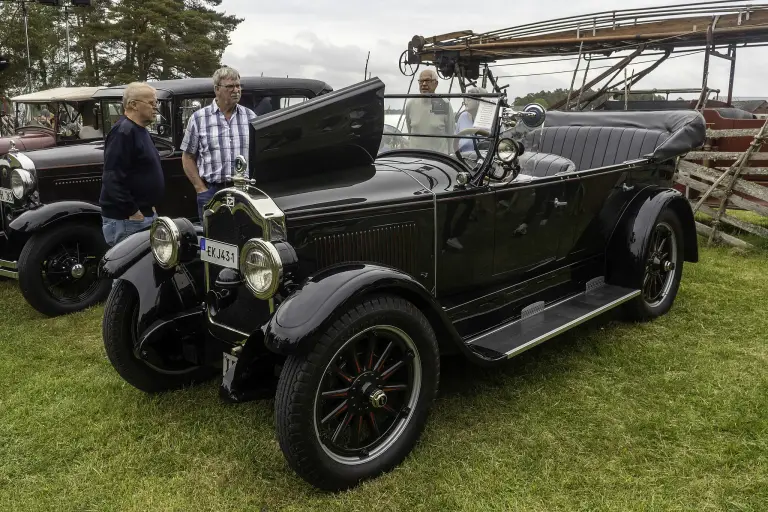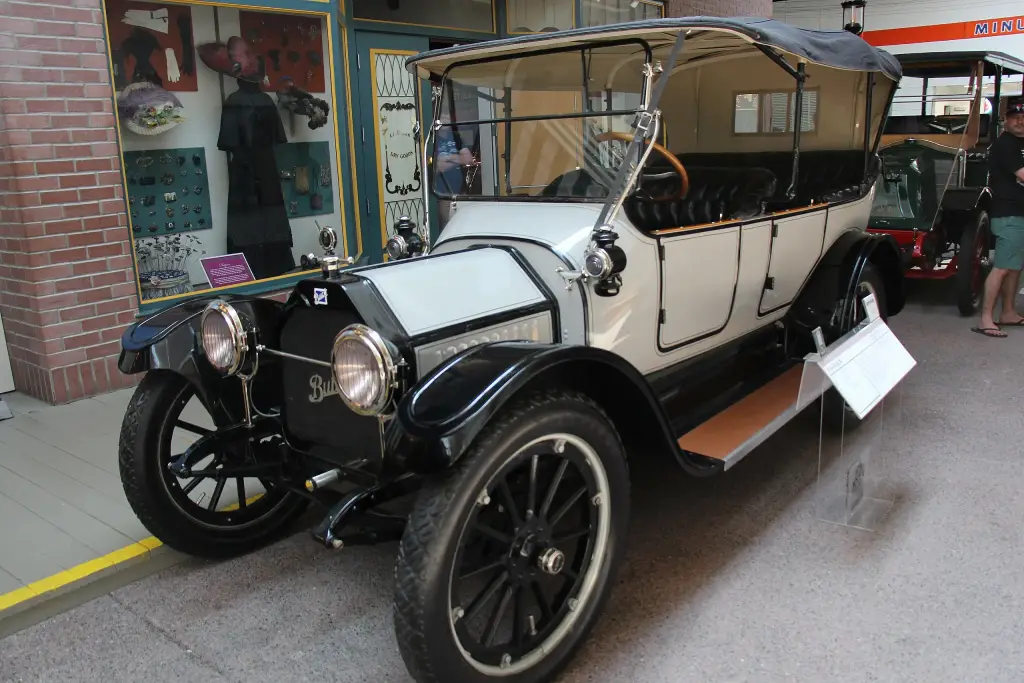
The Buick Four was the four-cylinder branch of Buick’s range, built from 1909 to 1918. It sat below the larger Buick Six and was offered as a touring car, phaeton or roadster.
Buick Four at a glance
| Maker | Buick, General Motors |
|---|---|
| Production | 1909–1918 |
| Bodies | touring car, phaeton, roadster |
| First model | Model 10, 1908–1910 |
| Engine | 165 cu in (2,703 cc) overhead-valve four |
| Power | 40 bhp |
| Gearbox | three-speed manual |
| Brakes | drum, on the rear wheels |
| Model 10 wheelbase | 88 in (2,235 mm) |
| Model 10 built | 23,100 |
| Became junior model | 1914, when the Buick Six arrived |
Based on one source, the English Wikipedia article on the Buick Four, which also covers the Model 10 of the record titled «Buick 10». No free photographs of the period cars were available in the material.
History of the Buick Four
The Model 10 of 1908–1910 was the defining car of the line. It had an overhead-valve, in-line 165-cubic-inch four-cylinder engine developing 40 bhp, mounted at the front and driving the rear wheels through a shaft. The gearbox had three forward speeds with the lever to the right of the driver, and the brake pedal worked drum brakes on the rear wheels. On an 88-inch wheelbase it was sold as a five-passenger touring car, a four-door landaulet or a four-door sedan, and 23,100 were built.
The Model 10 was an improvement of a car developed by the Janney Motor Company, which Buick had acquired. For 1911 the range became the Model 32 roadster and Model 33 touring car; only the wheelbase changed, to 89 inches for the roadster and 100 inches for the touring car, and 1,150 and 2,000 respectively were made at a list price of US$1,000.
1912 brought three models: the Model 34 short-wheelbase roadster on 91 inches, the Model 35 long-wheelbase touring car on 102 inches and the Model 36 long-wheelbase roadster. Production was 1,400, 6,050 and 1,600 cars respectively.
For 1913 the Model 24 roadster replaced the Model 34 and 36, and the Model 25 replaced the Model 35 touring car; both shared a 105-inch wheelbase and unchanged mechanicals. That year 2,850 Model 24 and 8,150 Model 25 were built. The designations changed again for 1914 to the B-24 roadster and B-25 touring sedan, with 3,126 and 13,446 assembled, the only significant addition being a standard folding windscreen.
For 1915 the roadster became the C-24 and the touring car the C-25, and production rose again to 3,256 and 19,080 cars. The Buick Four was discontinued in 1918, briefly revised for 1922, 1923 and 1924, and then dropped for good. The next four-cylinder Buick was the 1980 Skylark, which offered one as an option.
Design and features
- Overhead-valve four: 165 cubic inches and 40 bhp in the Model 10.
- Junior model: the Four sat below the Six from 1914.
- Many body styles: touring car, phaeton, roadster and landaulet.
- Big seller: 23,100 Model 10s alone.
Buick Four versions
- Model 10 (1908–1910): the original, 23,100 built.
- Model 32 and 33 (1911): roadster and touring car.
- Model 34, 35, 36 (1912): three wheelbase and body combinations.
- Model 24 and 25 (1913), then B-24/B-25 and C-24/C-25: the final forms.
The Four was the smaller brother of the Buick Six, and it is the earliest chapter of the Buick collection on this site.
Sources
- Buick Four, English Wikipedia: Model 10, 1911-1915 models, production figures