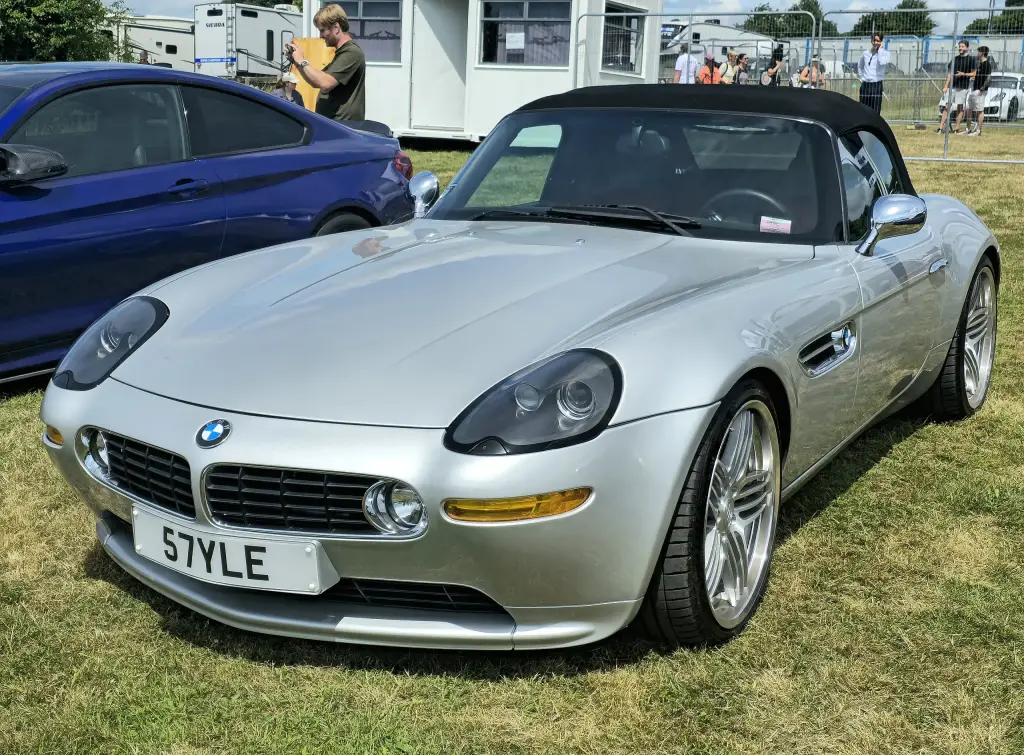
The Z8 was conceived as a styling exercise to celebrate the BMW 507 of the late 1950s and became one of the most expensive cars BMW had built. It used an aluminium spaceframe, the V8 from the M5 and a six-speed manual gearbox, and it carried a matching hardtop as standard. Production ran from March 2000 to July 2003.
BMW Z8 at a glance
| Maker | BMW |
|---|---|
| Internal code | E52 |
| Production | March 2000 to July 2003, hand-built |
| Total built | 5,703 cars, including 555 Alpina Roadster V8 |
| Designer | Henrik Fisker, inspired by the BMW 507 of 1956–1959 |
| Body | aluminium spaceframe with a bolted-on aluminium skin |
| Engine | S62 4.9-litre V8, 294 kW (400 PS) at 6,600 rpm |
| Weight distribution | 50:50, with the engine behind the front axle |
| Gearbox | six-speed manual |
| Acceleration | 4.7 seconds to 100 km/h, according to BMW |
| Top speed | 250 km/h limited, about 290 km/h without the limiter |
| Price | 235,000 DM at launch, US$128,000 in America |
The sources give different production start dates; this page follows the German figures for production, March 2000 to July 2003.
History of the BMW Z8
Design and concepts
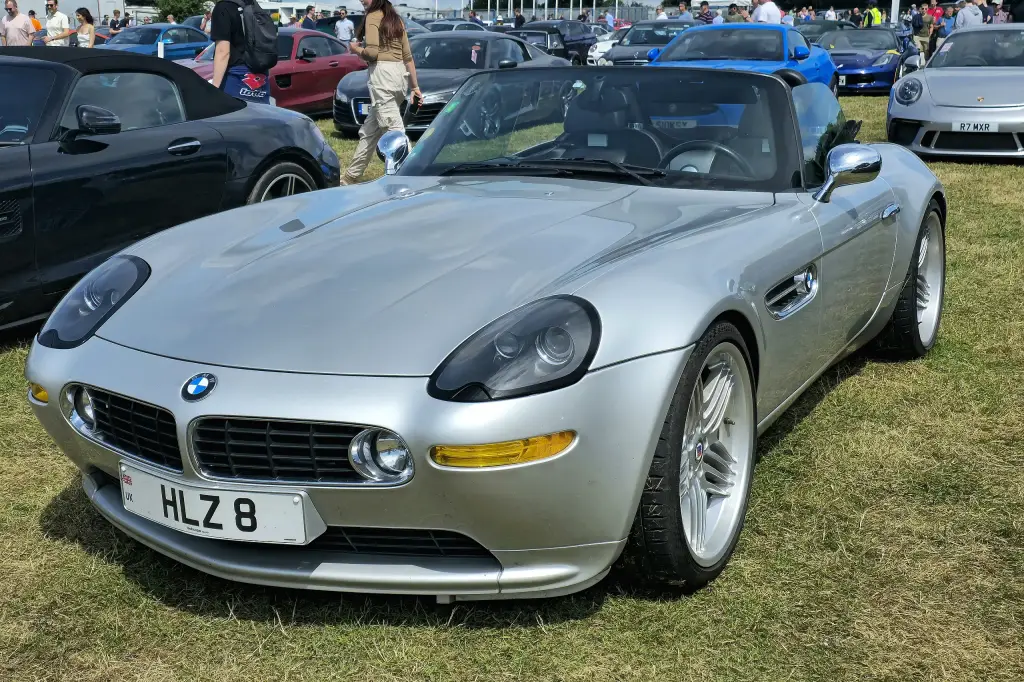
The Z8 was developed under the code E52 between 1993 and 1999 by a design team led by Chris Bangle, with styling work concentrated in 1993–1995. Henrik Fisker drew the exterior, which looked back to the BMW 507 built from 1956 to 1959, with a wide kidney grille and side air vents; the interior was the work of Scott Lempert according to the English article and of Mike Ninic and Bruno Amatino according to the German one, with the steering wheel by David Carp. A concept called the Z07 previewed the car at the Tokyo Motor Show in October 1997 and in closed form in Detroit in 1998. Because the concept followed the E52 programme closely, very few changes were needed for production: the windscreen was more upright, the front air dam larger and the hardtop had a double-bubble shape. The production car was shown at the IAA in 1999, and prototypes had been testing since 1996.
Engineering
The body was built around a MIG-welded aluminium spaceframe with a screwed-on skin; the cavities were left unsealed because aluminium does not rust, and the result was light and very stiff. Sill covers and bumpers were polyurethane and housed the aerials for radio, navigation and telephone. The S62 V8 of 4,941 cc came from the E39 M5 and made 294 kW (400 PS), sent through a six-speed manual to the rear wheels; the engine sat behind the front axle for a 50:50 balance. BMW quoted 4.7 seconds to 100 km/h, Motor Trend measured 4.2 seconds to 60 mph, and Car and Driver found the car quicker than a Ferrari 360 Modena in acceleration, handling and braking. Top speed was limited to 250 km/h, with about 290 km/h possible without the limiter. The tail-lights and indicators used neon tubes, and in the United States the indicators in the tail-lights were red because of the local rules.
Equipment and the Alpina version
Every Z8 came fully equipped, with airbags, ABS, air conditioning, navigation, telephone, xenon headlights, heated electric leather seats, a hardtop with a heated rear window and its own stand, plus a “birth book” and a 1:18 scale model in the ordered colour. The dashboard instruments sat in the centre and were angled slightly towards the driver, and small multifunction controls kept the cabin uncluttered. BMW promised a 50-year supply of spare parts. Many cars were finished by BMW Individual with bespoke paint and trim. A Z8 served as the safety car in the 2001 MotoGP season. With the Z8 out of production by November 2002, the Alpina Roadster V8 took its place in 2003: a 4.8-litre M62 V8 of 280 kW (381 PS) and 520 N·m, a five-speed Steptronic automatic, softer suspension and 20-inch Alpina wheels on conventional tyres. Altogether 555 Alpina cars were built, 450 of them for the United States.
Design and features
- Aluminium spaceframe: a hand-welded structure with a bolted-on body, light and very rigid.
- M5 engine: the S62 V8 placed behind the front axle for a 50:50 weight distribution.
- 507 tribute: wide grille and side vents recalling the BMW roadster of the late 1950s.
- Matching hardtop: supplied with every car and styled to suit the body rather than for practicality alone.
- Neon lighting: tail-light and indicator tubes that lit faster than bulbs and were meant to last the car’s life.
BMW Z8 versions
- Z07 concept (1997): the show car that previewed the production design.
- Standard Z8 (2000–2003): fully equipped, six-speed manual only.
- BMW Individual cars: bespoke paint and interior treatments from the factory division.
- Z8 safety car (2001): a one-off version for MotoGP.
- Alpina Roadster V8 (2002–2003): 4.8-litre V8, automatic gearbox, softer chassis, 555 built.
The Z8 shares its V8 with the M5 (E39) and followed the open two-seaters Z3 and 8 Series in spirit. More cars are in the BMW collection.
Sources
- BMW Z8, English Wikipedia: development, Z07 concept, specifications, Alpina
- BMW Z8, German Wikipedia: production dates and totals, construction, equipment, price