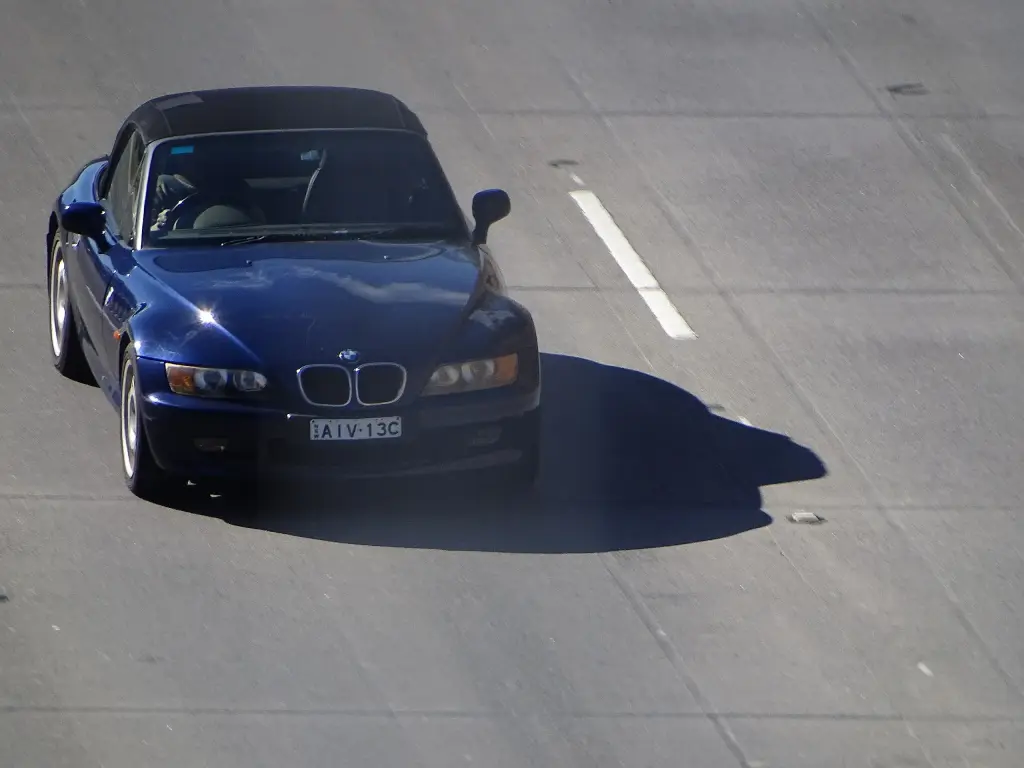
The Z3 was BMW’s first mass-produced Z Series car and its first model built entirely outside Germany, at Greer in South Carolina. It arrived in 1995 as a two-seat roadster on a shortened 3 Series Compact platform, with a coupé following in 1998. The M versions borrowed their straight-six engines from the M3.
BMW Z3 at a glance
| Maker | BMW US Manufacturing, Greer, South Carolina |
|---|---|
| Production | 1995–2002 |
| Body styles | roadster (E36/7), coupé (E36/8) |
| Platform | E36/5 Compact, shortened E36 |
| Rear suspension | semi-trailing arms from the E30 3 Series |
| First car built | 20 September 1995 |
| Built by July 2002 | 179,273 roadsters and 17,815 coupés |
| Engines | four- and six-cylinder petrol, 1.8 to 3.2 litres |
| M engines | S50, S52 and S54 straight-six, five-speed manual only |
| Facelift | April 1999, with a new rear end and L-shaped tail-lights |
| Special edition | James Bond Edition, 100 cars sold in 1996 |
| Successor | Z4 (E85) |
Production totals differ between sources; this page uses the German figures for roadsters and coupés built at Greer.
History of the BMW Z3
Development
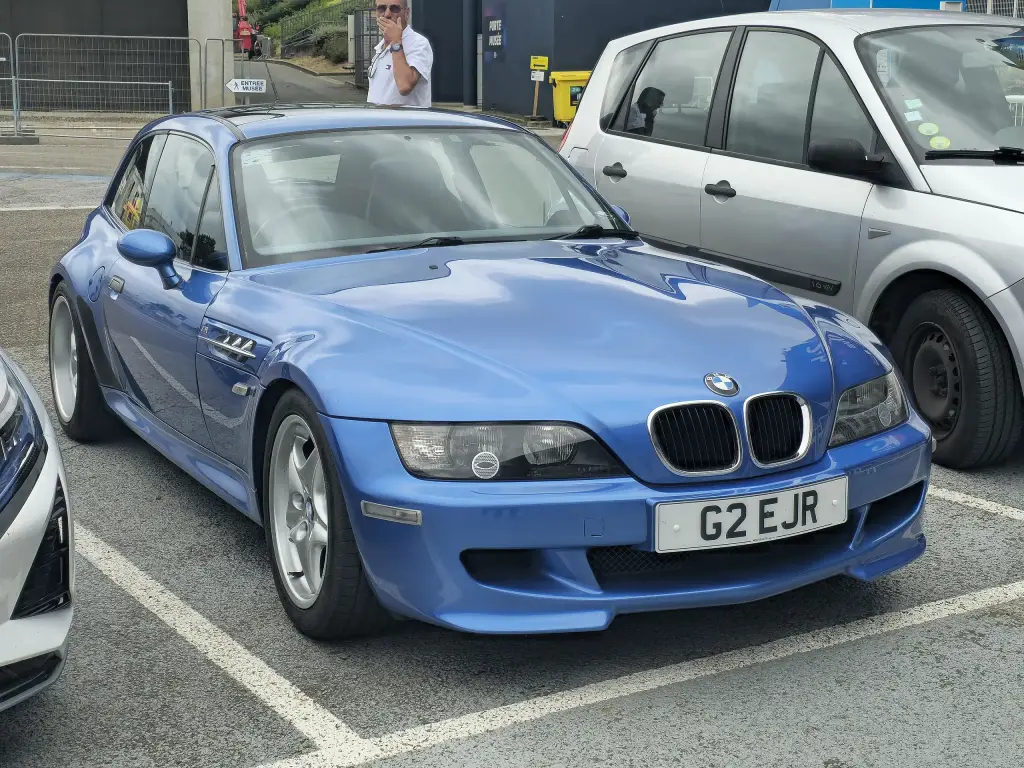
Work on the roadster began in 1991 under Burkhard Göschel. Joji Nagashima designed the exterior, completing it in mid-1992, 39 months before production, and the design was frozen in 1993; patents were filed in Germany on 2 April 1994 and in the United States on 27 September 1994. The car was introduced by a video press release from BMW North America on 12 June 1995, and the first one was built on 20 September 1995. It used the shortened platform of the E36 Compact, including that car’s older semi-trailing arm rear suspension, and it was the first BMW made only outside Germany: more than 60% of its parts came from North America, partly to reduce exposure to exchange rates. The coupé was developed by a group of BMW engineers in their own time; it shares the platform and parts with the roadster but has a chassis-stiffening hatch area that is 2.7 times stiffer. It was shown at the Frankfurt Motor Show in 1997, went into production in January 1998 and reached customers that September.
The range
Roadster production started with four-cylinder 1.8 and 1.9 models, and six-cylinders arrived in 1996 with the 2.8, recognisable by its wider rear wings. Four-cylinder cars had a single tailpipe, six-cylinder cars two, and a removable hardtop was offered as an accessory. The 1.8, 2.0 and 2.2i were not sold in the United States, which was the only market for the 2.3 and 2.5. In October 1998 the 2.8 gained double VANOS, a new intake manifold, an electronic throttle and Siemens engine management. The facelift of April 1999 brought raised rear wings, L-shaped tail-lights, chrome rings around the headlights and an extra lining for the roof, and ended the visual differences between engine versions. The 2.0 arrived with the new engine generation, the 3.0i replaced the 2.8 in June 2000 and the 2.2 replaced the 2.0 that October.
M versions and specials
The M Roadster and M Coupé used M3 engines: the S50 in Europe, the less powerful S52 in North America and, from June 2001, the S54, detuned to 239 kW (325 PS) because the exhaust was not long enough to match the M3. They came only with a five-speed manual and had a limited-slip differential, a wider rear track, E36 M3 brakes, unique bumpers and mirrors, Roadstar Style 40 wheels and the M division’s first quad exhaust. In 1996, to mark the car’s appearance in the film GoldenEye, BMW sold a James Bond Edition through the Neiman Marcus catalogue at $35,000, planned as 20 cars and raised to 100; all were 1.9i models in Atlanta blue with beige leather, half manual and half automatic. In 1999 the M division built a single Z3 with the 5.4-litre M73 V12 and a six-speed gearbox, which spun its wheels even in third and was never put into production. The last Z3 was built on 28 June 2002.
Design and features
- Compact platform: a shortened E36 Compact floorpan with the older E30-type semi-trailing arm rear axle.
- Two characters: open roadster and, from 1998, a hatchback coupé nicknamed the clown shoe.
- M versions: M3 engines, M3 brakes, a limited-slip differential and quad exhausts.
- American production: the first BMW built entirely outside Germany, with over 60% North American content.
- GoldenEye tie-in: the James Bond Edition of 100 cars sold through a department store catalogue.
BMW Z3 versions
- 1.8 and 1.9: four-cylinder roadsters that opened the range in 1995.
- 2.8: the first six-cylinder, with wider rear wings, from 1996.
- 2.3 and 2.5: United States only, using the 2.5-litre engine.
- 2.0, 2.2i, 3.0i: the post-facelift six-cylinders.
- Z3 Coupé 2.8 and 3.0i: closed hatchback bodies from 1998.
- M Roadster and M Coupé: S50, S52 and later S54 engines, five-speed manual only.
The Z3 used the platform of the 3 Series (E36) and was replaced by the Z4 (E85). The retro-styled flagship of the period was the Z8, and more cars are in the BMW collection.
Sources
- BMW Z3, English Wikipedia: development, body styles, M models, special editions
- BMW Z3, German Wikipedia: production figures, facelift, engines
- BMW Z3, Italian Wikipedia: launch, facelift, final car