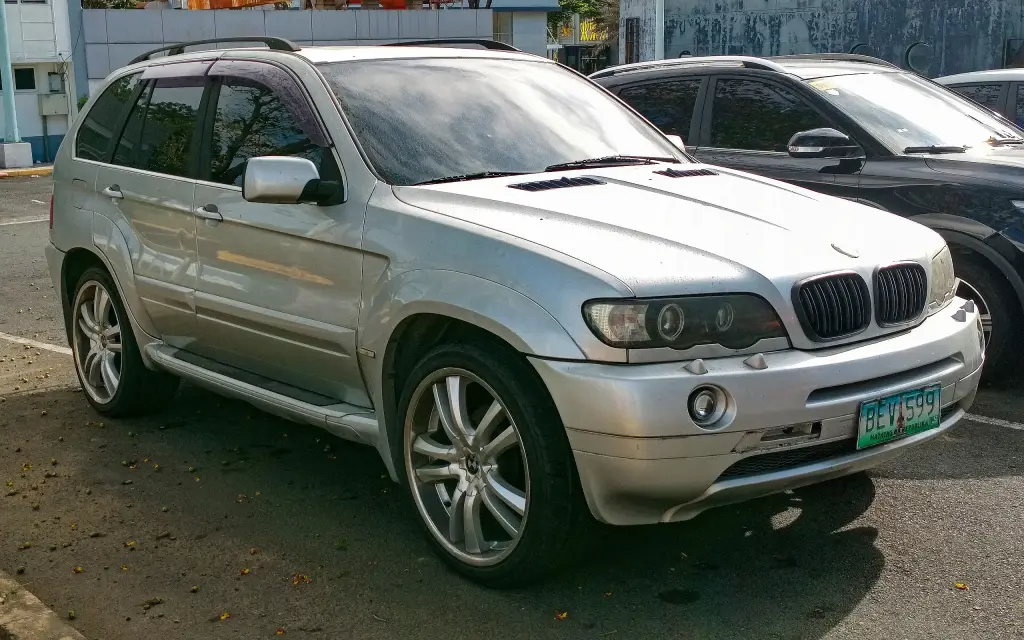
The E53 was the first SUV BMW ever built, developed in the years after the company bought Land Rover. It took the hill descent system and off-road engine management from the Range Rover and much of its mechanical hardware from the E39 5 Series. BMW insisted on calling it a Sports Activity Vehicle and set it up as a sporting road car rather than an off-roader.
BMW X5 (E53) at a glance
| Maker | BMW, Greer in South Carolina and Toluca in Mexico |
|---|---|
| Production | 1 September 1999 to 22 September 2006 |
| Body style | five-door SUV with a two-piece tailgate |
| Drive | all-wheel drive, 62% of torque to the rear |
| Shared with | Range Rover L322 and BMW 5 Series (E39) |
| Project leader | Eduard Walek |
| Design frozen | 1996, 35 months before production |
| Sport models | 4.6is from 2001, 4.8is from 2004 |
| 4.6is output | 342 hp (255 kW) from the M62B46 V8 |
| 4.8is output | 355 hp (265 kW) from the N62 V8 |
| Facelift | 2003, for the 2004 model year |
| One-off | X5 LM with the Le Mans V12, a Nürburgring record in 2000 |
Based on one source, the English Wikipedia article on the E53; the German article was not available.
History of the BMW X5 (E53)
Development
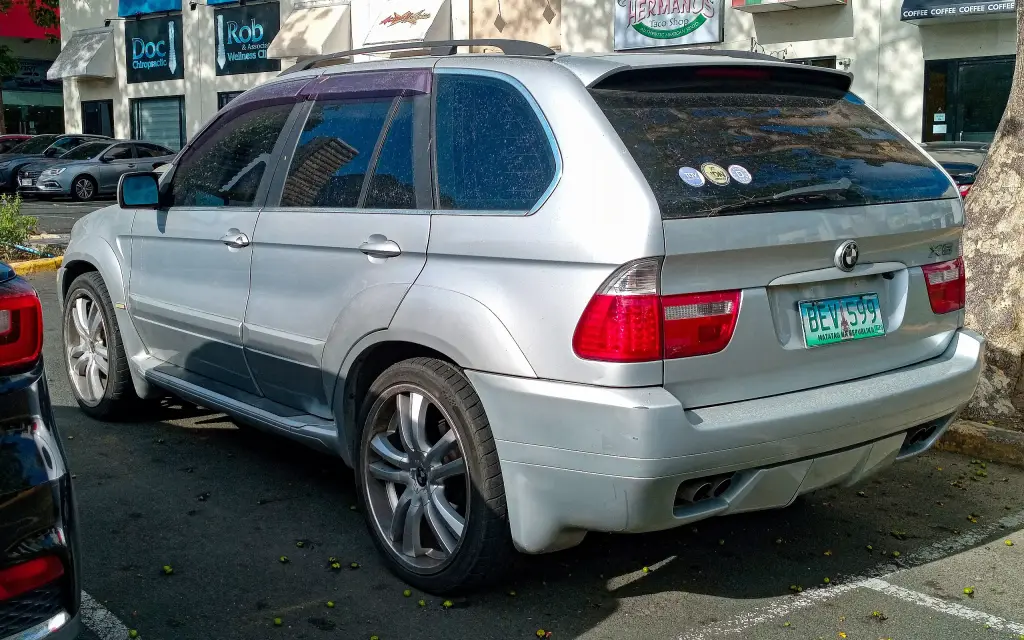
The story starts in 1994, when BMW began thinking about a sports utility vehicle after buying Land Rover. Eduard Walek was named project leader and chief engineer, and Chris Chapman later worked with Chris Bangle in Munich on two full-scale clay models. By 1996 the design was approved and frozen, 35 months before production, and patents were filed on 10 June and 9 December 1998, registered in the United States on 18 January 2000. The Rover takeover paid off directly: engineers could use Range Rover technology, including hill descent control, and the X5 took its two-piece tailgate straight from the British car. Engines and electronics came from the E39 5 Series parts bin to keep costs down.
Chassis and interior
Although the X5 had all-wheel drive, BMW routed 62% of the engine’s torque to the rear wheels from the start so that it would feel like the company’s rear-wheel drive saloons, and its off-road ability was deliberately well below that of a Range Rover. The interior was shared with the E39, with a similar dashboard; a cassette head unit was standard on every car and the CD unit was optional at first, later becoming standard, while a navigation radio replaced the CD player with a cassette unit behind a retractable screen. A premium sound system was standard and a digital sound processing upgrade optional, and BMW Assist with an SOS button was offered. Production began on 1 September 1999 at Greer in South Carolina and also took place at Toluca in Mexico.
Sport models and the facelift
The 4.6is of 2001 used the M62B46 V8 with 342 hp (255 kW), came in four colours, wore 20-inch wheels over larger brakes and had rear fender flares with different bumpers. In 2004 it was replaced by the 4.8is, whose N62 V8 produced 355 hp (265 kW). A one-off X5 LM carried the P75 engine based on the S70/3 V12 of the 1999 Le Mans-winning V12 LMR, and Hans-Joachim Stuck used it to set a Nürburgring lap record in 2000. Work on the mid-life update began in 2000 for a 2003 launch: a radical design was chosen in late 2001, then replaced by a more conservative one after the reaction to the E65 7 Series, and the facelifted car was presented in 2003 for the 2004 model year with new headlights, a larger grille, corona rings, revised tail-lights and the new xDrive system. The E70 replaced it in 2006.
Design and features
- Land Rover engineering: hill descent control and an off-road engine management system came from the Range Rover L322.
- Rear-biased drive: 62% of torque went to the rear axle to keep the handling close to a BMW saloon.
- Two-piece tailgate: taken directly from the Range Rover.
- Sport versions: the 4.6is and 4.8is with wide arches, 20-inch wheels and larger brakes.
- X5 LM: a one-off with a Le Mans-derived V12 that set a Nürburgring record in 2000.
BMW X5 (E53) versions
- 3.0i and 4.4i: the original six- and eight-cylinder models.
- 3.0d: the six-cylinder turbodiesel.
- 4.6is (2001–2003): M62B46 V8, 342 hp, 20-inch wheels and fender flares.
- 4.8is (2004–2006): N62 V8 with 355 hp.
- Facelift (2004 model year): new lights, grille and the xDrive system.
- X5 LM: one car with the P75 V12 from the Le Mans winner.
The X5 was joined in the range by the smaller X3 (E83) and was replaced by the X5 (E70). Its engines came from the 5 Series (E39), and more cars are in the BMW collection.
Sources
- BMW X5 (E53), English Wikipedia: development, chassis, sport models, facelift