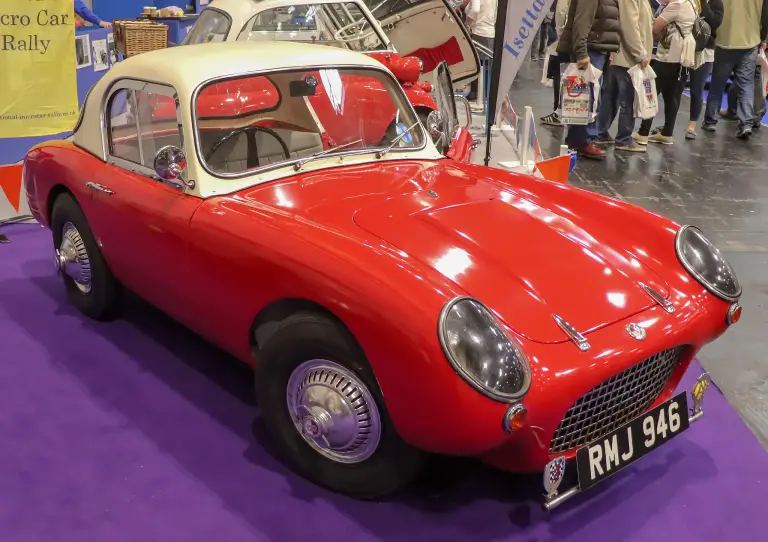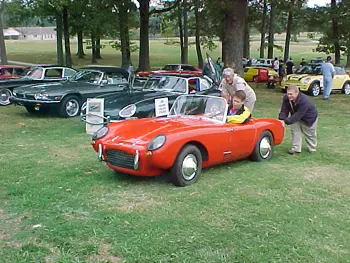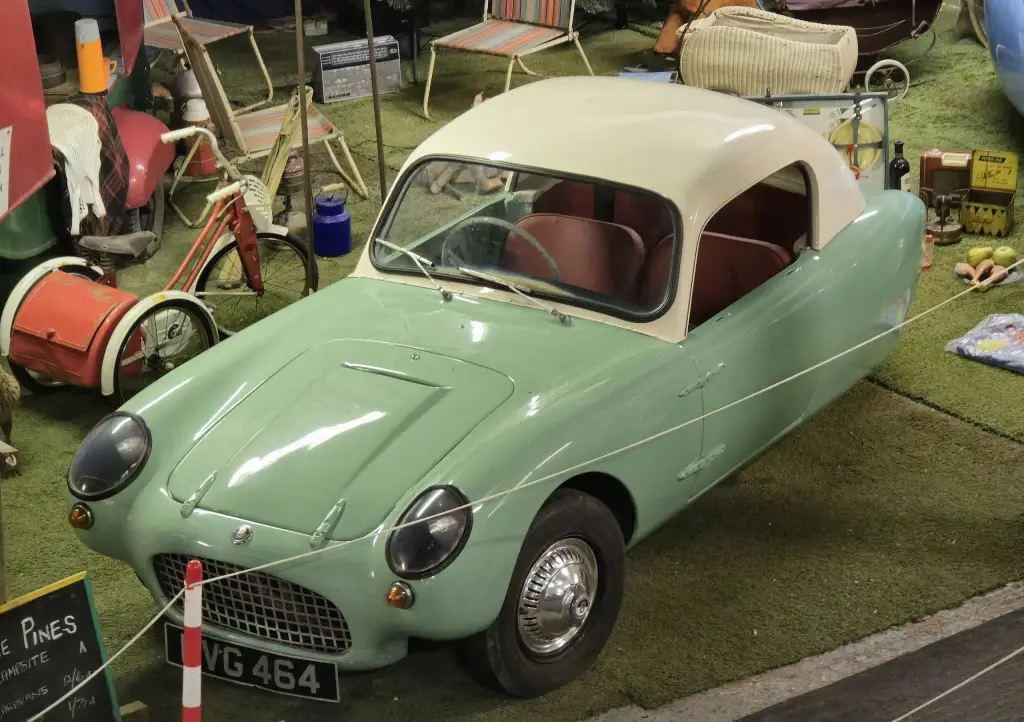
The Berkeley T60 was a three-wheeled mini sports car that Berkeley Cars of Biggleswade built from September 1959 to December 1960. With a single rear wheel, a 328 cc Excelsior two-stroke driving the front wheels and a glassfibre body, it could be driven in Britain with a motorcycle licence and cost £400 at its launch.
Berkeley T60 at a glance
| Maker | Berkeley Cars Ltd, Biggleswade, Bedfordshire |
|---|---|
| Production | September 1959–December 1960 |
| Layout | three wheels, front-wheel drive |
| Engine | Excelsior air-cooled two-cylinder two-stroke |
| Displacement | 328 cm³ |
| Bore × stroke | 58 mm × 62 mm |
| Power | 18 bhp (13.2 kW) at 5,000 rpm |
| Gearbox | four-speed |
| Front suspension | independent, coil springs |
| Rear suspension | single wheel on a trailing arm |
| Price at launch | £400 |
| Built | about 1,800 T60 and 50 T60/4 |
This page is based on the German Wikipedia article on the T60 and the English Wikipedia article on Berkeley Cars.
History of the Berkeley T60
A three-wheeler in the bubble car boom
The T60 appeared in September 1959, late in the British microcar boom. As a three-wheeler it could be driven in the United Kingdom on a motorcycle licence, and purchase tax and vehicle tax were lower than those on four-wheeled cars, which made it popular. Its single rear wheel was carried on a trailing arm, while the front wheels had the independent coil-spring suspension used on Berkeley’s four-wheeled cars; a four-speed gearbox drove the front wheels through the same 328 cm³ Excelsior two-stroke that powered the Sports SE328.
Roadster, coupé and the T60/4
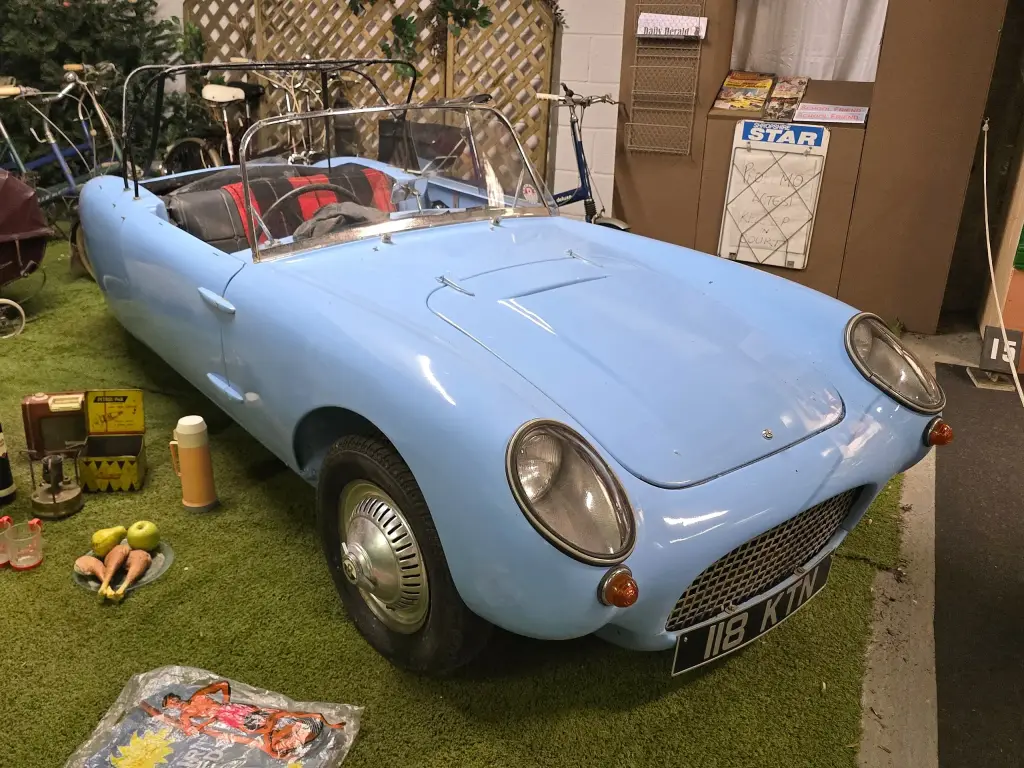
The car was made as a roadster with a fabric roof and as a coupé with a fixed roof, both on the glassfibre body. The first six hundred or so cars had a bench seat for two and an umbrella-handled handbrake under the dashboard, with floors reinforced by aluminium beams. Later cars received steel-beam-reinforced floors, individual seats and a floor-mounted handbrake lever with a pistol grip; chassis numbers ran from 1 to 1800. In October 1960 Berkeley added the T60/4, which kept the mechanical layout and the appearance of the last two-seat T60 but had the rear of the body lengthened to take an extra bench behind the two individual seats, room for two children. The bench had a hump in the middle, below which the single rear wheel sat.
The end of the line
The very last of the roughly 1,800 cars had modified front and rear suspension units — presumably, in the words of the German account, so that the front bridge over the differential no longer broke and the rear damper unit stopped coming loose. Fifty T60/4 cars had been built when car production at Berkeley ended in December 1960, as the company went into liquidation after the collapse of the caravan market that had financed it. After about 4,100 cars of all types, the workforce was laid off shortly before Christmas that year.
Design and features
- Motorcycle-licence driving: one rear wheel made the T60 a motorcycle for British licensing and tax purposes, which was the point of the layout.
- Excelsior two-stroke: the same 328 cm³ air-cooled twin as in the four-wheeled Sports, with 18 bhp at 5,000 rpm.
- Front-wheel drive: a four-speed gearbox and front-wheel drive, with independent coil-sprung front suspension.
- Two body styles: a roadster with a fabric roof and a coupé with a fixed glassfibre roof.
- The T60/4: a lengthened 2+2 version from October 1960, of which fifty were made.
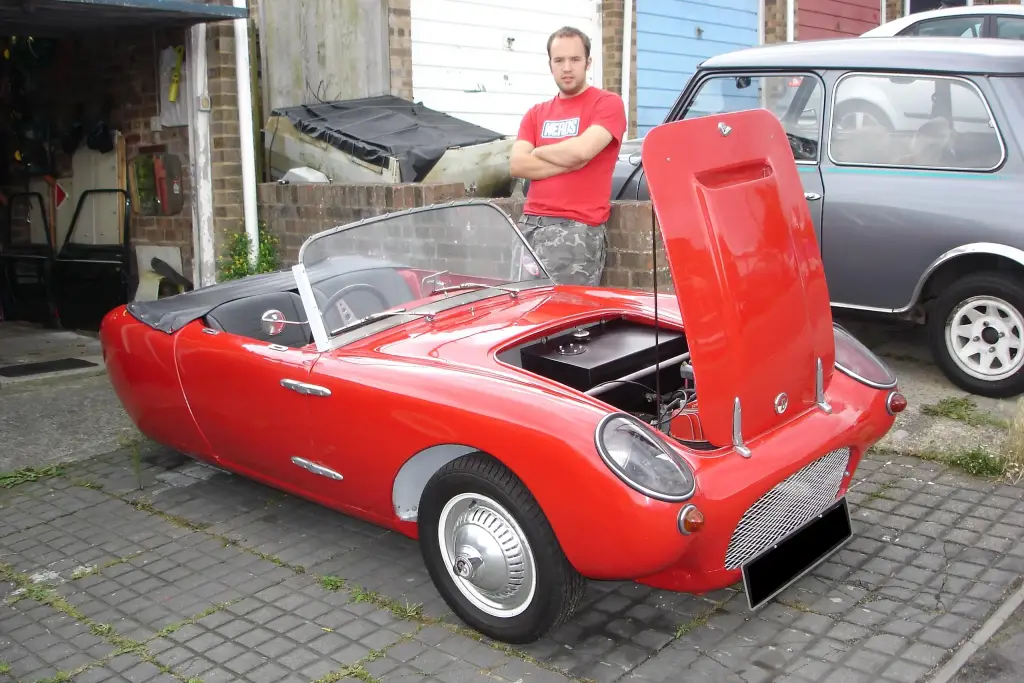
Berkeley T60 versions
- T60 roadster: the open version with a fabric roof.
- T60 coupé: the same car with a fixed roof.
- Later T60: individual seats, steel-reinforced floor and pistol-grip handbrake in place of the early bench and umbrella handle.
- T60/4: the 2+2 of October 1960, with a longer rear body and a bench for two children.
The T60 used the engine of the four-wheeled Berkeley Sports, and the later Berkeley B65 was built beside it in 1960. More cars are in the Berkeley collection.
Video: Berkeley T60
Video on YouTube.
Sources
- Berkeley T60, German Wikipedia: production, layout, equipment, T60/4, numbers
- Berkeley Cars, English Wikipedia: company history, closure