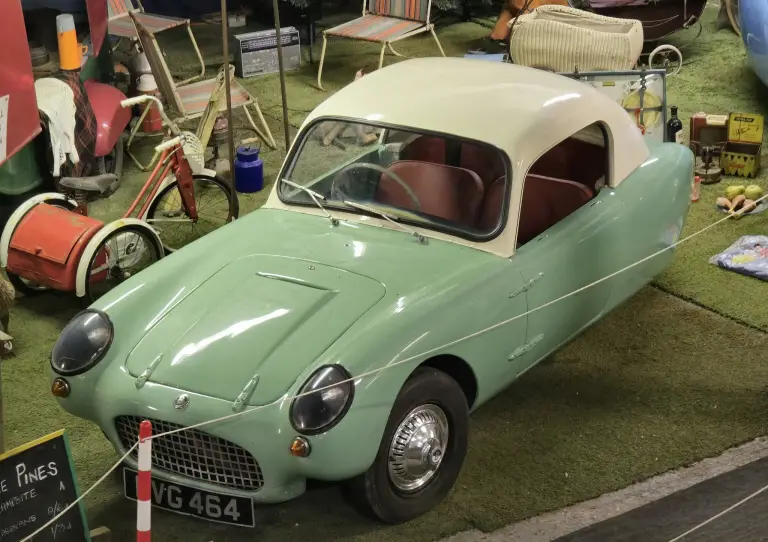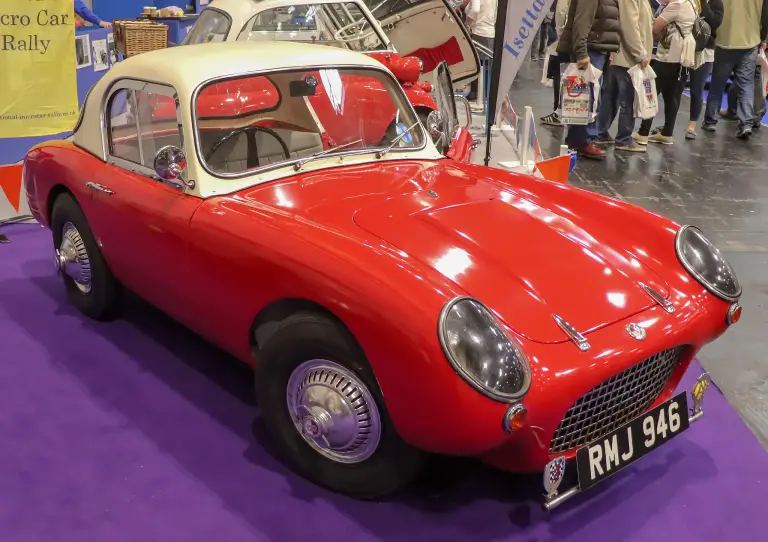
The Berkeley B65 was a mini sports car that the British firm Berkeley Cars built from September to December 1960. It was meant to stand beside the three-wheeled T60 and the larger B95 and B105, and it combined the three-part glassfibre body of the B90 with a small two-stroke engine. Fewer than twenty were made before car production at Biggleswade ended.
Berkeley B65 at a glance
| Maker | Berkeley Cars Ltd, Biggleswade, Bedfordshire |
|---|---|
| Production | September–December 1960 |
| Class | mini sports car |
| Body | three-part glass-reinforced plastic, B90 pattern |
| Engine | Excelsior two-cylinder two-stroke |
| Displacement | 328 cm³ |
| Bore × stroke | 58 mm × 62 mm |
| Power | 18 bhp (13.2 kW) at 5,000 rpm |
| Engine intended for the body | three-cylinder two-stroke |
| Built | fewer than 20 |
| Company production | 1956–1960, about 4,100 cars |
The B65 itself is described in one source, the German Wikipedia article; the company history comes from the English Wikipedia article on Berkeley Cars, so the model’s details rest on a single source.
History of the Berkeley B65
A body intended for another engine
The B65 was prepared in 1960 to stand beside two other models: the three-wheeled T60 and the larger B95 and B105. For it Berkeley took the three-part glassfibre body of the B90, a shell designed around a three-cylinder two-stroke engine. The car was completed with the older Excelsior two-cylinder unit of 328 cm³, with a bore and stroke of 58 by 62 mm, which gave 18 bhp (13.2 kW) at 5,000 rpm — the same output as in the model it followed.
Four months and fewer than twenty cars
Production ran from September to December 1960 and fewer than twenty B65s were completed. The model therefore never became a series car: it arrived at the very end of the British microcar boom, when the Mini and the Austin-Healey Sprite had already taken the market Berkeley had helped to create.
The end of Berkeley Cars
Berkeley Cars Ltd was based in Biggleswade, Bedfordshire, and between 1956 and 1960 built economical sporting microcars with motorcycle-derived engines from 322 to 692 cm³ and front-wheel drive. The company had grown out of Berkeley Coachworks, one of the largest caravan manufacturers in Europe, and used its experience with glass-reinforced plastic to make frameless bodies. About 4,100 cars of all types had been sold when the collapse of the caravan market at the end of 1960 caused cash-flow problems, and the firm went into liquidation on 12 December 1960. An attempt to sell the company to Sharp’s Commercials, maker of the Bond Minicar, came to nothing, and the assets were liquidated in 1961. The factory was later used by Kayser Bondor to make women’s underwear, was demolished in 2002 and the site was turned over to housing; a road called Berkeley Close is the only obvious link to the works. The Berkeley Enthusiasts’ Club now supplies parts for the few hundred surviving cars.
Design and features
- B90 body: the three-part glassfibre shell designed for a three-cylinder engine, fitted here with a two-cylinder unit.
- Excelsior 328 cm³: the air-cooled two-stroke already proven in the Sports SE328, with 18 bhp at 5,000 rpm.
- Extreme rarity: fewer than twenty cars in four months of production, which makes the B65 one of the rarest Berkeleys.
- End of the line: built only in the last months before the company went into liquidation in December 1960.
Berkeley B65 versions
- B65 (1960): the only version, with the B90 body and the 328 cm³ Excelsior engine.
- B90: the model whose three-part body the B65 used; that shell had been laid out around a three-cylinder two-stroke.
- T60, B95 and B105: the stablemates the B65 was meant to stand beside in the 1960 range.
The B65 shared its engine with the Berkeley Sports and was sold alongside the three-wheeled Berkeley T60. More cars are in the Berkeley collection.
Sources
- Berkeley B65, German Wikipedia: production dates, body, engine, numbers
- Berkeley Cars, English Wikipedia: company history, closure, survival