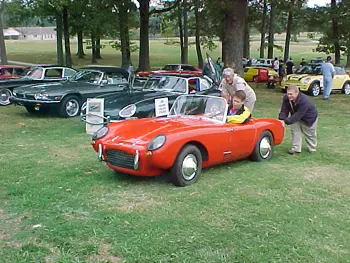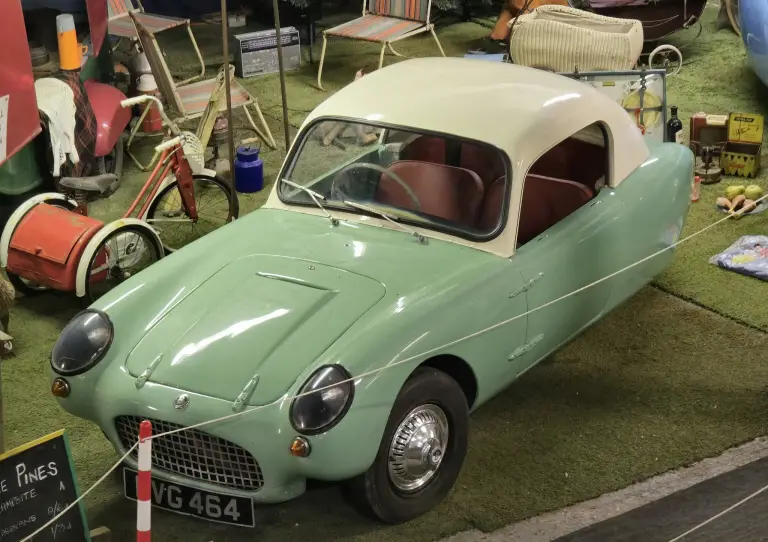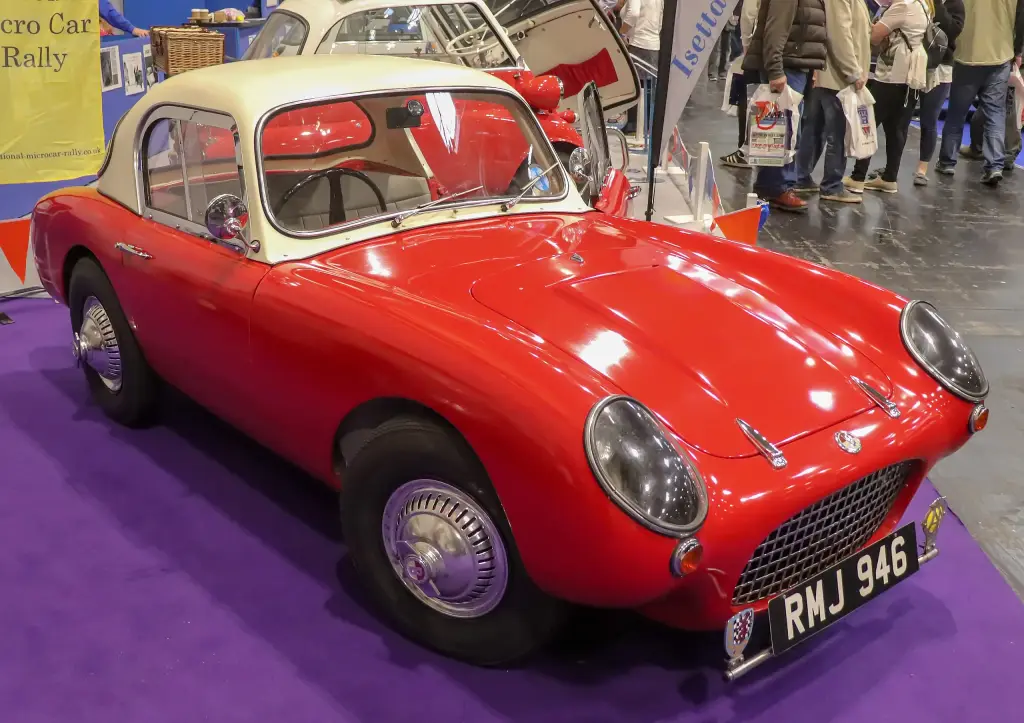
The Berkeley Sports was the first car built by Berkeley Cars of Biggleswade: a two-seat roadster with a body of glass-reinforced plastic and a small motorcycle-derived two-stroke engine driving the front wheels. Announced in September 1956 and built until April 1958 in two series, it was one of the first British cars with a frameless glassfibre body.
Berkeley Sports at a glance
| Maker | Berkeley Cars Ltd, Biggleswade, Bedfordshire |
|---|---|
| Production | October 1956–April 1958 |
| Body | two-seat roadster, glass-reinforced plastic in three mouldings |
| SA322 engine | British Anzani two-cylinder two-stroke, 322 cm³ |
| SE328 engine | Excelsior two-cylinder two-stroke, 328 cm³ |
| Power | 15 bhp (SA322), 18 bhp (SE328) |
| Drive | front-wheel drive |
| Gearbox | three-speed, column change at first |
| Suspension | all-round independent, coil springs |
| Brakes | Girling hydraulic drums, 178 mm |
| Weight | 274 kg (SA322) |
| Built | 163 SA322 and 1,259 SE328 |
This page is based on the English Wikipedia article on Berkeley Cars and the German Wikipedia article on the Sports.
History of the Berkeley Sports
A caravan maker looks for winter work
Berkeley Cars Ltd, based in Biggleswade in Bedfordshire, produced economical sporting microcars with motorcycle-derived engines from 322 to 692 cm³ and front-wheel drive between 1956 and 1960, selling about 4,100 cars before bankruptcy in 1960. The car was a collaboration between the designer Lawrence “Lawrie” Bond and the Berkeley Coachworks factory of Charles Panter, at the time one of the largest caravan manufacturers in Europe. The works had built up considerable skill with glass-reinforced plastic and was looking for work to fill the gaps in the very seasonal caravan market. What Panter and Bond wanted, in their own words, was “something good enough to win World 750cc races… but cheap, safe, easily repairable and pretty.”
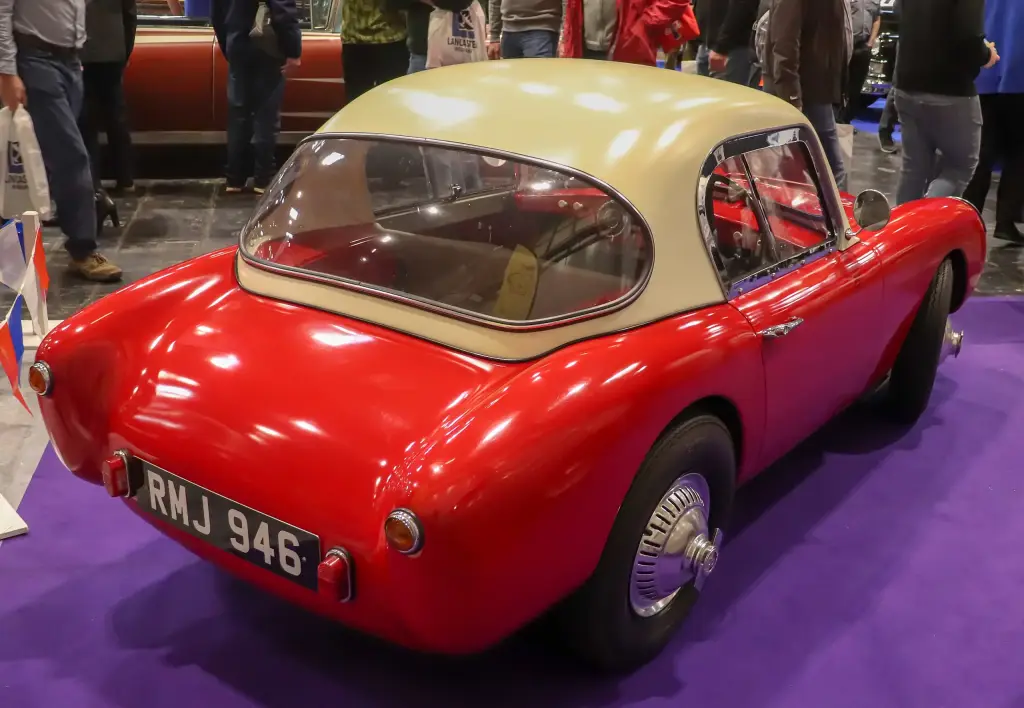
The SA322
The first production car, the Sports SA322, was announced in September 1956 and built from October 1956 to January 1957. Two prototypes, registered RMJ395 and RMJ946, were seen testing around Biggleswade in the late summer of 1956; Stirling Moss drove one at Goodwood in September, and the car was shown to the public at the 1956 London Motor Show, a year before the Lotus Elite, which was also of glassfibre monocoque construction. Bond’s two-seater open tourer consisted of three large mouldings — floor or “punt”, nose and tail — with no conventional chassis, and the front edges of the doors slanted forward so that they hinged upwards and then closed by themselves. A hatch behind the front seat revealed a compartment for the spare wheel and luggage that could double as a basic seat for a small child, and equipment was so basic that the fuel gauge was an optional extra. Power came from a transversely mounted British Anzani twin of 322 cm³ giving 15 bhp, with a chain and a three-speed gearbox to the front wheels. The engine had already been used by Cotton and Greeves, but in the Berkeley it received a Siba Dynastart for battery charging and electric starting, and it was an advanced two-stroke with a rotary inlet valve in the centre of the crankshaft. The gearbox was an Albion HJR5 with a steering-column gearchange. All-round independent coil-spring suspension, a kerb weight of 605 lb (274 kg) and Girling hydraulic drum brakes of 7 in gave good performance and excellent roadholding. 163 cars were built.
The SE328
After 163 SA322s, Berkeley switched to the SE328 with a 328 cm³ Excelsior engine of 18 bhp; production ran from January 1957 to April 1958, with chassis numbers from 164 to 1422. Many cars went to the United States, where they sold for about $1,600, and the maker advertised the number 70 — 70 mph and 70 mpg. Export cars had separate headlamps to meet American lighting rules, while home-market cars had the lamps faired into the wings. Until about June 1957 the cars kept the column gearchange, and a Deluxe version offered polished wheel trims and spinners, a tachometer and twin carburettors. Motor tested a 328 cc car in 1957 and recorded a top speed of 62.1 mph (99.9 km/h). 1,259 SE328s were built before the model gave way to the more powerful B90 Twosome.
Racing
The SE328 was relatively successful in small-class racing and received a good deal of press coverage. Pat Moss drove a Berkeley Sports SE328 in the 1958 Liège–Brescia–Liège rally in the 350 cm³ class: the Berkeley team of six works cars led until Slovenia, but the cars’ poor climbing ability in the summer heat showed their weakness, Pat Moss’s car had to be towed to Italy by another Berkeley, and none of the works cars finished.
Design and features
- Frameless glassfibre body: three large mouldings and no conventional chassis, a year before the Lotus Elite.
- Self-closing doors: the front edges slanted forward so that the doors hinged upwards and dropped shut by themselves.
- Motorcycle engines: a 322 cm³ Anzani with a rotary valve, then a 328 cm³ Excelsior with piston-port timing.
- Very light: 274 kg with all-round independent suspension and a top speed of about 62 mph in Motor’s 1957 test.
- Spartan equipment: the fuel gauge cost extra, but a hatch behind the seats could carry luggage or seat a child.
Berkeley Sports versions
- SA322 (1956–1957): the Anzani-engined first series, 163 built.
- SE328 (1957–1958): the Excelsior-engined second series, 1,259 built.
- SE328 Deluxe: polished wheel trims and spinners, tachometer and twin carburettors.
- Export SE328: separate headlamps for the United States in place of the faired-in home-market lamps.
The Sports was followed by the three-wheeled Berkeley T60 and by the short-lived Berkeley B65. More cars are in the Berkeley collection.
Sources
- Berkeley Cars, English Wikipedia: SA322 and SE328, engine, test figures, racing
- Berkeley Sports, German Wikipedia: body, engines, production numbers, rally history