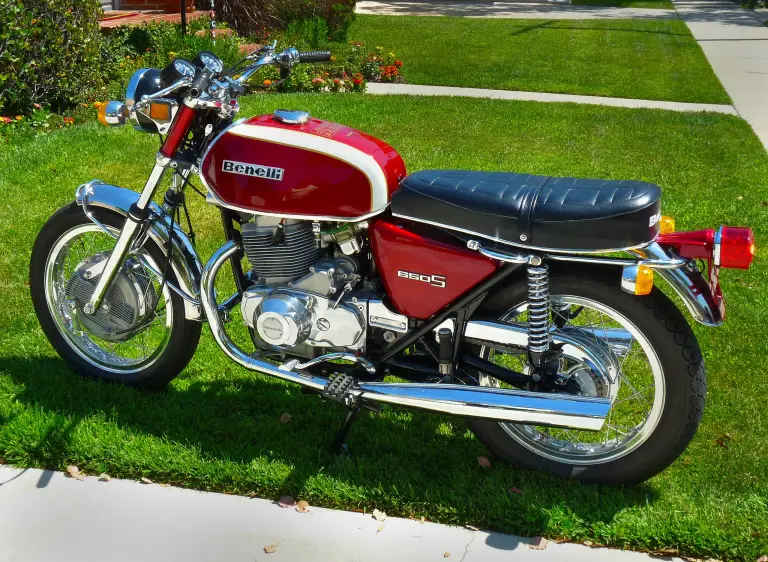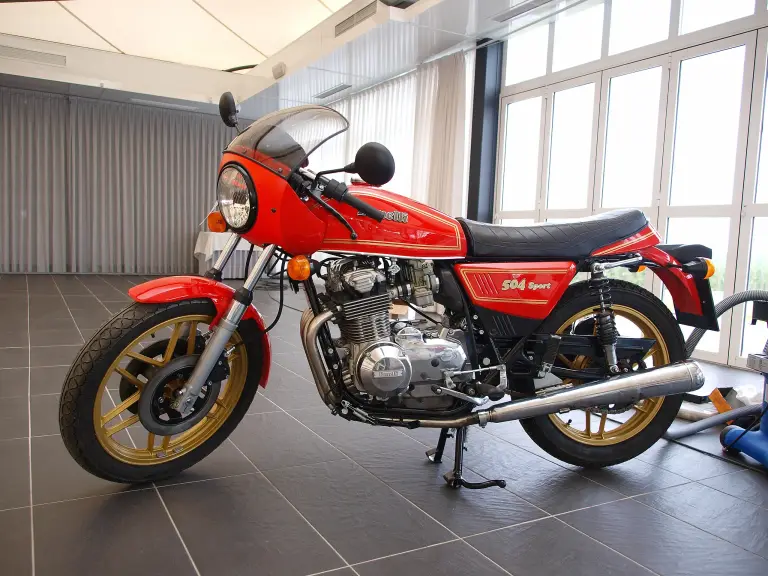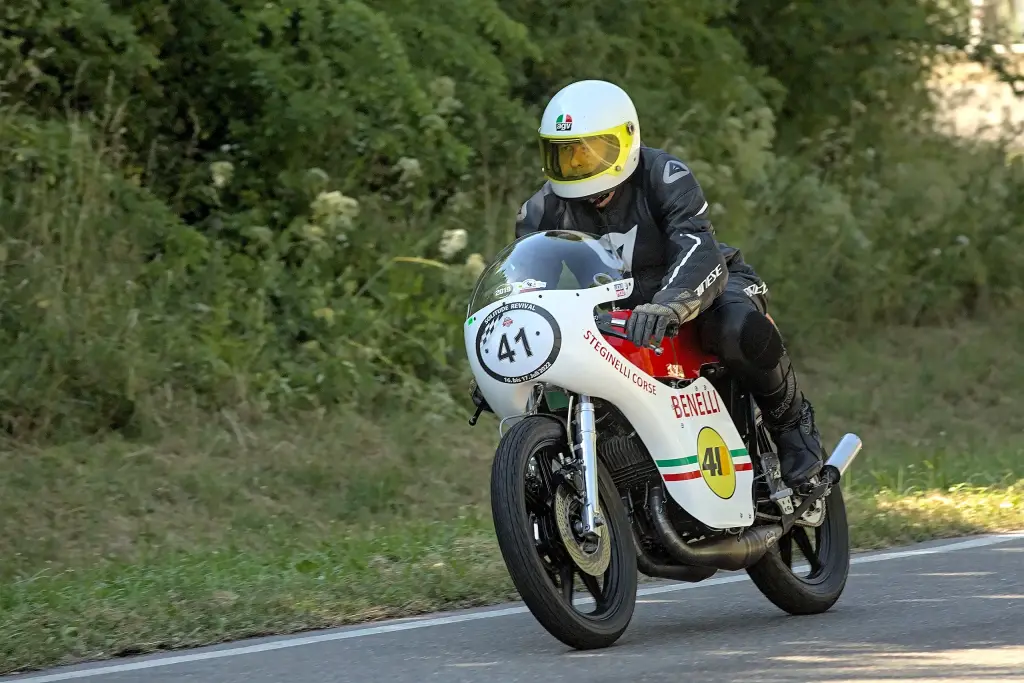
The Benelli 250 2C was a 250 cc two-stroke twin designed by Peter Dürr and sold from 1972 to 1986. Although its 231 cc engine was down on power compared with Japanese 250s, the bike was about 20 kg lighter and handled better; it also appeared as the MotoBi and, with a more upmarket specification, as the Moto Guzzi 250 TS.
Benelli 250 2C at a glance
| Maker | Benelli, Pesaro (Italy) |
|---|---|
| Production | 1972–1986 |
| Also sold as | MotoBi 250 2C, Moto Guzzi 250 TS, Benelli Phantom (USA) |
| Engine | 180° two-stroke twin, air-cooled, alloy head, cast-iron barrels |
| Capacity | 231 cc (marketed as 250) |
| Bore and stroke | 54 × 47 mm |
| Claimed power | 24 hp at 7,500 rpm; 30 hp for the Moto Guzzi 250 TS |
| Carburettors | twin 22 mm Dell’Orto; 25 mm on the TS |
| Gearbox | five-speed, chain final drive |
| Front brake | Grimeca double-sided drum; Brembo disc from 1976 |
| Top speed | 143 km/h |
| Built | 27,000, of which 12,000 Moto Guzzi |
History of the Benelli 250 2C
Peter Dürr’s twin
Peter Dürr joined Benelli from Aermacchi in 1969 and began work on new 125 and 250 cc two-stroke twins, influenced by the Suzuki and Yamaha 250s. The twins were seen testing around the Pesaro factory in 1971. The 250 was unveiled at the 1972 Milan motorcycle show and went on sale in early 1973. Although it was down on power next to the Japanese bikes, it weighed about 20 kg less and handled much better.
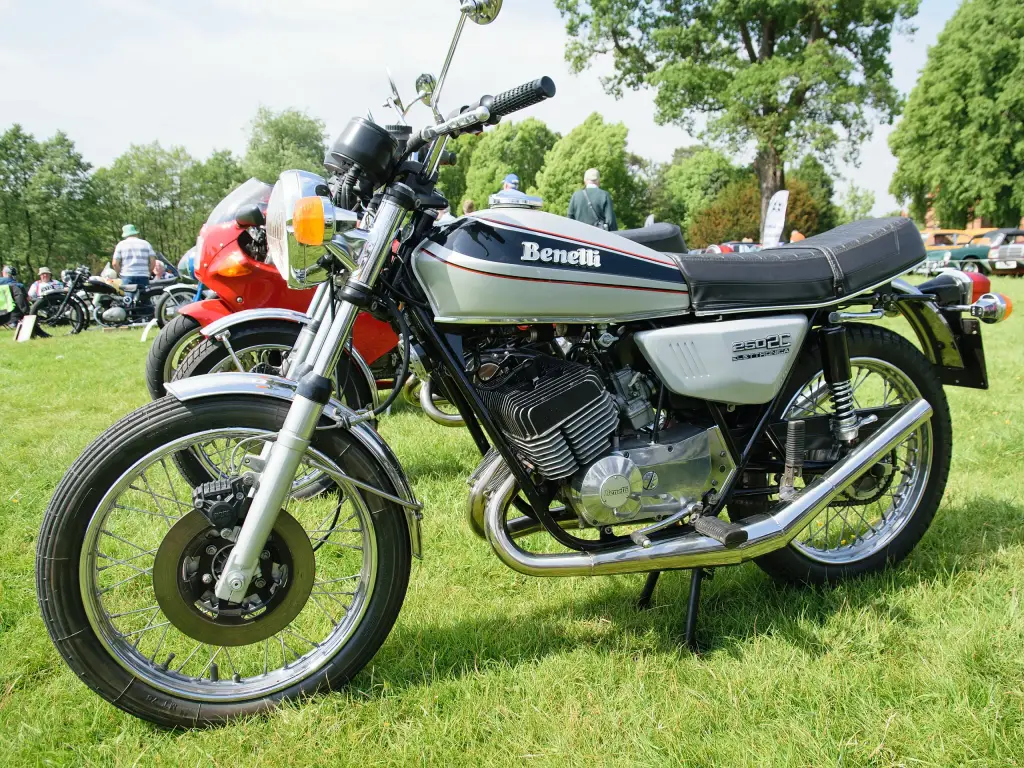
Much of the running gear was bought in: the frame was made by Benelli Armi, the forks, yokes and rear suspension units came from Marzocchi, the brakes from Grimeca, the silencers from Silentium and the wiring and switchgear from Aprilia. CDI ignition was offered as an extra and bikes fitted with it were designated 2CE.
De Tomaso and the Moto Guzzi 250 TS
The Argentine industrialist Alejandro de Tomaso acquired Benelli in September 1971 and Moto Guzzi in late 1972, then merged the two companies. A Moto Guzzi version of the 250, the 250 TS, appeared in 1974 with alloy cylinders and chrome-plated bores, larger 25 mm Dell’Orto carburettors and 30 hp at 8,000 rpm against 24 hp at 7,500 rpm for the Benelli. It also had a larger tank and side panels taken from the Guzzi v-twins.
Updates and sales
CDI became standard in 1975, with Elettronica added to the model name. In 1976 a single Brembo front disc replaced the double-sided drum, and these bikes are sometimes called Mark 2. A cafe racer version arrived in the early 1980s with three-spoke cast wheels, triple discs and a combined tank and seat unit.
Sales outside Italy and Spain were poor, possibly because of the lack of oil injection and the value of the lira. In Italy the import of Japanese motorcycles under 350 cc was prohibited after lobbying by de Tomaso, so the 2C sold well; in Spain, where Japanese imports were also restricted, it competed successfully with the Spanish singles. In Britain the importer handed back the franchise after electrical problems and failures of the left-hand big end, and in the United States the bike was marketed as the Benelli Phantom. Production of the 2C ended in 1986, when Guzzi Benelli Moto SpA was formed and the Pesaro factory was sold; the English article gives 1988 as the final year.
Design and features
- Light weight: about 20 kg less than the Japanese 250s of the period.
- Handling: duplex-cradle frame with Marzocchi forks and shocks.
- Two-stroke twin: 180° crank, 24 hp, five-speed gearbox with the change on the left.
- Brake development: a double-sided drum at first, then a Brembo disc from 1976.
- Badge engineering: sold as MotoBi, Moto Guzzi 250 TS and, in America, Benelli Phantom.
Benelli 250 2C versions
- 250 2C (1973–1986): standard model with cast-iron barrels and drum brake.
- 2CE: factory option with CDI ignition.
- Mark 2 (1976 onwards): single Brembo front disc.
- Moto Guzzi 250 TS (1974–1981): alloy cylinders, 25 mm carburettors, 30 hp.
- Cafe racer (early 1980s): cast wheels, triple discs, one-piece tank and seat.
The smaller 125 2C used the same design, and the four-cylinder models of the same era are covered in the 354 article. More Benelli models are in the Benelli collection.
Sources
- Benelli 250 2C, English Wikipedia: design, updates, sales, technical details
- Benelli 2C, Italian Wikipedia: 250 section, prices, performance
- Benelli, English Wikipedia: company background