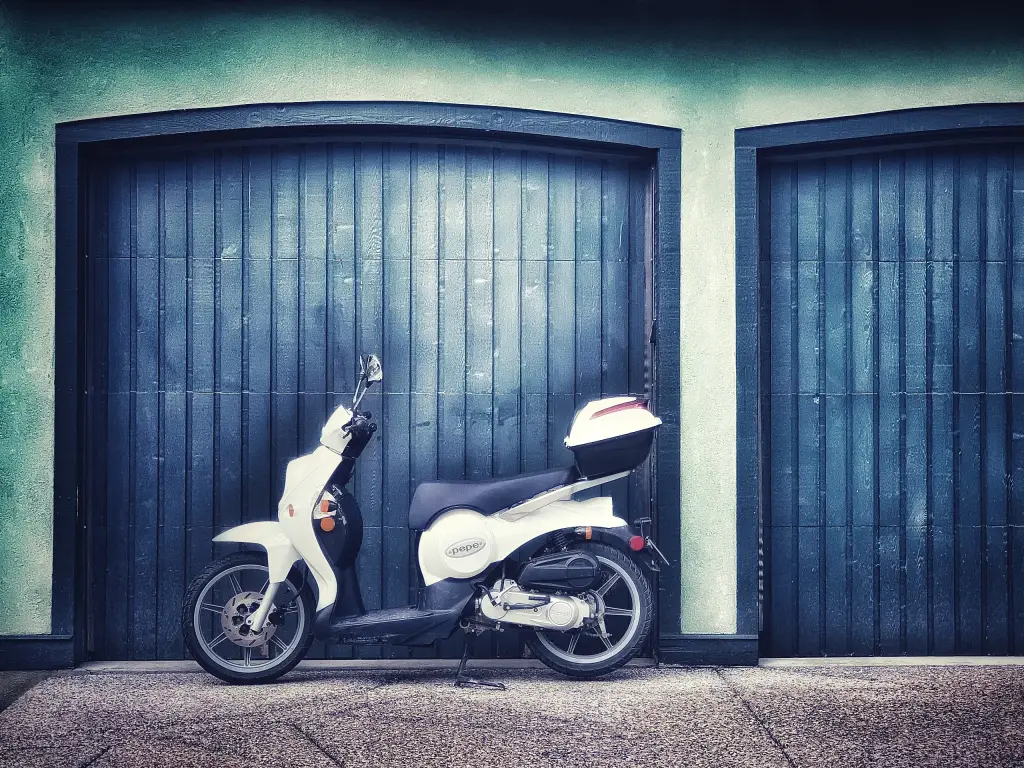
The Benelli Pepe was the company’s first high-wheeled 50 cc scooter, launched in 1998 and kept in production, with interruptions and facelifts, until 2015. Its simple two-piece bodywork and 16-inch wheels made it cheap to build and easy to ride, and it was also sold as the Renault Specimen.
Benelli Pepe at a glance
| Maker | Benelli, Pesaro (Italy) |
|---|---|
| Production | 1998–2015, with a break in 2003–2005 |
| Also sold as | Renault Specimen; Benelli Andretti M50 in the USA |
| Engine | 49 cc single-cylinder two-stroke, air-cooled, by Minarelli |
| Frame | monorail with double rear cradle |
| Wheels | 16-inch |
| Front brake | 220 mm disc |
| Rear brake | 110 mm drum |
| Tank | 7.5 litres |
| Seating | single-seater in Italy; two-seater abroad |
| Later engines | 100 cc two-stroke (2001); 50 cc four-stroke (2012); 125 cc (2015) |
History of the Benelli Pepe
A cheap high-wheeler
The Pepe went into production in June 1998 as Benelli’s first high-wheeled 50 cc scooter. Its rounded design, circular headlight set into the front panel and two-tone bodywork were aimed at young buyers. It was designed to lower production costs: the body is made in two single pieces, most components are polypropylene and the front is ABS, while the handlebar bridge is a simple chrome tube attached to the frame at the top of the front shield. The instrumentation was sparse, without a fuel gauge but with a reserve warning light, and the tank holds 7.5 litres.
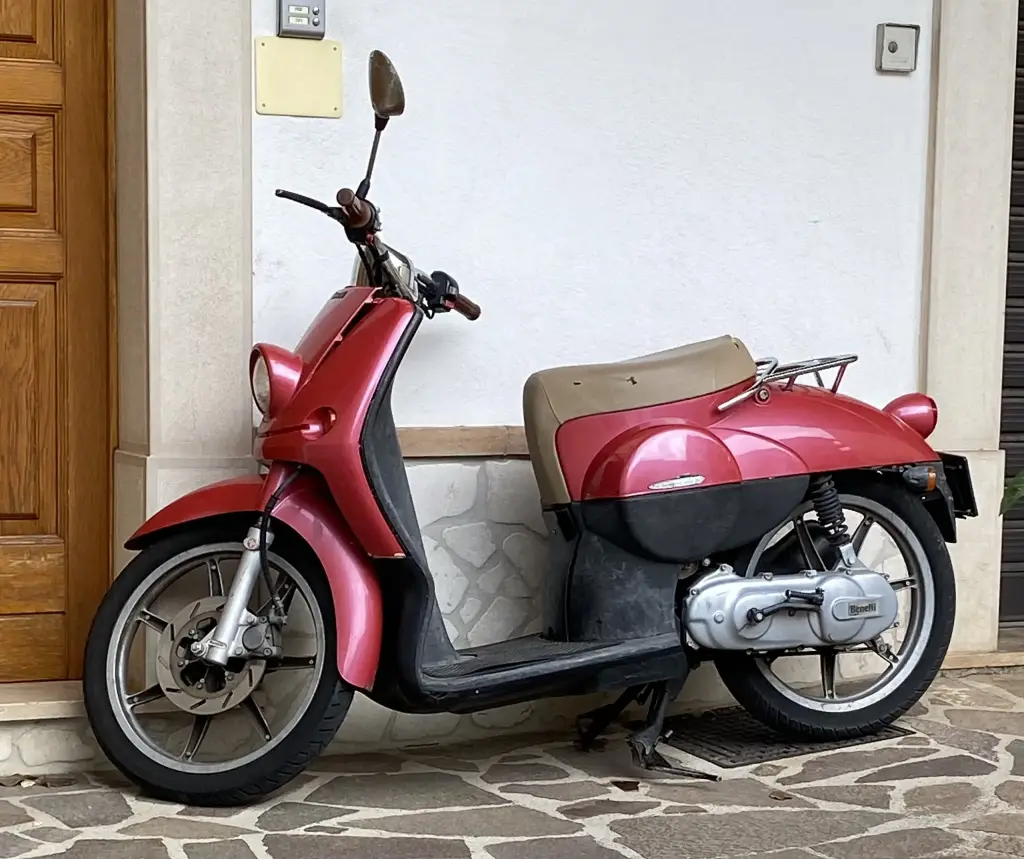
The 49 cc engine was a Minarelli air-cooled two-stroke. The monorail frame has a double rear cradle and 16-inch wheels, and braking is by a 220 mm front disc and a 110 mm rear drum. At its Italian debut the Pepe was a single-seater, while abroad a two-seater version with a longer saddle and passenger footrests was homologated.
Pepe LX and Renault
In September 2001 the first facelift arrived and the range became the Pepe LX, with renewed plastics and a more elegant look; a new 100 cc engine joined the 50, and both were Euro 1. A two-seat saddle became optional on the 50 in Italy. From 2002 an agreement with Renault meant the Pepe was also sold as the Renault Specimen, identical apart from the badge on the shield and side panel.
Production stopped in 2003 because of financial difficulties. After the Qianjiang Motorcycle group bought Benelli at the end of 2005, production restarted in Pesaro with a 2006 range of the 50 base and 50 LX in Euro 2 form; the 100 was not relaunched because of low sales, while the Renault version continued through the French company’s network. In 2007 the range gained the Classic, which was simply the pre-facelift 1998 model put back into production.
Four-stroke and the end
A new facelift of the Pepe 50 replaced the LX in May 2010, while the Classic stayed. In November 2011, at the Milan show held for Benelli’s centenary, a 50 cc four-stroke version was presented and went on sale in March 2012 alongside the two-stroke. At EICMA 2014 the 2015 range was shown with 50 cc four-strokes and, for the first time, a 125 cc version; the old 50 cc two-stroke left the range. Production ended in 2015 as Benelli withdrew from scooters to concentrate on motorcycles.
Design and features
- High wheels: 16-inch wheels for stability on poor roads.
- Cheap construction: two-piece bodywork, polypropylene panels and an ABS front.
- Minarelli two-stroke: a simple air-cooled 49 cc engine.
- Long life: facelifts in 2001 and 2010, plus Classic and four-stroke versions.
Benelli Pepe versions
- Pepe 50 (1998): the original single-seater with a two-stroke engine.
- Pepe LX (2001): new plastics, optional 100 cc engine, Euro 1.
- Pepe Classic (2007): the pre-facelift bodywork back in production.
- Pepe 50 four-stroke (2012): four-stroke engine alongside the two-stroke.
- Pepe 125 (2015): the final range added a 125 cc version.
Benelli’s larger scooter is described in the Velvet article, and the later 50 cc sporty model in the 49X article. More Benelli models are in the Benelli collection.
Video: Benelli Pepe.mov
Video on YouTube.
Sources
- Benelli Pepe, English Wikipedia: history, facelifts, Renault version
- Benelli Pepe, Italian Wikipedia: technical details, Italian market