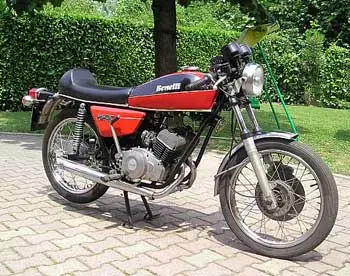
The Benelli 125 2C was the smaller of the two-stroke twins that Peter Dürr designed for the Pesaro factory. It shared the layout and running gear of the 250 2C but used a smaller-capacity twin, and it stayed in production through several updates until the mid-1980s.
Benelli 125 2C at a glance
| Maker | Benelli, Pesaro (Italy) |
|---|---|
| Production | 1972–1986 (125 versions) |
| Engine | two-stroke twin, air-cooled |
| Fuel | pre-mix, 5% oil; 3% from the 1976 SE |
| Tank | 12.5 litres |
| Claimed power | 15.4 hp at 7,750 rpm; 17 hp in the 1976 SE |
| Top speed | 116 km/h; 117 km/h SE; 135 km/h Sport |
| Front brake | drum; 260 mm disc from 1975 |
| Front suspension | Marzocchi telescopic forks |
| Price at launch | 420,000 lire (1972) |
| Main markets | Italy and Spain |
The 125 2C has no article of its own: it is described in the Italian Wikipedia article on the 2C family, and the English article on the 250 2C gives the shared design background.
History of the Benelli 125 2C
A smaller 2C
The German two-stroke specialist Peter Dürr joined Benelli from Aermacchi in 1969 and began designing new 125 and 250 cc two-stroke twins, influenced by the Suzuki and Yamaha 250s. The twins were seen testing around the Pesaro factory in 1971. The 125 was presented at the Milan motorcycle show in 1971 and went on sale in 1972 at 420,000 lire.
The little Benelli had a 12.5-litre tank and cast-iron barrels, and although the frame was prepared for an oil mixer the production bike relied on pre-mix lubrication at 5%, which made it notably smoky. Its claimed top speed was 116 km/h, high for a 125 of the period. As on the 250, the frame came from Benelli Armi, the forks from Marzocchi, the brakes from Grimeca, the silencers from Silentium and the switchgear from Aprilia.
1974 and 1975 updates
In 1974 the 125 received electronic ignition in place of points, Aprilia indicators and a larger rear light on a black support. A year later came bigger changes: a 260 mm front disc brake, a stronger Guzzi-built fork, new footrests fixed to the frame, a redesigned rear brake lever and more modern switchgear. The choke lever on the handlebar disappeared in favour of knobs on the carburettors, and the seat became wider and more comfortable.
SE, Sport and the end
The 1976 model was called SE, for Seconda Edizione. Its main change was a switch from cast-iron barrels to light-alloy cylinders with chrome-plated bores, which allowed the oil content of the mixture to fall to 3%. Power rose from 15.4 hp at 7,750 rpm to 17 hp at 8,100 rpm, weight fell by about seven kilograms, top speed reached 117 km/h and acceleration over 400 metres improved. The SE cost 968,800 lire and stayed in production until 1979, when it was the quickest standard 125 on the Italian market.
The 125 Sport of 1979–1986 added a fairing, twelve-spoke cast wheels, revised instruments and black indicators, with 18 hp and a claimed 135 km/h. There were also a Custom with a high windscreen, raised handlebars and leg guards (1979–1985) and a Turismo with the front disc moved to the right side (1981–1985). Sales were strong in Italy and Spain, where imports of small Japanese motorcycles were restricted, but weak elsewhere; in Britain the importer gave up the franchise after electrical faults and failures of the left-hand big end.
Design and features
- Pre-mix lubrication: no oil injection; the 5% mixture fell to 3% with the SE’s chrome-lined alloy barrels.
- Steady development: electronic ignition, indicators and a 260 mm disc brake arrived between 1974 and 1975.
- Light and quick: 116–117 km/h from a small twin, and the fastest 125 in its class in the late 1970s.
- Sport version: fairing, twelve-spoke cast wheels and 18 hp.
Benelli 125 2C versions
- 125 2C (1972–1975): base model with cast-iron barrels and a drum front brake.
- 125 SE (1976–1979): Seconda Edizione, alloy cylinders, 17 hp.
- 125 Sport (1979–1986): fairing, cast wheels, 18 hp, 135 km/h.
- 125 Custom (1979–1985): high windscreen, raised handlebar, leg guards.
- 125 Turismo/T (1981–1985): front disc on the right, two-piston caliper.
The 125 2C shared its design with the larger 250 2C, and its four-cylinder relatives are described in the 354 article. More Benelli models are in the Benelli collection.
Sources
- Benelli 250 2C, English Wikipedia: shared design, components, sales
- Benelli 2C, Italian Wikipedia: 125 versions, prices, updates
- Benelli, English Wikipedia: company background