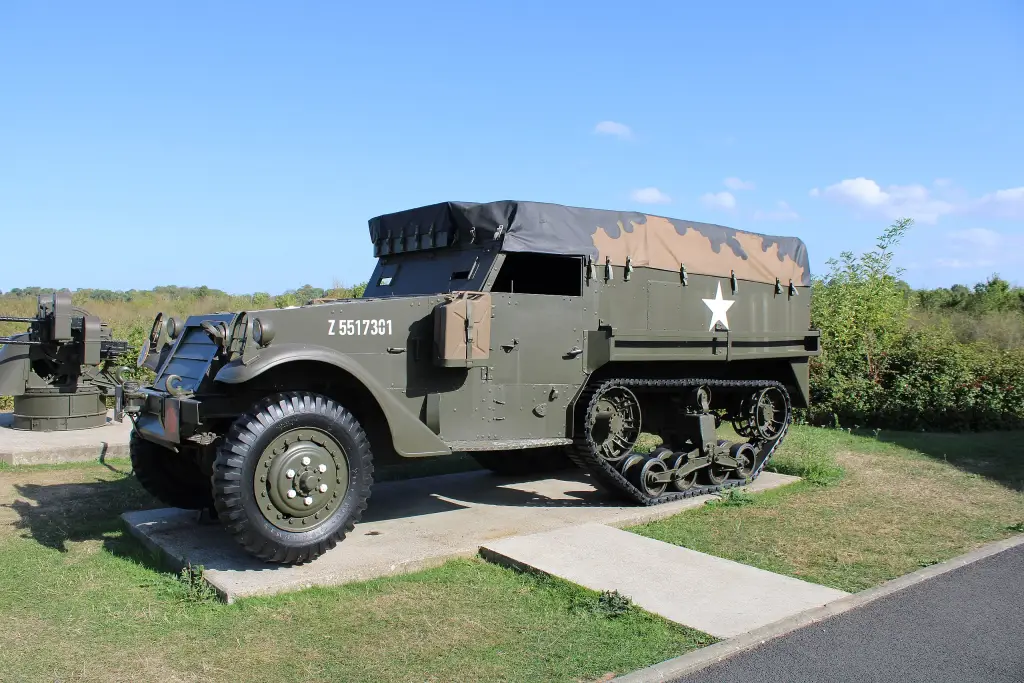
The M3 half-track is an American armoured personnel carrier half-track widely used by the Allies during the Second World War and in the Cold War. Derived from the M2 half-track car, it was built by the Autocar Company, the Diamond T Motor Company and the White Motor Company.
M3 half-track at a glance
| Type | armoured personnel carrier half-track |
|---|---|
| Standardized | 1940 |
| Builders | Autocar, Diamond T and White |
| Crew and load | one driver and a squad of 12 soldiers |
| Length / width / height | 6.17 m / 2.22 m / 2.26 m (20 ft 3 in / 7 ft 3.5 in / 7 ft 5 in) |
| Weight | 8.01 t (M3) or 8.36 t (M3A1) gross |
| Engine | White 160AX six-cylinder petrol, 6,330 cc, 148 hp (110 kW) |
| Gearbox | manual, four forward and one reverse, two-speed transfer case |
| Range | 220 miles (350 km) on a 60 US gallon tank |
| Armour | 6–12 mm |
| Production | about 15,000 standard M3s; nearly 54,000 with variants |
History of the M3 half-track
Development of an armoured half-track began with an Ordnance directive to convert an M3 Scout Car into a half-track. The prototype, the T7, built at Rock Island Arsenal with help from White, failed tests at Aberdeen Proving Ground in 1938 because of its front-wheel drive and was turned back into a scout car. Through 1939 and 1940 the Army developed the M2 half-track car, and the M3 was a larger version with a rear door and five more seats. After tests at Aberdeen in the summer of 1941 it was accepted into service.
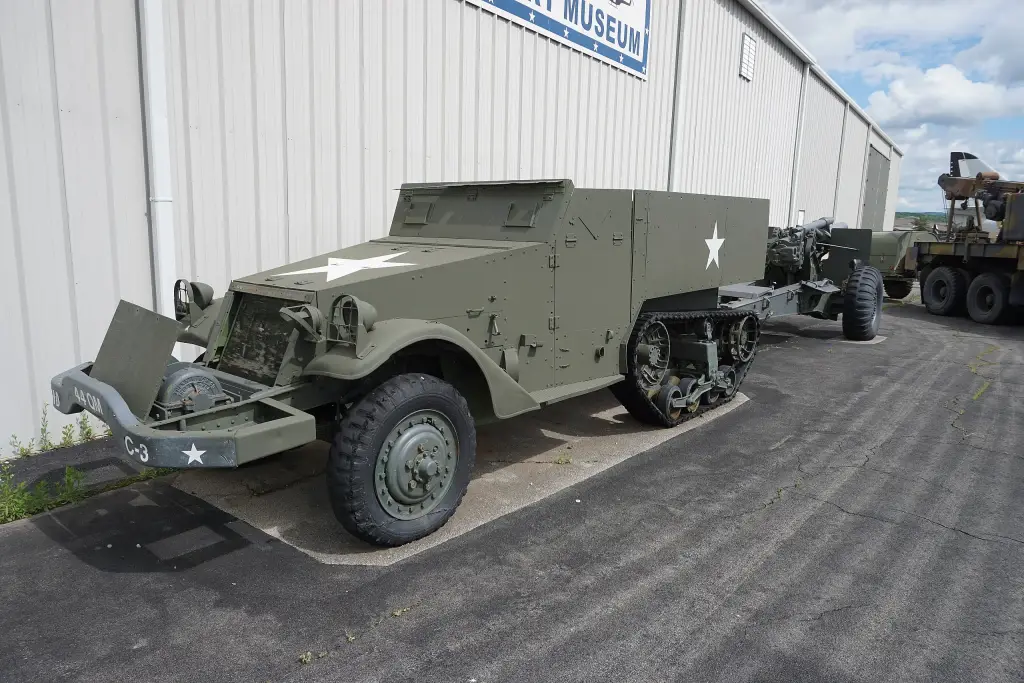
The M3 was meant for armoured infantry regiments and was quickly used with the Provisional Tank Group when Japan invaded the Philippines; early mechanical faults were corrected after field reports. Its first use in the intended role came in Operation Torch, and it later served in Sicily, Italy and Operation Overlord. American troops first nicknamed the half-tracks “Purple Heart boxes”, complaining that there was no overhead protection and that the armour was weak against machine guns. General Omar Bradley wrote that its bad name came from troops using it for too many things.
The design used many commercial components to improve reliability and speed of production. The tracks were molded rubber over steel cabling, which made repairs difficult, and the vehicle had a wide turning radius and no power steering. Total output of the M3 and its variants ran to nearly 54,000 vehicles, and International Harvester built the near-identical M5 half-track for Lend-Lease.
Design and features
- Armament: early vehicles carried a pintle-mounted .50-calibre M2 Browning behind the front seats; the M3A1 added a raised ring “pulpit” mount over the passenger seat and mounts for .30-calibre guns.
- Protection: fully armoured body with an adjustable shutter for the radiator and bulletproof panels with vision slits.
- Mobility: leaf-sprung front wheels and volute-sprung rear bogies on rubber tracks.
- Stowage: rifles in brackets behind the seats, ammunition and rations below; racks for land mines were added in 1942.
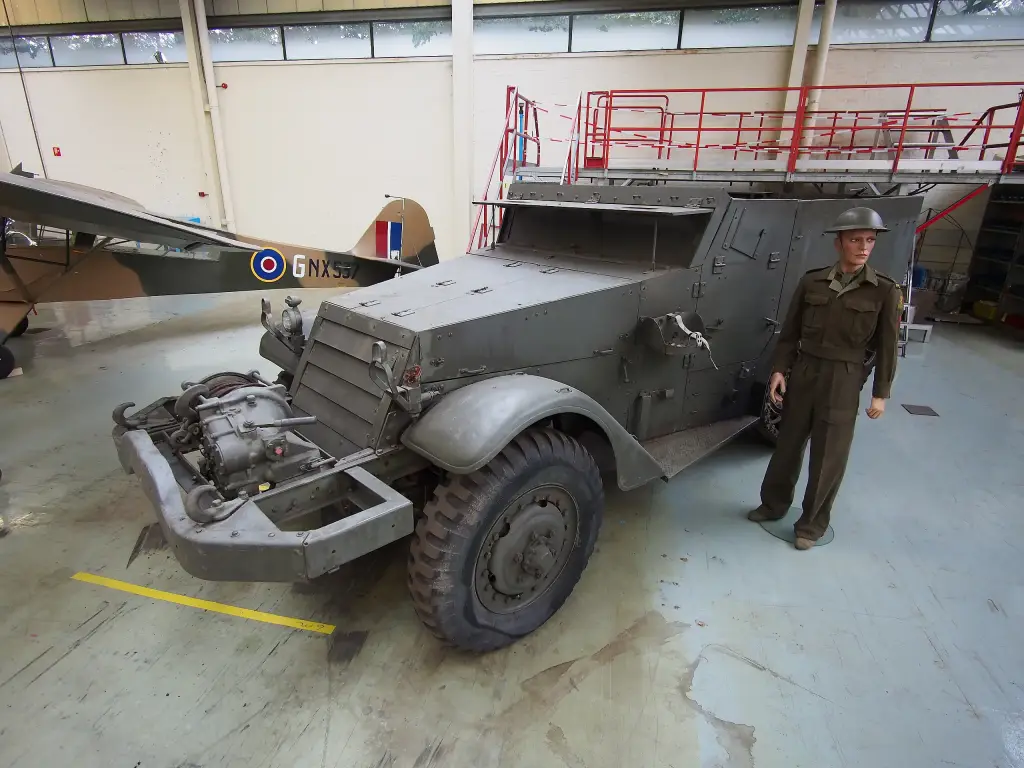
M3 half-track versions
- M3 and M3A1: White and Autocar half-track; the A1 added the M49 ring mount, and many M3s were converted.
- M5 and M5A1: International Harvester version with a 450 cu in (7,400 cc) engine and a welded body, mainly for Lend-Lease.
- M3A2 and M5A2: a planned common vehicle that was never built.
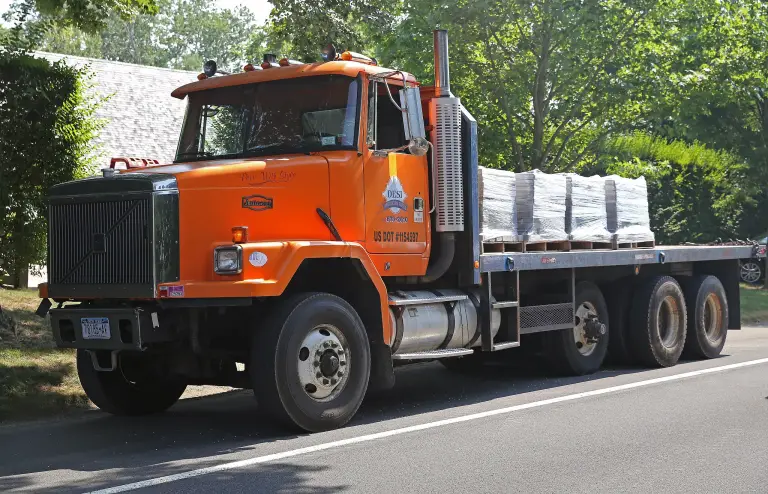
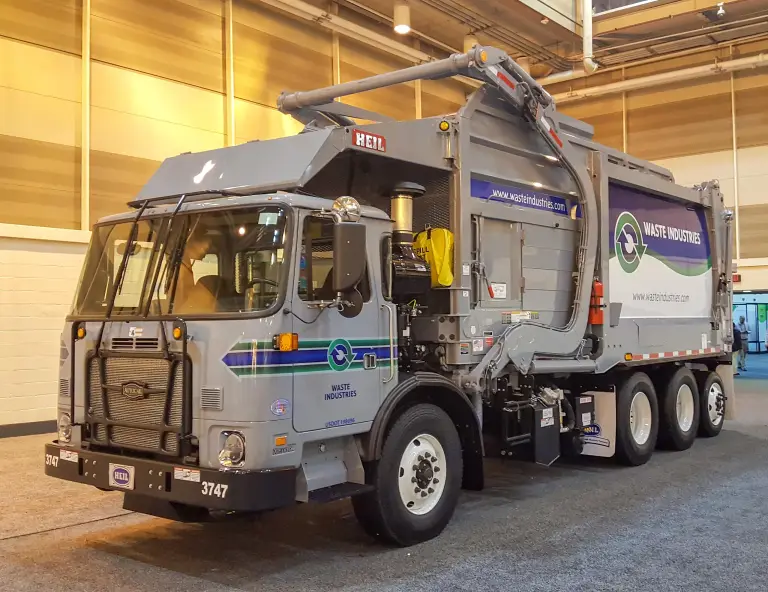
More Autocar vehicles are in our Autocar collection, for example the A64.
M3 half-track questions and answers
Who built the M3 half-track?
The Autocar Company, Diamond T and White.
How many soldiers did it carry?
A driver and a squad of 12.
Why the nickname “Purple Heart box”?
Troops complained of no overhead protection and weak armour.
What was the M5?
A very similar half-track built by International Harvester for Lend-Lease.
Sources
- M3 half-track, English Wikipedia: specifications, design, development, service, variants