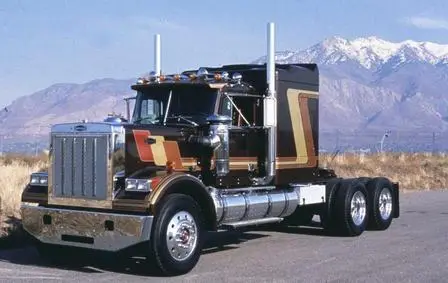
The Autocar A64 was the smallest of the three aluminium lightweight conventionals that Autocar listed as the A64, A75 and A102. It belonged to the years when Autocar was the top brand of the White Motor Corporation, and it was built to carry more payload for the same gross weight.
Autocar A64 at a glance
| Maker | Autocar Company, a White Motor Corporation brand |
|---|---|
| Model family | A64, A75 and A102, aluminium lightweight |
| Layout | Conventional cab, engine ahead of the driver |
| Weight-saving feature | Aluminium construction |
| Plant | Exton, Pennsylvania, from 1954 |
| Later plant | Ogden, Utah, from 1980 |
| Survivor in service | A64B tractor, Detroit Diesel 8V71 |
| Gearbox of that truck | Fuller RTO-13 Roadranger |
| Also in the range | AP extreme-duty, C gasoline conventionals, CK half-cab |
There is no Wikipedia article on the A64 itself: this page is based on the two marque articles (English and German) and on the description of the truck in the video. The A64 was a low-volume model, so the page is short.
History of the Autocar A64
Autocar under White
The Autocar Company had been building trucks since 1899 and passenger cars until 1911. In 1953 it was taken over by the White Motor Corporation, which made Autocar the top-of-the-line brand of its four-brand portfolio. A year later the old Ardmore works outside Philadelphia was replaced by a new plant at Exton, Pennsylvania, and it was from Exton that the conventional models of the 1960s and 1970s were delivered.
The lightweight line
Autocar’s catalogue of those years listed the A64 together with the A75 and A102 as aluminium, lightweight trucks. The point of the aluminium was tare weight: on a conventional truck with a long bonnet, saving weight in the cab and chassis left more of the legal gross weight for payload. Next to them the range also held the AP extreme-duty trucks with planetary axles, the C gasoline conventionals, the CK half-cab and, from 1974, the KK construction model.
How the line ended
The Exton plant closed in 1980 and production moved to White’s newer plant at Ogden, Utah. White was insolvent a year later and Volvo acquired its US assets and brands, keeping Autocar as the division for severe-duty trucks. The last traditional Autocar with the Autocar Driver Cab left Ogden on 18 December 1987. The A64B, a tractor version of the lightweight conventional, is the variant still seen at work today; the truck in the video below is one of them, with a Detroit Diesel 8V71 behind a Fuller RTO-13 gearbox.
Design and features
- Aluminium construction: the whole point of the A64 line was a lower tare weight, so more payload could be carried legally.
- Conventional layout: the engine sat ahead of the driver in a long bonnet, as on most American heavy trucks of the period.
- Place in a full range: the lightweight A-series was sold alongside the AP extreme-duty trucks, the C conventionals and the CK half-cab.
- Simple, serviceable mechanics: the A64B in the video runs a Detroit Diesel 8V71 and a Fuller Roadranger, the standard combination of its day.
Autocar A64 versions
- A64: the base lightweight conventional of the family.
- A64B: the tractor version, the variant most often found in preservation and in the video below.
- A75: the middle model of the aluminium trio.
- A102: the largest of the three aluminium lightweight conventionals.
The A64 shares its White-era background with the Construcktor and the later ACL. More trucks of the marque are in the Autocar collection.
Video: Shifting a Fuller RTO-13 in an Autocar A64 B with Detroit Diesel 8v71
Video by RUMELYTRACTOR on YouTube.
Sources
- Autocar Company, English Wikipedia: model list, White years, plants, end of the traditional cab
- Autocar (Fahrzeugmarke), German Wikipedia: marque history, takeover dates