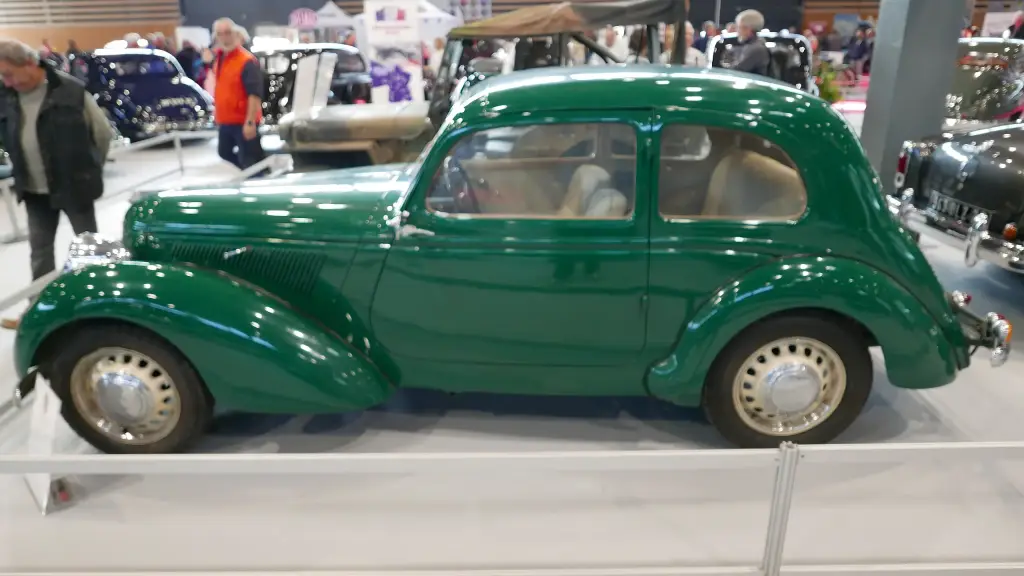
The Amilcar Compound was a front-wheel-drive car with a unitary body and chassis, designed by Jean-Albert Grégoire and introduced by Amilcar shortly before the Second World War, after the firm had been taken over by Hotchkiss. Its light-alloy construction was advanced for a mass-produced French car of the late 1930s, and the war cut its career short.
Amilcar Compound at a glance
| Maker | Amilcar, under Hotchkiss ownership |
|---|---|
| Production | April 1938–1942 |
| Designer | Jean-Albert Grégoire, bodywork by Vinciguerra |
| Layout | front-wheel drive, unitary body and chassis |
| Body material | Alpax aluminium alloy castings with steel pressings |
| Engine (B38) | 1,185 cc four-cylinder, side valves, 33 hp |
| Engine (B67) | 1,340 cc four-cylinder, overhead valves |
| Gearbox | four-speed, all-synchromesh, mounted ahead of the engine |
| Suspension | independent all round, torsion bars at the rear |
| Top speed | 110 km/h (B38), 115 km/h (B67) |
| Shown | Paris Motor Show, 1937 |
History of the Amilcar Compound
A Grégoire design for Hotchkiss
By the autumn of 1937 Hotchkiss, which had bought Amilcar, used the name for its entry-level model, a car in the class of the Peugeot 202, Renault Juvaquatre and Simca 8. The engineering was supplied by Jean-Albert Grégoire, an energetic campaigner for front-wheel drive and aluminium construction, whose ideas also appeared in the ranges of other makers in the 1930s and 1940s. The body was styled by the coachbuilder Vinciguerra, who took the Hotchkiss 20 CV Sport coach as his model.
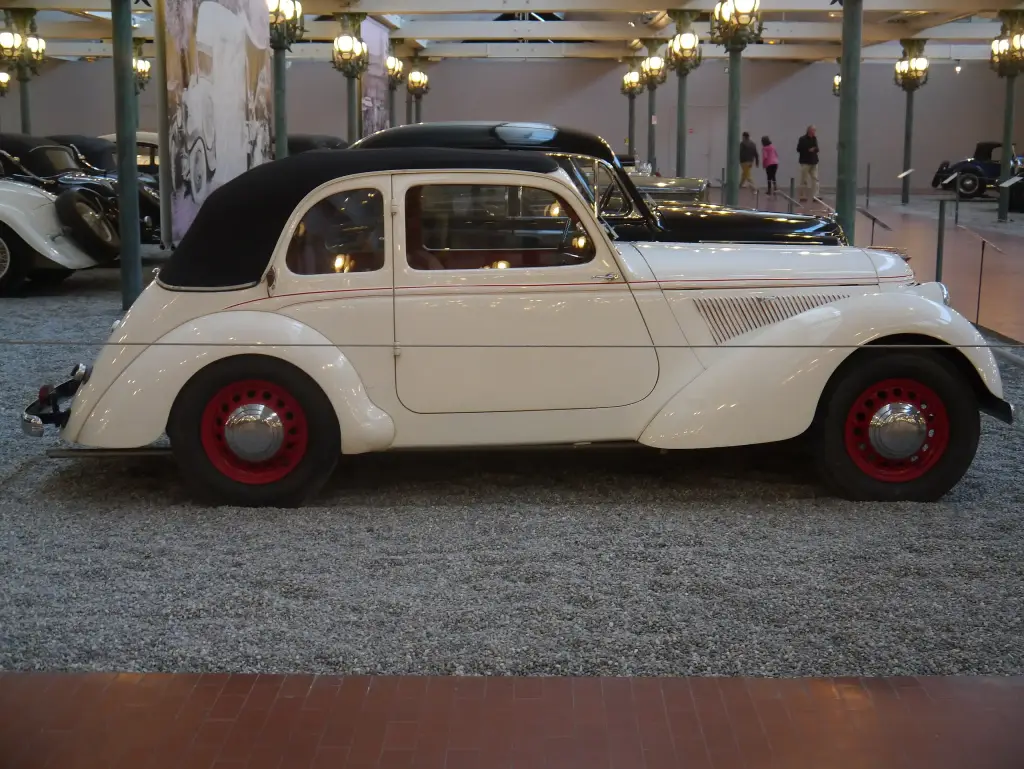
Slow start
The first Compound, the B38, was presented at the 1937 Paris Motor Show, but production was delayed by difficulties with the light-metal panels, then a very new technology. Series production only got under way a year later: 35 cars were built in the last quarter of 1938, 576 in 1939, and a further 64 in the early months of 1940. Three bodies were listed, a two-seater roadster, a four-seat coach and a four-seat drophead coach; at the 1938 Paris show the roadster cost 29,900 francs, rising to 31,400 in May 1939, while the coach was 33,400 and the drophead 34,900.
Engineering
The 1,185 cc side-valve four, derived from the Hillman Minx engine, sat behind a four-speed all-synchromesh gearbox mounted ahead of it, with gear selection by cables. Drive went to the front wheels through short shafts and constant-velocity joints, steering was by rack and pinion, and the suspension was independent all round, with torsion bars at the rear. Brakes were Bendix from the start. The body used extensive Alpax aluminium-alloy castings assembled into a frame, with steel pressings bolted and welded on: the Compound was the first series-production car with a unitary body of cast light alloy, a technique that later appeared in the Aluminium Français-Grégoire prototype and the Panhard Dyna X.
The B67 and the war
An improved Compound, the B67, was prepared to answer criticism of the B38’s performance. Bores were enlarged by 4 mm, taking capacity from 1,185 to 1,340 cc, and the side valves gave way to overhead valves; claimed top speed rose from 110 to 115 km/h. Several pre-production B67s ran in the summer of 1939 and the launch was planned for the October 1939 Paris show, which was cancelled after France and Britain declared war on Germany. In June 1940 the German army invaded and occupied the northern half of the country. Between the summer of 1942 and the spring of 1943 Hotchkiss built 149 Compound estates on the older B38 mechanicals: 50 went to the postal service, 50 to civilian customers and 49 to the French Red Cross as ambulances. After the war the government blocked plans to resume Compound production, and the remaining B67 engines and tooling were sold to Impéria, which used them in about 1,000 of its front-wheel-drive TA8 models.
Design and features
- Front-wheel drive: unusual in a French family car of 1938 and the reason the Compound was so adaptable to estate and ambulance bodies.
- Alpax light-alloy body: cast aluminium alloy parts in a unitary structure, a pioneering use of light metal.
- Cable-operated gearbox: a four-speed all-synchromesh unit mounted ahead of the engine.
- Independent suspension: all round, with torsion bars at the rear.
- Bendix brakes: fitted from the first cars.
Amilcar Compound versions
- B38 (1938–1940): 1,185 cc side-valve engine, 110 km/h.
- B67 (1939–1940): 1,340 cc overhead-valve engine, 115 km/h, about five pre-production cars.
- Roadster, coach and drophead coach: the three catalogue bodies of 1938–1939.
- Wartime estates: 149 built in 1942–1943, including postal vans and Red Cross ambulances.
The Compound was the last Amilcar, built under Hotchkiss ownership after the Pégase had been withdrawn. The 1920s cars were very different: see the CC and the CGS. More cars are in the Amilcar collection.
Sources
- Amilcar Compound, English Wikipedia: production figures, engineering, B67, wartime
- Amilcar Compound, French Wikipedia: bodies, prices, engine origin, body construction