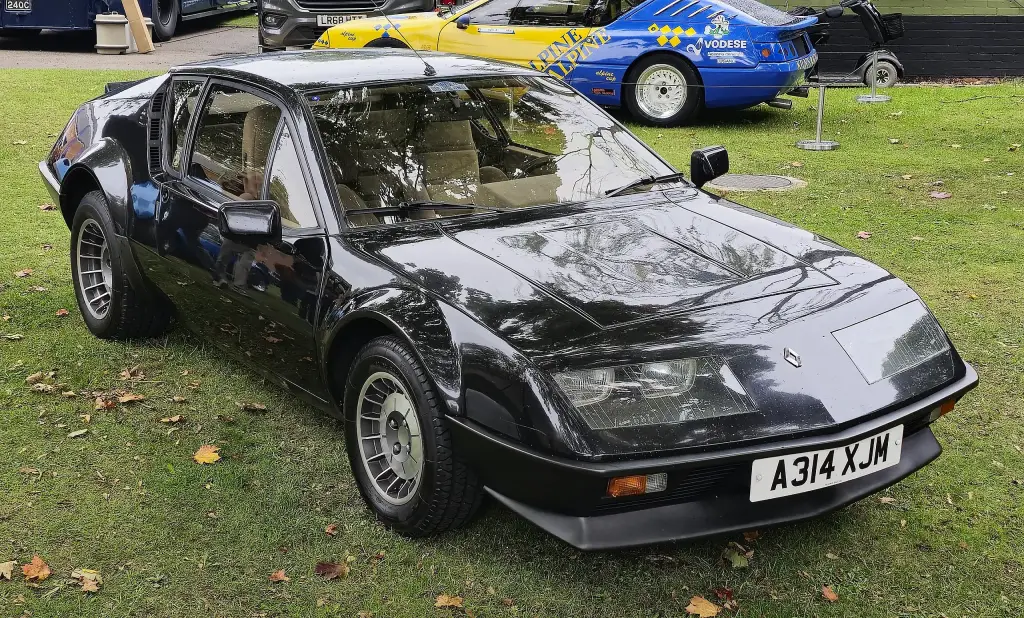
The Alpine A310 is a sports car built by the French manufacturer Alpine from 1971 to 1984. It was the last Alpine model conceived by the founder Jean Rédélé, designed as a more broadly appealing grand tourer than the focused A110.
Alpine A310 at a glance
| Production | 1971–1984; first shown at the 1971 Geneva Motor Show |
|---|---|
| Chassis and body | tubular steel backbone chassis with a fibreglass shell moulded in a single piece |
| First series (1971–1976) | four-cylinder engine and six headlights; considered underpowered |
| A310 V6 (from 1976) | restyled by Robert Opron, 90° 2,664 cc PRV V6, 150 PS (110 kW), 220 km/h (137 mph) |
| Layout | engine mounted longitudinally at the rear, five-speed manual gearbox |
| Pack GT (1983–1984) | wheel arches and bigger spoilers; 27 A310 V6 Pack GT Kit Boulogne with a 2.9 L V6 and triple Weber 42DCNF carburettors, 193 PS (142 kW) |
| Rear suspension | from model year 1981 shared with the mid-engined Renault 5 Turbo |
| Rally | French Rally champion 1977 with Guy Fréquelin |
This page is based on English Wikipedia only, so the figures could not be cross-checked against a second source.
History of the Alpine A310
Dieppe-based Alpine was an independent company founded in 1955 that specialised in competition cars and sporting road cars. The A110 had won the 1973 Monte Carlo Rally and the World Rally Championship but was considered too focused to sell in volume as a grand tourer, so Rédélé sought a second model with wider appeal. The first A310, built 1971–1976, had a four-cylinder engine and six headlights. Being larger, heavier and no more powerful than its predecessor, the early A310 was considered underpowered for the potential of its chassis.
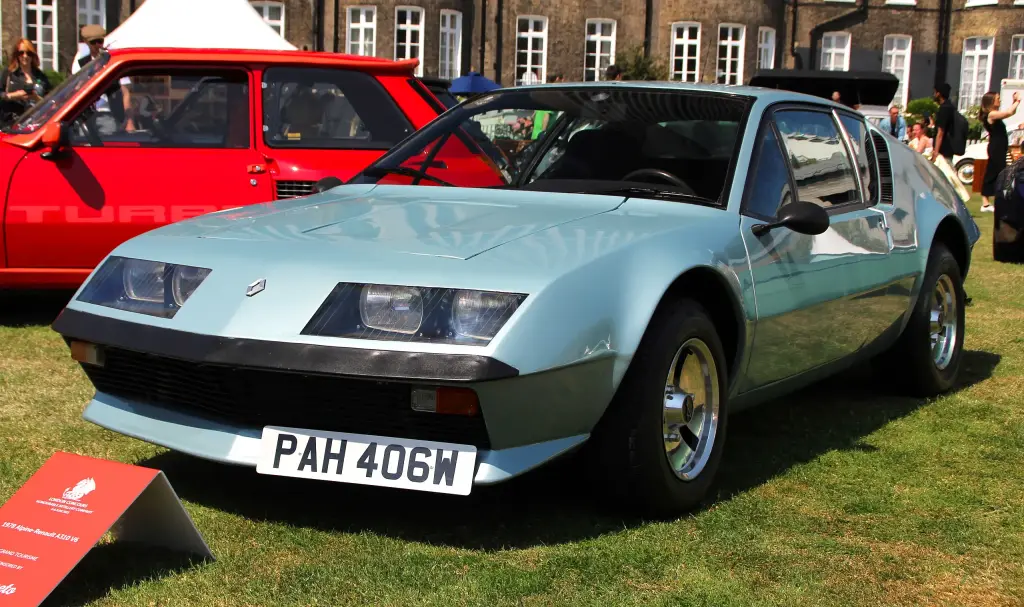
In 1976 the A310 was restyled by Robert Opron and fitted with the more powerful, newly developed 90-degree PRV V6, used in some Peugeots, Renaults and Volvos. It became Renault’s performance flagship, with 150 PS and 220 km/h. From model year 1981 the rear suspension and the wheels were shared with the Renault 5 Turbo, and in 1983–1984 the “Pack GT” inspired by the Group 4 A310 racing cars added wheel arches and larger spoilers.
In 1973 the A310 was designated to replace the A110 in the World Rally Championship, where it saw mixed success. It had great success in French motorsport as a Group 4 car: in 1977 Guy Fréquelin won the French Rally championship in an Alpine Renault A310 V6, and in 1983 the car moved to the Group B rally stage.
Design and features
- Chassis: a hefty tubular steel backbone with a body moulded in one piece, as on the A110.
- Parts: mostly from the Renault parts shelf, but the steering rack came from the Peugeot 504 and the turn signals from the Simca 1301.
- Build effort: a car took 130 hours to build, developed for small-scale artisanal production.
Alpine A310 versions
- A310 four-cylinder (1971–1976).
- A310 V6 (1976–1984): with the PRV V6.
- A310 V6 Pack GT and Pack GT Kit Boulogne (1983–1984).
More Alpine cars are in our Alpina and Alpine collection, for example the A110 and the GTA and A610 that replaced it.
Alpine A310 questions and answers
When was the Alpine A310 built?
From 1971 to 1984.
What engine did the A310 V6 have?
A 2,664 cc PRV V6 with 150 PS, the same engine family as in the DeLorean.
Who designed the 1976 restyling?
Robert Opron.
What replaced the A310?
The Renault Alpine GTA, later the A610.
Sources
- Alpine A310, English Wikipedia: history, V6, competition