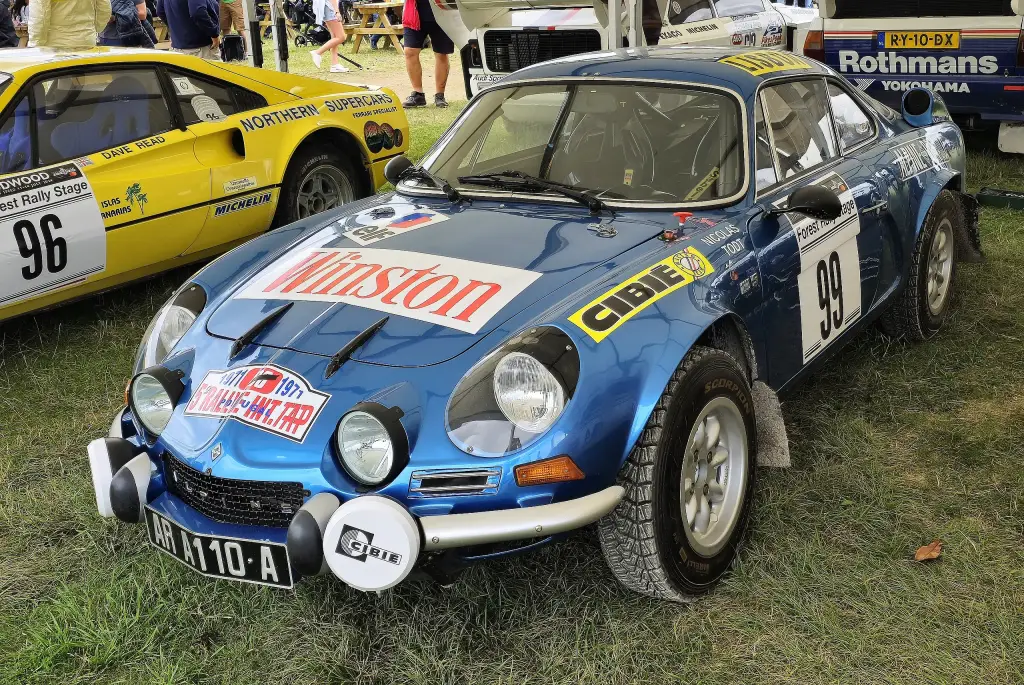
The Alpine A110 is a sports car produced by the French manufacturer Alpine from 1963 to 1977, styled as a “berlinetta”, a small enclosed two-door coupé. It succeeded the Alpine A108, was powered by a succession of Renault engines and became famous as a rally car, winning the 1971 Monte Carlo Rally and making Alpine the first World Rally champion in 1973.
Alpine A110 at a glance
| Production | 1963–1977 (A110, also called the Berlinette) |
|---|---|
| Founder of Alpine | Jean Rédélé, Dieppe |
| Weight and power | from about 620 kg and 51 hp at the beginning to 180 hp by the end of production |
| First engines | 1.1 L Renault R8 Major or R8 Gordini; Gordini 95 PS SAE (70 kW) at 6,500 rpm |
| A110 1600 S | aluminium Cléon-Alu engine of the Renault 16 TS with two twin-venturi Weber 45 carburettors, 125 PS DIN (92 kW) at 6,000 rpm, top speed 210 km/h |
| Competition engines | up to 1.8 L |
| Predecessor | Alpine A108 |
| Licence production | “Dinalpin” by DINA in Mexico, 1965–1974 |
This page is based on English Wikipedia only, so the figures could not be cross-checked against a second source. The page gives 1971 for Renault’s acquisition of Alpine in one passage and implies the mid-1970s in another.
History of the Alpine A110
Alpine was founded by Jean Rédélé, a Frenchman from Dieppe and an enthusiastic rally driver of the post-war era, who modified Renault 4CVs for better performance and built lighter bodies. Launched in 1963, the A110, like previous road-going Alpines, used many Renault parts. While its predecessor the A108 was designed around Dauphine components, the A110 was updated to use R8 parts. Unlike the A108, which came first as a cabriolet and later as a coupé, the A110 came first as a berlinette and then as a cabriolet; the most obvious change from the A108 was the restyled rear bodywork, made to fit the larger engine.
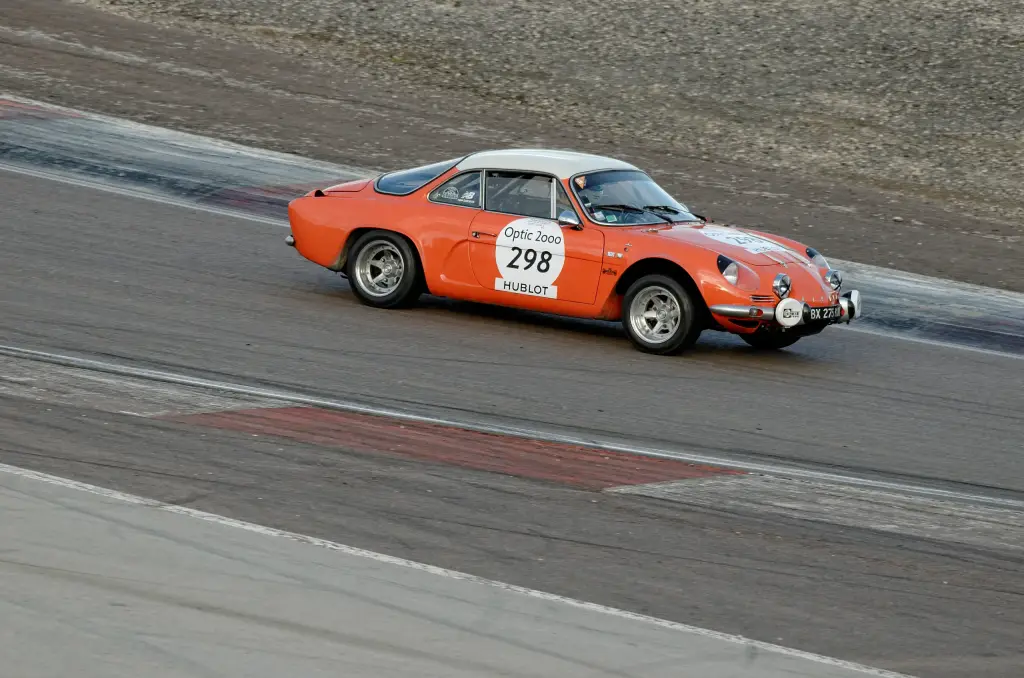
The A110 achieved most of its fame in the early 1970s as a rally car. After winning several rallies in France in the late 1960s with the cast-iron R8 Gordini engines, it was fitted with the aluminium-block Cléon-Alu engine of the Renault 16 TS. In 1970–1972 it competed in the International Championship for Manufacturers, winning events throughout Europe; a notable victory was the 1971 Monte Carlo Rally with the Swede Ove Andersson. When the World Rally Championship replaced the International Championship in 1973, Renault chose to compete with the A110, with Bernard Darniche, Jean-Pierre Nicolas and Jean-Luc Thérier as permanent drivers; the A110 won most of the races where the works team was entered, making Alpine the first World Rally Champion. By 1974 advances in rallying had left the A110 outdated and sales declined.
Design and features
- Body: glass-fibre berlinette over a steel backbone chassis, with a rear-mounted Renault engine.
- A110 GT4: a restyled 2+2 coupé on A110 mechanicals that replaced the long-wheelbase A108 2+2.
- Licence builds: the Mexican Dinalpin among others.
Alpine A110 versions
- A110 1100 and A110 1600 S: road versions with Renault engines (our older “1300” and “1600” pages about the same car are covered here).
- A110 1800 Group 4: the rally cars with engines up to 1.8 litres.
- A110 GT4: the 2+2.
More Alpine cars are in our Alpina and Alpine collection, for example the A108, the A210 and the A310.
Alpine A110 questions and answers
When was the Alpine A110 built?
From 1963 to 1977.
What engines did it have?
Renault engines from 1.1 litres up to 1.8 litres in competition versions.
What did the A110 win?
The 1971 Monte Carlo Rally (Ove Andersson) and the 1973 World Rally Championship for Alpine.
What is the Berlinette?
The name for the A110 as a small enclosed two-door coupé.
Where else was it built?
Under licence in Mexico (Dinalpin, 1965–1974) and by other manufacturers.
Sources
- Alpine A110, English Wikipedia: history, engines, rally record