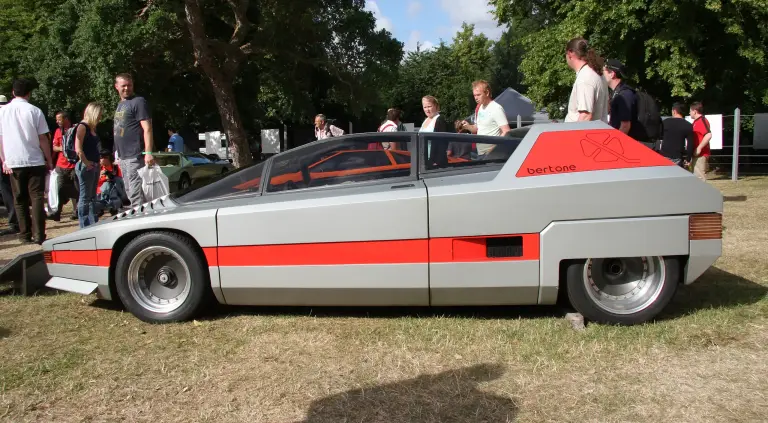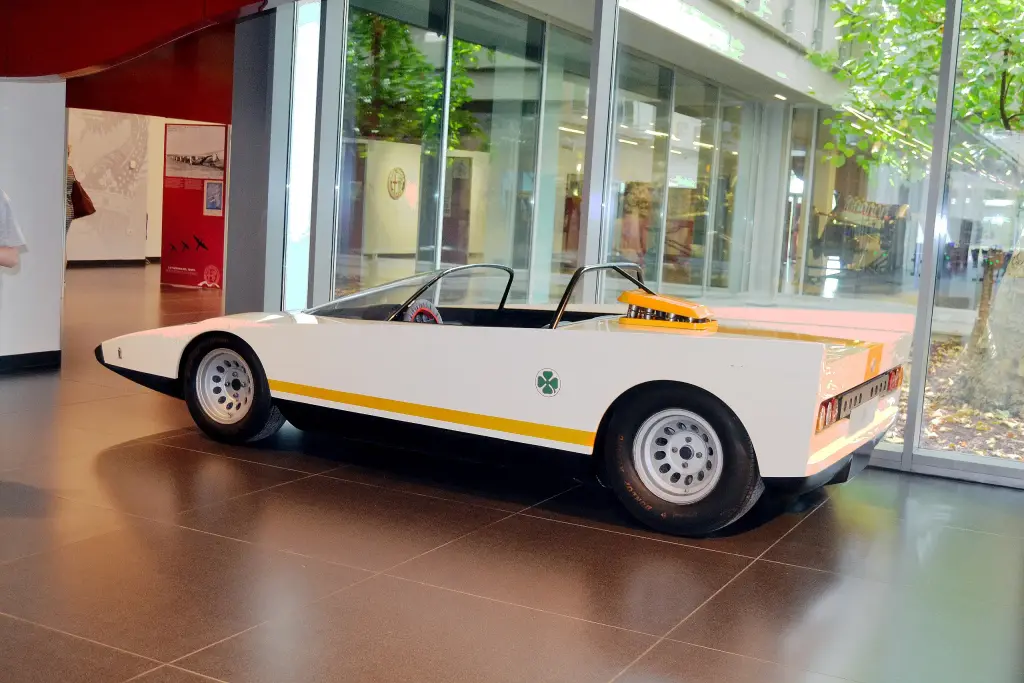
The Alfa Romeo 33 Pininfarina Cuneo, also called the P/33 Cuneo, was a dream car built by Alfa Romeo and Pininfarina in 1971. It is one of six dream cars based on the Alfa Romeo 33 Stradale chassis by the best-known Italian coachbuilders of the late 1960s and early 1970s.
Alfa Romeo 33 Cuneo at a glance
| Type | dream car, one-off |
|---|---|
| Year | 1971 |
| Builder | Alfa Romeo and Pininfarina |
| Designer | Paolo Martin |
| Shown | Brussels Motor Show, 1971 |
| Base | chassis of the P33 Roadster G.S. (Alfa Romeo 33 Stradale) |
| Engine | 2.0 litre (1,995 cc) V8 with twin ignition, mid-mounted |
| Output | 230 hp at 8,800 rpm |
| Gearbox | six-speed manual |
| Colours | white with orange stripe, black interior with orange seats |
| Production | none; kept at the Museo Storico Alfa Romeo in Arese |
This article is based on one source, the Italian Wikipedia page on the car.
History of the Alfa Romeo 33 Cuneo
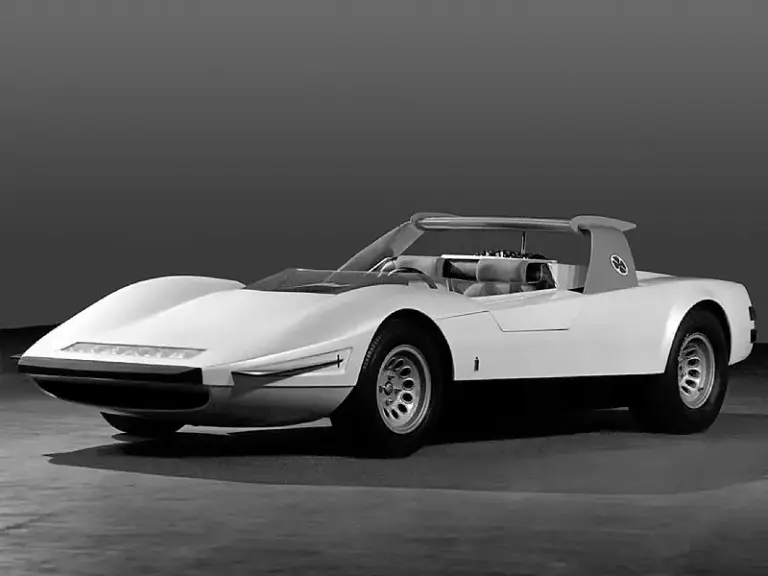
Pininfarina’s Cuneo was first called simply the 33 Spider inside Alfa Romeo, and the name Cuneo, meaning wedge, soon stuck. It was shown at the 1971 Brussels Motor Show. To build it, Pininfarina reused the chassis of the P33 Roadster G.S., a low white roadster also drawn by Paolo Martin and shown at the 1968 Turin Motor Show, and the body of that earlier car was dismantled.
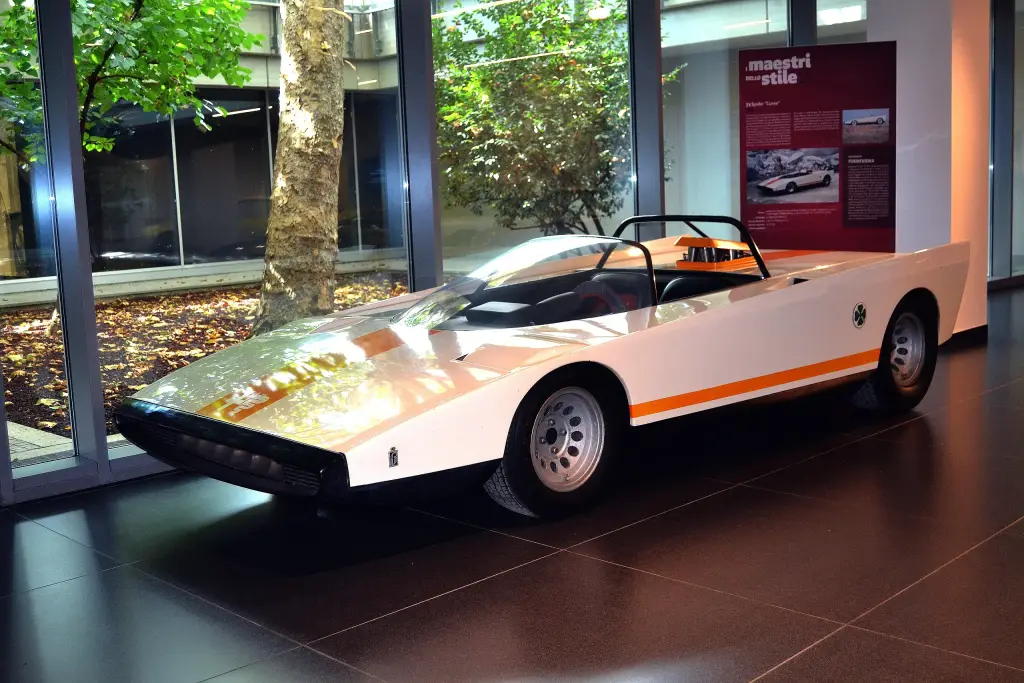
The Cuneo kept several ideas from the Roadster G.S.: the low, sharp wedge line, the white and orange colour scheme, a full-width bumper and a strip of headlights. Its squared-off lines went against the rounded shapes common in the 1960s and struck both insiders and the public with a very low cuneiform profile, from which only the windscreen and an arched roll-bar rise.
Under the skin it used the same engine as the 33 Stradale, a V8 of 1,995 cc with twin ignition, giving 230 hp at 8,800 rpm and driving through a six-speed manual gearbox in the middle of the car. Like the other dream cars based on the 33 Stradale chassis, the Cuneo never went into production. It is kept at the Museo Storico Alfa Romeo in Arese.
Design and features
- Profile: a near-perfect wedge with no doors, topped by the low windscreen and an arched roll-bar that also carries the cover of the intake trumpets.
- Nose: a large black rubber bumper wraps the front and holds the headlight strip behind a plexiglas sheet, plus the air intakes for the twin radiators.
- Sides and tail: small fins rise towards the tail and help stability; two NACA ducts feed the engine; the rear panel carries eight single exhaust pipes and three round lights on each side.
- Interior: almost all black, with orange seat covers matching the body, five small round gauges in the centre of the dash and the rev counter behind a four-spoke steering wheel.
Alfa Romeo 33 Cuneo versions
- P33 Roadster G.S. (1968): the earlier Paolo Martin design on the same chassis, shown in Turin; its body was dismantled so that the chassis could be used for the Cuneo.
- 33 Stradale dream cars: six one-offs by the leading Italian coachbuilders, of which the Cuneo is one.
More Alfa Romeo models are in our Alfa Romeo collection, for example the Montreal.
Alfa Romeo 33 Cuneo questions and answers
What does Cuneo mean?
Wedge in Italian; the name comes from the shape of its side profile.
Who designed it?
Paolo Martin at Pininfarina.
What engine did it have?
The 2.0 litre V8 of the Alfa Romeo 33 Stradale, with 230 hp at 8,800 rpm.
Was it ever sold?
No. It was a dream car and stays in the Alfa Romeo museum at Arese.
Sources
- Alfa Romeo 33 Pininfarina Cuneo, Italian Wikipedia: history, design, engine