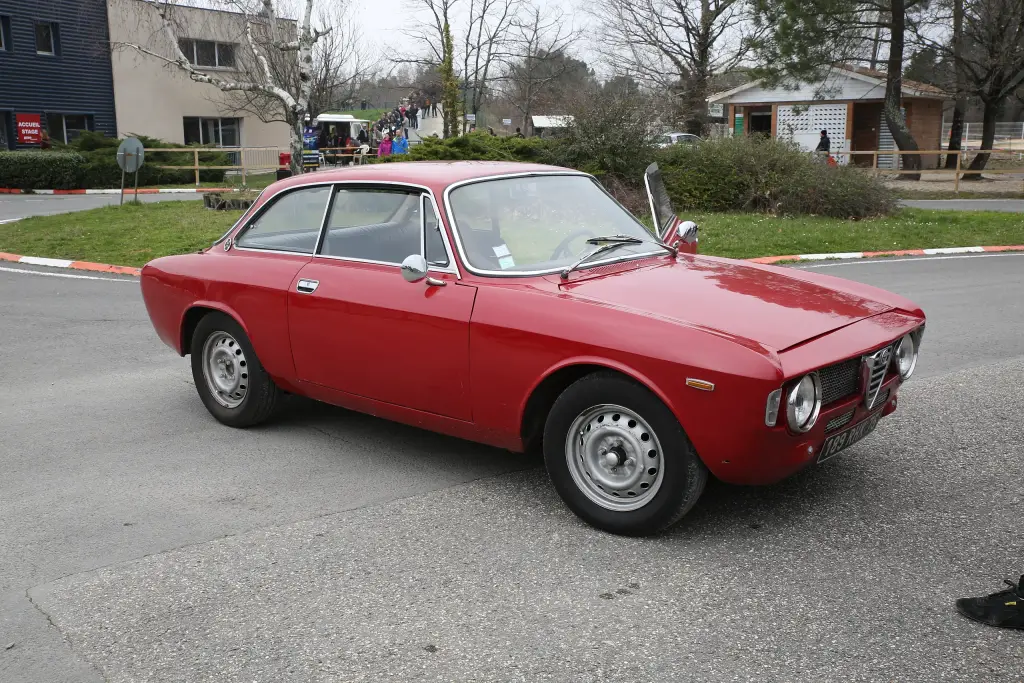
The Alfa Romeo 105 and 115 series coupés were a range of cars made by Alfa Romeo from 1963 until 1977, based on a shortened floorpan of the Giulia saloon. They were the successors to the Giulietta Sprint coupé, and the basic body shape shared by all models was designed by Giorgetto Giugiaro for Bertone.
Alfa Romeo 105/115 coupés at a glance
| Production | 1963–1977 |
|---|---|
| Platform | shortened floorpan of the Giulia saloon |
| Design | Giorgetto Giugiaro for Bertone, one of his first major projects there |
| Engines | all-aluminium Twin Cam four-cylinder, 1,290 cc to 1,962 cc, two valves per cylinder |
| Fuel supply | twin carburettors; SPICA mechanical port fuel injection on US 1750 GTV and 2000 GTV |
| Rear suspension | live axle with coil springs |
| Convertible | Giulia Sprint GTC by Touring, limited to 1,000 units |
| Zagato version | GT 1300 Junior Zagato and GT 1600 Junior Zagato, designed by Ercole Spada |
This page is based on English Wikipedia only, so the figures could not be cross-checked against a second source.
History of the Alfa Romeo 105/115 coupés
The range was made in two categories. The Gran Turismo (GT) and Gran Turismo Veloce (GTV) were the most sporting cars of the range and sold very well worldwide: the first was the Giulia Sprint GT (1963, built until 1965), which evolved into the Giulia Sprint GT Veloce (1966), the 1750 GTV (1967) and the 2000 GTV. On the other side was the GT Junior range with smaller engines, popular with buyers who did not need maximum power or could not afford the tax on larger engines, notably in Italy.
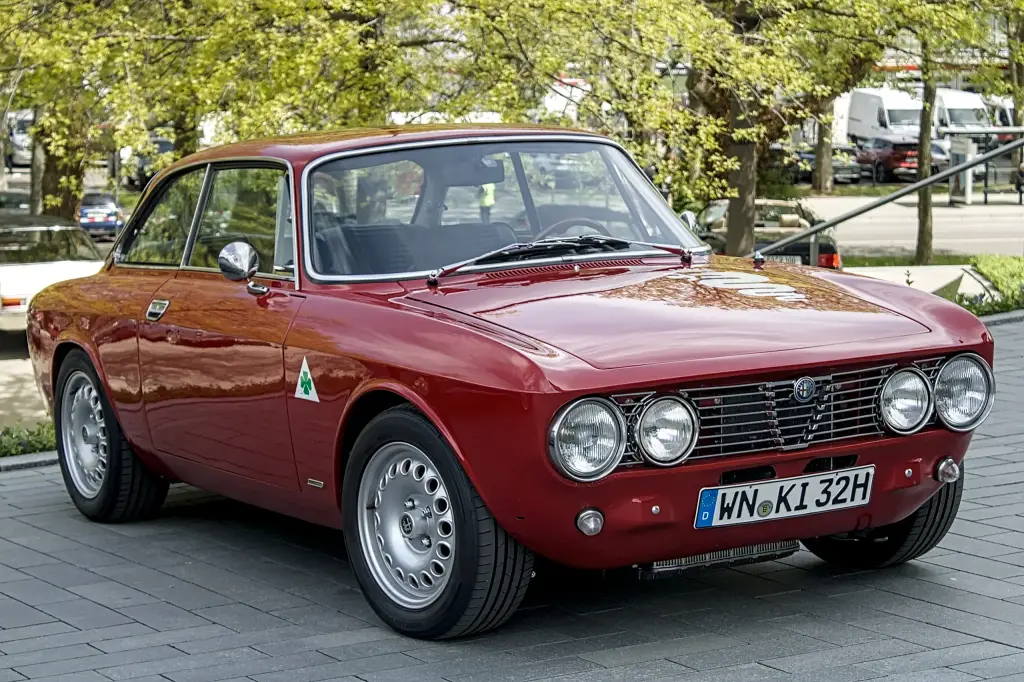
The Giulia Sprint GT was revealed at a press event at the newly opened Arese plant on 9 September 1963 and shown later that month at the Frankfurt Motor Show; its Bertone body is known as the “scalino” (step) or step-front. Both categories were used to derive the lightweight GTA models, intended for competition homologation, which were priced much higher and sold in much smaller numbers.
Design and features
- Body: the flat grille with integrated headlamps and the balance of glass and metal were groundbreaking styling features; the shape borrowed heavily from Giugiaro’s earlier design for the Alfa Romeo 2000 Sprint and 2600 Sprint.
- Engine: the all-light-alloy Alfa Romeo Twin Cam, with competition versions using twin-spark cylinder heads.
- Transmission: some US-market cars had a three-speed ZF automatic.
Alfa Romeo 105/115 coupés versions
- Giulia Sprint GT (1963–1965): the first, with the step-front body.
- Giulia Sprint GT Veloce (1966) and 1750 GTV (1967): the more powerful GTs.
- GT Junior (1300 and 1600): the smaller-engined cars, also as Zagato coupés.
- GTA: the lightened competition models; see the Giulia GTA.
- Giulia Sprint GTC: the Touring convertible, 1,000 built.
More Alfa Romeo cars of the era are in our Alfa Romeo collection, for example the GT 1300 Junior, the 2000 GTV and the Giulia saloon. Our older “Giulia 1600 Sprint GT” and “105” pages are covered here.
Alfa Romeo 105/115 coupés questions and answers
What are the Alfa Romeo 105 series coupés?
The Giulia-based Bertone coupés built from 1963 to 1977, from the Sprint GT to the 2000 GTV.
Who designed them?
Giorgetto Giugiaro, for Bertone.
What does GTV mean?
Gran Turismo Veloce; “veloce” is Italian for fast.
What is a GT Junior?
The smaller-engined version of the GT, popular where larger engines were heavily taxed.
What does the A in GTA mean?
“Alleggerita”, Italian for lightened.
Sources
- Alfa Romeo 105/115 Series Coupés, English Wikipedia: bodywork, mechanics, models