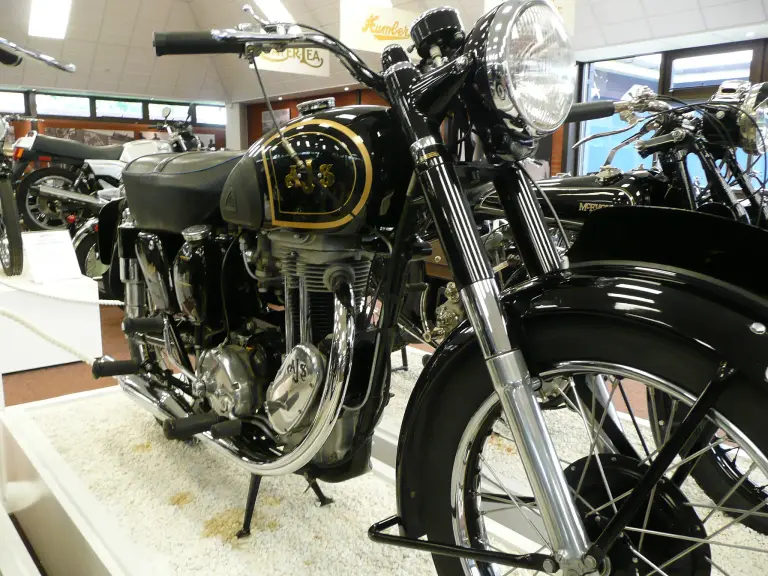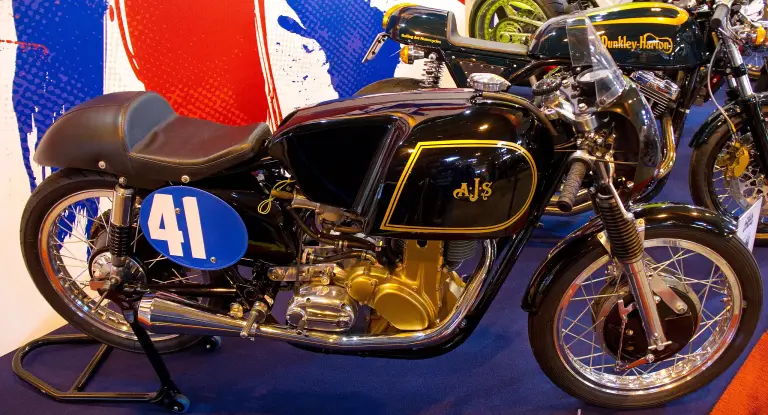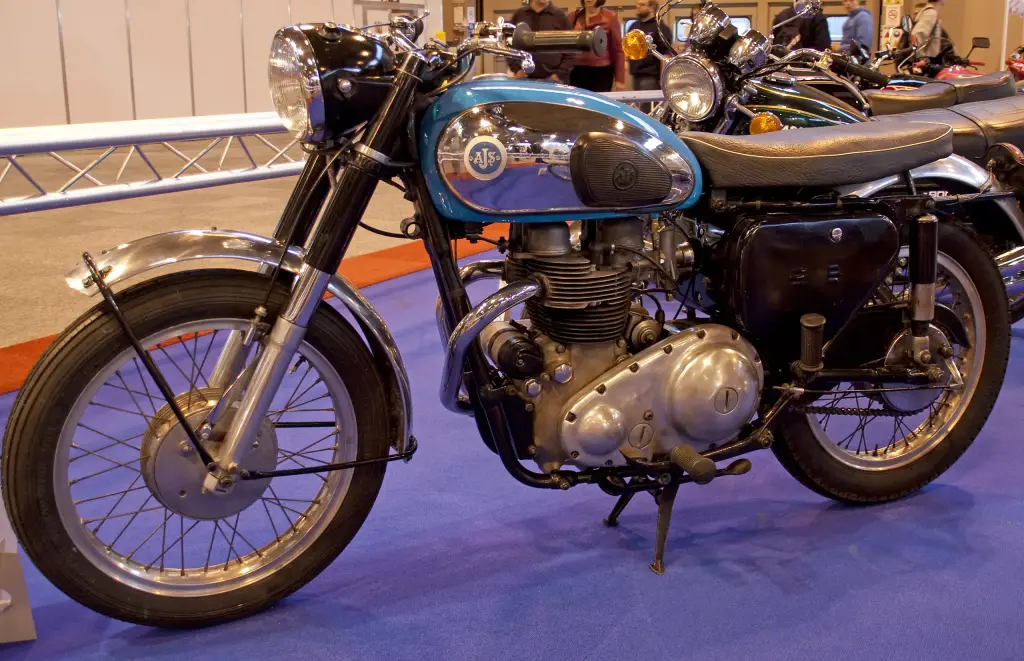
The AJS Model 31 was a British 650 cc twin made by Associated Motor Cycles at the former Matchless works in Plumstead, London. Developed in 1958 specifically to capture the American market, it was sold alongside the Matchless G12 and stayed in production until 1966.
AJS Model 31 at a glance
| Maker | Associated Motor Cycles, Plumstead, London |
|---|---|
| Also sold as | Matchless G12 |
| Designed | Phil Walker |
| Developed | 1958, for the US market |
| Production | from September 1958 to 1966 |
| Engine | 646 cc twin, developed from the 600 cc Matchless G11 |
| Stroke | 79.3 mm, lengthened from 72.8 mm |
| De Luxe | 1959, new cradle frame and cylinder head |
| CSR | Competition / Springer / Road, siamese exhaust |
| Performance | about 100 mph in De Luxe form |
| Racing success | Thruxton 500 win for Langston and Chapman |
| Name from 1963 | Hurricane |
based on one source: the English Wikipedia article on the Model 31.
History of the AJS Model 31
A 650 for America
The Model 31 was also produced as the Matchless G12 by the same company. Designed by Phil Walker, it had to be a 650 cc machine, but AMC wanted to use as many cycle parts as possible from the preceding 600 cc Matchless G11, which had been badge-engineered as the AJS Model 30. The cylinders could not be bored out further, so the stroke was lengthened from 72.8 mm to 79.3 mm, raising capacity to 646 cc. That called for a new crankshaft and primary chaincase, which also gave the opportunity to fit a Lucas alternator. Volume production began in September 1958.
The De Luxe
In 1959 the Model 31 was redesigned and modernised as the De Luxe, with a new full cradle tubular duplex frame and a new cylinder head. Vibration had always been a problem, so the crankshaft was upgraded to nodular iron. Capable of 100 mph, the Model 31 became popular in North America.
The CSR
The CSR designation officially stood for Competition / Springer / Road, but rivals dubbed the bike the Coffee Shop Racer. With its distinctive two-into-one siamese exhaust system and upgraded camshafts, the CSR was a high-performance motorcycle, though it was still prone to leaks and vibration. The factory diverted chief engineer Jack Williams from AJS 7R development to address the problems and modify the bikes for racing. The result was a win for Ron Langston and Don Chapman in the Thruxton 500 long-distance endurance race. Encouraged by that victory in 1963, AJS named the Model 31 the Hurricane.
The end
By 1966 AMC was in financial trouble, and production of the Model 31 ended. The last example was built in 1966, closing a short run that had begun with a machine designed for American showrooms eight years earlier.
Design and features
- Long-stroke 650: capacity raised from 600 cc by lengthening the stroke rather than boring out the cylinders.
- Shared cycle parts: much of the chassis came from the earlier 600 cc Matchless G11 / AJS Model 30.
- Cradle frame from 1959: the De Luxe brought a full cradle duplex frame and a new cylinder head.
- CSR specification: siamese exhaust and uprated camshafts turned the tourer into a club racer.
- Racing proof: a works-prepared CSR won the Thruxton 500 endurance race.
AJS Model 31 versions
- Model 31 (1958): the original 646 cc twin on G11-derived cycle parts.
- Model 31 De Luxe (1959): full cradle frame, new cylinder head and nodular iron crankshaft.
- Model 31 CSR: siamese exhaust, upgraded camshafts and racing modifications.
- Matchless G12: the same machine sold under the Matchless name.
- Hurricane (1963): the Model 31 renamed after the Thruxton victory.
The Model 31 was built alongside the smaller AJS Model 16 single at Plumstead, and its engineers also worked on the racing AJS 7R. More motorcycles are in the AJS collection.
Sources
- AJS Model 31, English Wikipedia: development, versions, racing