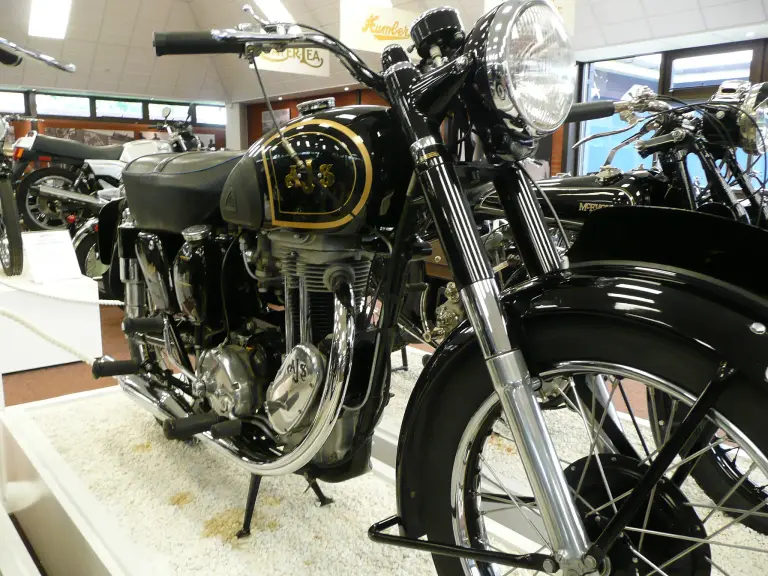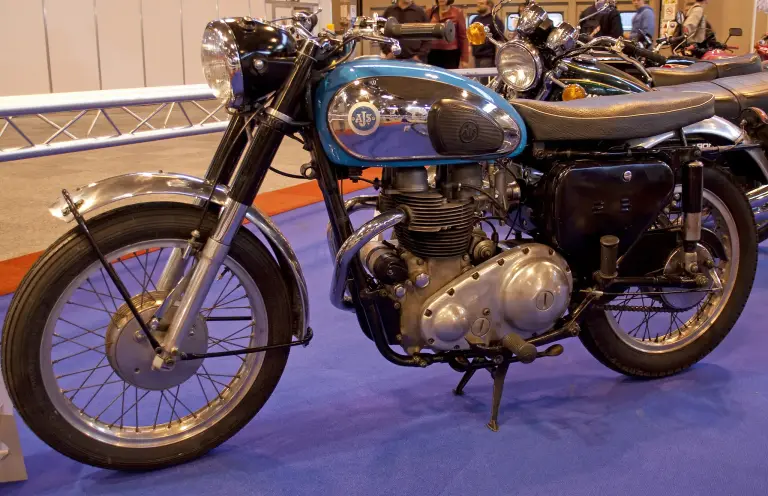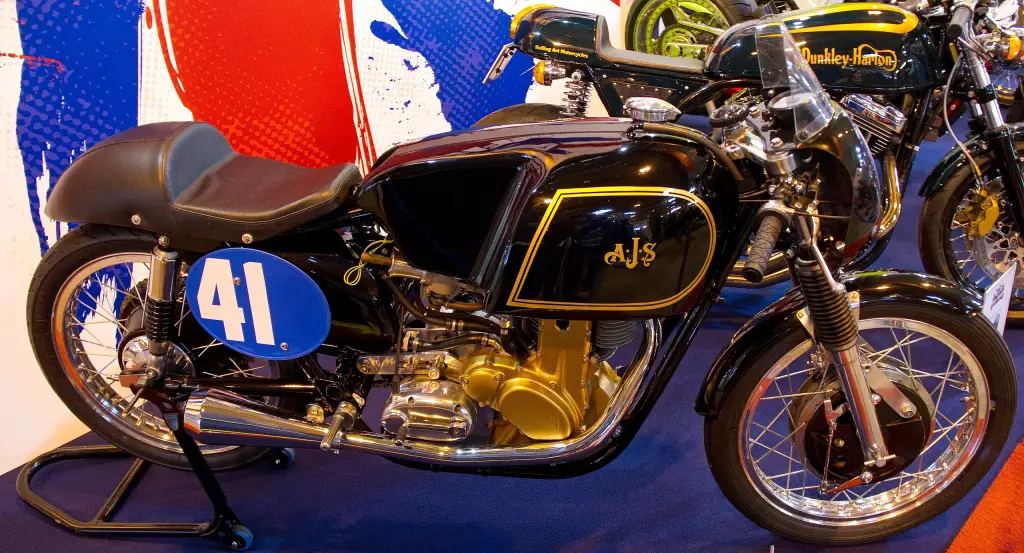
The AJS 7R was a British 350 cc racing motorcycle built from 1948 to 1963 by Associated Motor Cycles. Commonly known as the Boy Racer, it won races for the factory and for privateers from its introduction in 1948.
AJS 7R at a glance
| Maker | Associated Motor Cycles |
|---|---|
| Production | 1948–1963 |
| Designer | Phil Walker |
| Engine | 350 cc chain-driven overhead-camshaft single |
| Power at launch | 32 bhp at 7,500 rpm |
| 1956 dimensions | 75.5 × 78 mm, replacing 74 × 81 mm |
| Gearbox | Burman; AMC unit from 1958 |
| Frame | duplex, with Teledraulic front forks |
| 1957 output | 38.5 bhp at 7,600–7,800 rpm |
| 1957 weight | 285 lb (129 kg) |
| Top speed | 180–190 km/h (115–120 mph) |
| Final output | over 40 bhp by 1963 |
based on one source: the English Wikipedia article on the 7R.
History of the AJS 7R
A Phil Walker design
The 7R was a new design by Phil Walker and drew on the history of the pre-war AJS cammy singles. Its chain-driven overhead camshaft engine initially produced 32 bhp at 7,500 rpm, not quite as much as its competitors. The duplex frame and Teledraulic front forks stayed relatively unchanged through production, while the engine was altered repeatedly: the included valve angle was progressively narrowed and the crankshaft strengthened. In 1956 the dimensions changed from the original long-stroke 74 × 81 mm to the squarer 75.5 × 78 mm, and in 1958 the AMC gearbox replaced the older Burman unit.
The three-valve 7R3
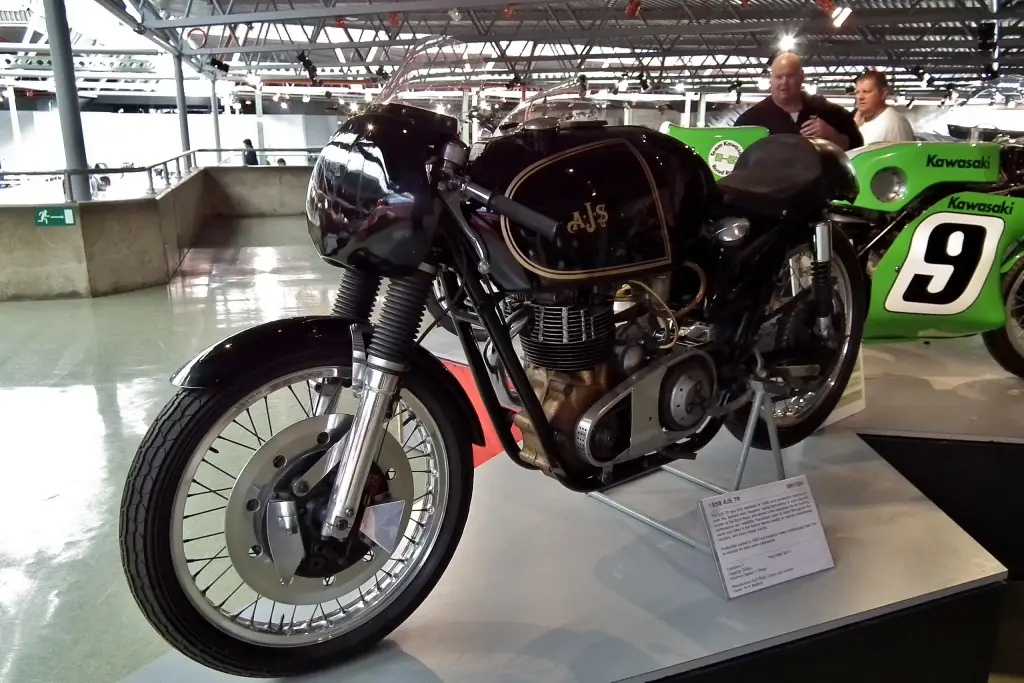
In 1951 AJS development engineer Ike Hatch built a three-valve-head version of the 7R with the 75.5 × 78 mm dimensions, making 36 bhp. It was called the AJS 7R3 and was Ike’s answer to the Italian multi-cylinder racers. It did well in its first year and less well in the second. For 1954 the works team manager Jack Williams developed the bike further, lowering the engine in the frame and making tuning changes that gave 40 bhp at 7,800 rpm. It immediately won the first two rounds of the World Championship and took first place at the Isle of Man TT. These were factory specials; one has survived and a second has been reconstructed from spares.
Privateer years
AMC withdrew from works racing at the end of 1954, after the death of Ike Hatch and in the face of fierce competition from other European machines. AJS then made a production version of the standard two-valve 7R for privateers, and a 500 cc version was sold badged as the Matchless G50. The 1957 7R, with 75.5 mm bore and 78 mm stroke, gave 38.5 bhp at 7,600–7,800 rpm, weighed 285 lb (129 kg) and reached 180–190 km/h. By the end of production in 1963 the two-valve overhead-camshaft engine made over 40 bhp.
Beyond the tarmac
The 7R was not only a road racer. The Swedish rider Bill Nilsson converted one into a motocross machine and rode it to win the inaugural FIM 500 cc Motocross World Championship in 1957. AJS 7Rs won the Junior Manx Grand Prix in 1961, 1962 and 1963 and finished second in 1966.
Design and features
- Overhead camshaft single: a chain-driven camshaft in the tradition of the pre-war AJS cammy racers.
- Constant development: narrower valve angle, stronger crankshaft and squarer bore and stroke by 1956.
- Light and quick: 129 kg and 180–190 km/h in 1957 specification.
- Available to privateers: production two-valve racers after the works team withdrew in 1954.
- Versatile: a converted 7R won the first 500 cc Motocross World Championship.
AJS 7R versions
- 7R (1948–1963): the standard two-valve overhead-camshaft racer.
- 7R3 (1951): three-valve works special of 36 bhp.
- 1954 works special: lowered engine and 40 bhp at 7,800 rpm.
- Matchless G50: the 500 cc version badged as a Matchless.
- Production racers: two-valve machines sold to privateers after 1954.
The 7R came from the same Plumstead works as the road-going AJS Model 16 and AJS Model 31. More motorcycles are in the AJS collection.
Sources
- AJS 7R, English Wikipedia: design, 7R3, racing record