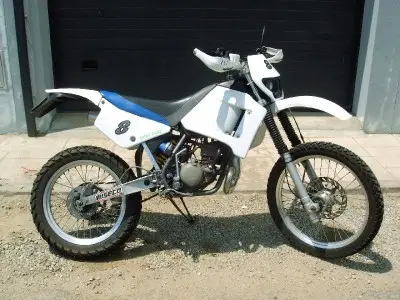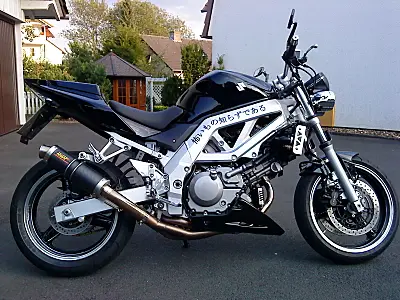
The AJP PR4 125 was presented in 2001 and became the first four-stroke motorcycle built by AJP Motos, a small firm from Penafiel in northern Portugal. Its fuel tank sat beneath the rider’s seat to lower the centre of gravity, a layout the company still uses. A 200 cc version arrived in 2004 with the same cycle parts.
AJP PR4 at a glance
| Maker | AJP Motos, Portugal |
|---|---|
| Introduced | 2001 (PR4 125) |
| Engine | single-cylinder four-stroke, 125 cc; 200 cc from 2004 |
| Engine basis | closely based on the Honda XR series |
| Fuel tank | beneath the rider’s seat, lowering the centre of gravity |
| Cycle parts | lightweight frame, front and rear disc brakes, cast-alloy swingarm, composite silencer |
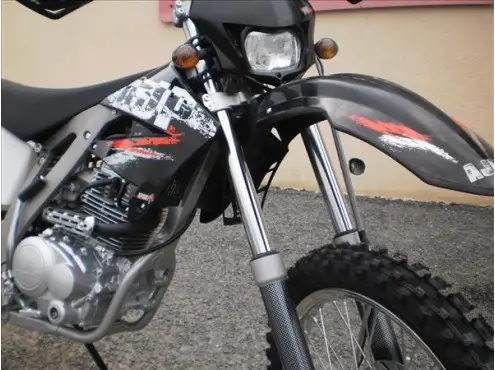
| Forks | upside-down forks, as on the larger PR5 |
| Engine sizes listed | 125 cc and 240 cc (the 2004 update used 200 cc) |
| First exports | France, Germany and England |
| Later exports | Spain, Poland, Italy and Greece after 2004 |
| Factory | Penafiel until 2003, Lousada afterwards |
AJP has no separate Wikipedia page for the PR4, so this article is based on the English and Portuguese articles about the company, which are close translations of one another. The engine sizes listed differ between them: 240 cc in English, 200 cc in Portuguese.
History of the AJP PR4
AJP began as a motorcycle repair and preparation workshop. António Pinto opened it in 1981 at the age of 22; in 1987 the firm was founded and built its first model, the Ariana 125, with a two-stroke Casal engine. Only 25 of them were made, but the design ideas were carried into later machines. The name AJP comes from the initials of António J Pinto, a seven-time Portuguese enduro champion.
The PR4 125 of 2001 marked a change of direction: it was AJP’s first four-stroke, and its engine was closely based on the Honda XR single. The fuel tank was moved beneath the rider’s seat, which shifted the centre of gravity and, in the company’s words, sharpened the handling. The same arrangement is still used on current AJP models. With the PR4 125 the firm also began exporting, first to France, Germany and England.
In 2004 AJP added a 200 cc version of the PR4. It shared its cycle parts with the 125 and gave the model a wider spread of buyers; exports then reached Spain, Poland, Italy and Greece. The factory had moved to a new facility in Lousada in 2003. Like the PR3 and PR5, the PR4 belongs to the PR family of four-stroke singles, with upside-down forks and equipment aimed at clubman enduro riders rather than at the trail market served by the lighter PR3.
Design and features
- Under-seat fuel tank: a layout AJP introduced on the PR4 and kept on later models to lower the centre of gravity.
- Honda XR-derived engine: a four-stroke single developed from the well-known XR series, in 125 cc and larger sizes.
- Enduro cycle parts: lightweight frame, disc brakes front and rear, cast-alloy swingarm and a composite silencer.
- Upside-down forks: the upgraded suspension that separates the PR4 and PR5 from the trail-orientated PR3.
- Export model: the PR4 was the first AJP sold outside Portugal.
AJP PR4 versions
- PR4 125 (2001): the original four-stroke, and the start of AJP’s export business.
- PR4 200 (2004): the same cycle parts with a larger 200 cc engine.
- 240 cc fitment: the English Wikipedia article lists the PR4 as available with either the 125 cc or the 240 cc motor.
The PR4 followed the two-stroke Galp 50 in the AJP range, and it is part of the wider story of AJP enduro motorcycles. More models are in the AJP collection.
Video: Test-Drive – AJP PR4
Video on YouTube.
Sources
- AJP Motos, English Wikipedia: PR4 history, engine basis, range layout
- AJP Motos, Portuguese Wikipedia: founding, under-seat tank, exports