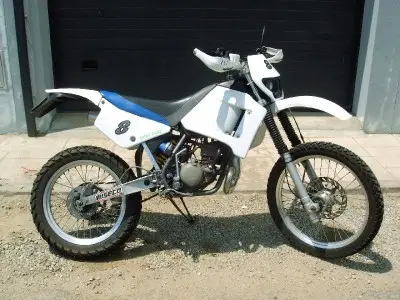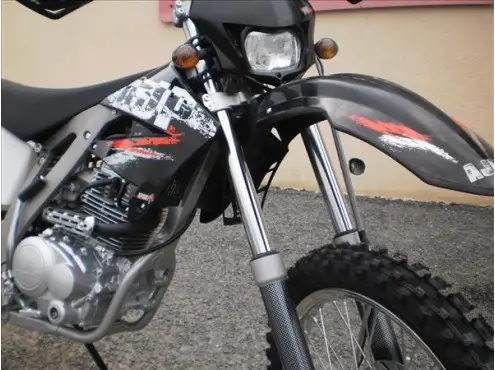
AJP Motos is a Portuguese maker of enduro and off-road motorcycles, all of them single-cylinder. The firm was founded in 1987 in Penafiel by the brothers António and Jorge Pinto, grew out of a workshop that prepared off-road bikes, and raced its way to five consecutive Portuguese enduro titles between 1996 and 2000.
AJP enduro at a glance
| Maker | AJP Motos, Portugal |
|---|---|
| Founded | 1987 in Penafiel, northern Portugal |
| Founders | brothers António and Jorge Pinto |
| Type | enduro and off-road motorcycles, single-cylinder |
| Name | initials of António J Pinto, seven-time Portuguese enduro champion |
| First model | Ariana 125 (1987), Casal two-stroke engine, 25 built |
| Enduro titles | five in a row, 1996–2000 |
| Off-road titles | 1996, 1997 and 1999 |
| First four-stroke | PR4 125, 2001 |
| Range | PR3, PR4 and PR5 four-strokes; PR7 adventure bike |
| Factory | Penafiel until 2003, Lousada afterwards |
AJP has no separate Wikipedia page for its enduro line, so this article is based on one source: the articles about the company in English and Portuguese, which largely duplicate each other. No free photographs of AJP enduro models are available, so the page keeps the image already attached to the record.
History of the AJP enduro
António Pinto opened a motorcycle repair and modification workshop in 1981, aged 22, and specialised in preparing off-road machines. In 1987 the workshop became AJP Motos and built its first motorcycle, the Ariana 125, with a two-stroke Casal engine. Only 25 were made, but the model established the firm and the initials it took from Pinto, a seven-time Portuguese enduro champion.
The early 1990s brought a partnership with the oil company Petrogal, now Galp Energia, which produced the small Galp 50 and a range of synthetic two-stroke oils. On the track the results were better still: AJP competed in the Portuguese national enduro championship from 1991 to 2000 and won five consecutive titles from 1996, adding national off-road championship victories in 1996, 1997 and 1999.
The real change came in 2001 with the PR4 125, the firm’s first four-stroke. Its engine was closely based on the Honda XR single, and the fuel tank moved beneath the seat to lower the centre of gravity. A 200 cc version followed in 2004, and by then AJP was exporting to France, Germany, England, Spain, Poland, Italy and Greece. The PR3 200 MX of 2007 introduced a light frame of steel tubing and twin aluminium spars; a homologated 99 kg PR3 with a 12.3 bhp 125 cc engine appeared in 2008, and 19 bhp 200 cc models in 2009. The PR5 of 2009 was a fuel-injected 250 cc machine of 115 kg, and the PR7 adventure bike arrived as a 650 cc prototype in 2014 and went into production in 2016 with a 600 cc engine.
Design and features
- Enduro first: every AJP is built for enduro or off-road use, with a single-cylinder engine.
- XR-derived four-strokes: the PR3, PR4 and PR5 engines are closely based on the Honda XR series.
- Light frames: steel tubing with twin aluminium spars on the PR3, plus disc brakes, a cast-alloy swingarm and a composite silencer.
- Classes for every rider: the trail-orientated PR3 with conventional forks, the clubman enduro PR4 and PR5 with upside-down forks, and the 600 cc PR7 adventure bike.
- Homologated models: road-legal versions such as the 2008 PR3 and the 2009 PR5 opened markets beyond Portugal.
AJP enduro versions
- PR3: the light trail bike with conventional forks, in 125 cc and 200 cc form.
- PR4: the four-stroke enduro of 2001, later built as a 200 cc.
- PR5: the fuel-injected 250 cc of 2009, 115 kg, with liquid cooling from 2016.
- PR7: the 600 cc adventure single, 165 kg wet, presented as a prototype in 2014.
- 125MR SuperMoto: a learner model on the PR3 frame with road tyres and reduced ground clearance.
The four-stroke that started the modern range is described in AJP PR4, and the firm’s earliest partnership model in AJP Galp 50. More models are in the AJP collection.
Sources
- AJP Motos, English Wikipedia: history, racing titles, PR range
- AJP Motos, Portuguese Wikipedia: founding, factory moves, PR3 details