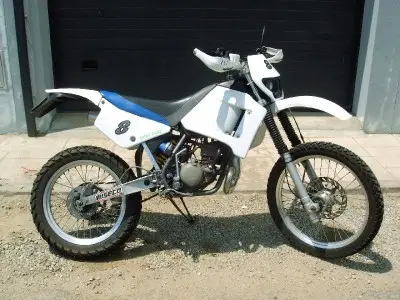
The AJP Galp 50 was developed in 1991, when the young Portuguese firm AJP Motos joined in partnership with the oil company Petrogal, now Galp Energia. The deal produced the motorcycle and a range of synthetic oils for two-stroke engines, and it gave the small Penafiel manufacturer a place in the Portuguese fuel brand’s marketing.
AJP Galp 50 at a glance
| Maker | AJP Motos, Penafiel, Portugal |
|---|---|
| Model | AJP Galp 50 |
| Year | 1991 |
| Partner | Petrogal, now Galp Energia |
| Also from the deal | a range of synthetic two-stroke oils |
| Company founded | 1987, by brothers António and Jorge Pinto |
| First model | Ariana 125 (1987), with a Casal two-stroke engine, 25 built |
| Place in the range | AJP’s early two-stroke years, before the four-stroke PR4 of 2001 |
| Racing at the time | Portuguese enduro championship, 1991–2000 |
| Factory | Penafiel until 2003, then Lousada |
AJP has no separate Wikipedia page for the Galp 50; this short article is based on one source, the articles about the company in English and Portuguese, which cover the model in a single sentence. No free photographs of the Galp 50 are available, so the page keeps the image already attached to the record.
History of the AJP Galp 50
António Pinto opened a motorcycle repair and modification workshop in 1981, at the age of 22, and prepared off-road machines for local riders. AJP Motos was founded in 1987 in Penafiel, in northern Portugal, and its first model was the Ariana 125, named in the Portuguese article after Pinto’s daughter, who was born the same year. It used a two-stroke Casal engine and only 25 were built, but it carried technical solutions that the firm developed in later models.
In 1991 AJP joined in partnership with Petrogal, the Portuguese oil company that is now Galp Energia. The best-known result was the Galp 50, a small motorcycle that carried the fuel brand’s name; the partnership also produced a range of synthetic oils for two-stroke engines, and the Portuguese article adds that AJP tested unleaded petrol with additives as part of the work. The Galp 50 belongs to the period when AJP’s range was built around small two-strokes.
The same years were the busiest in AJP’s racing history. From 1991 to 2000 the firm took part in the Portuguese national enduro championship and won five titles in a row between 1996 and 2000, with further victories in the national off-road championship in 1996, 1997 and 1999. The competition experience fed into the road and off-road models that followed, starting with the four-stroke PR4 125 in 2001.
Design and features
- A partnership machine: developed with Petrogal and sold under the Galp name, which gave a small maker national visibility.
- Two-stroke era: the Galp 50 comes from the years before AJP’s first four-stroke, when the range was built on small two-stroke engines.
- Oil programme: the same 1991 agreement produced synthetic two-stroke oils, tested on AJP’s own machines.
- Portuguese racing connection: the model’s years coincide with AJP’s run of national enduro titles.
AJP Galp 50 versions
- Galp 50 (1991): the production model developed under the Petrogal agreement.
- Ariana 125 (1987): the firm’s first motorcycle, a two-stroke with a Casal engine, of which 25 were made.
- PR4 125 (2001): the four-stroke that followed and took AJP into export markets.
The four-stroke that came next is described in AJP PR4, and the company’s off-road range in AJP enduro motorcycles. More models are in the AJP collection.
Video: AJP 50
Video on YouTube.
Sources
- AJP Motos, English Wikipedia: Petrogal partnership, Galp 50, racing titles
- AJP Motos, Portuguese Wikipedia: partnership details, Ariana name, oil programme