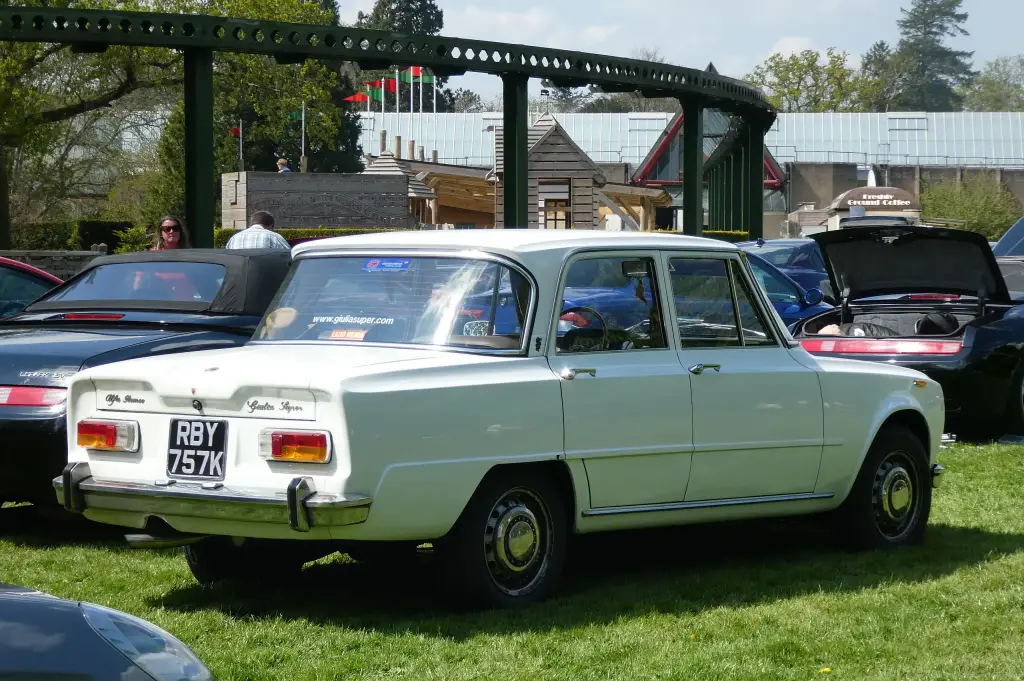
The Alfa Romeo Giulia of the Type 105 series is a four-door, entry-level compact executive sports saloon produced from 1962 to 1978. Alfa Romeo was one of the first mainstream manufacturers to put a powerful engine in a light-weight one-tonne four-door car for mass production, and the Giulia was praised for lively handling and acceleration.
Alfa Romeo Giulia (105) at a glance
| Production | 1962–1978 |
|---|---|
| Body | four-door saloon, boxy three-box shape |
| Engine | light-alloy twin-overhead-camshaft four-cylinder, 1,290 cc or 1,570 cc |
| Power | about 80 to about 110 bhp, depending on carburettors and tuning |
| Gearbox | 5-speed manual in most cases (the 1300 had four speeds) |
| Weight | about 1 tonne (2,205 lb) |
| Drag coefficient | Cd 0.34, wind-tunnel tested |
| Giulia Super (twin carburettor 1.6) | top speed 170 km/h (106 mph), 0–100 km/h in about 12 seconds |
| Giulia TI | 1,570 cc, 92 PS DIN at 6,200 rpm; unveiled 27 June 1962 at Monza |
This page is based on English Wikipedia only, so the figures could not be cross-checked against a second source.
History of the Alfa Romeo Giulia (105)
Giulia TI and the first models
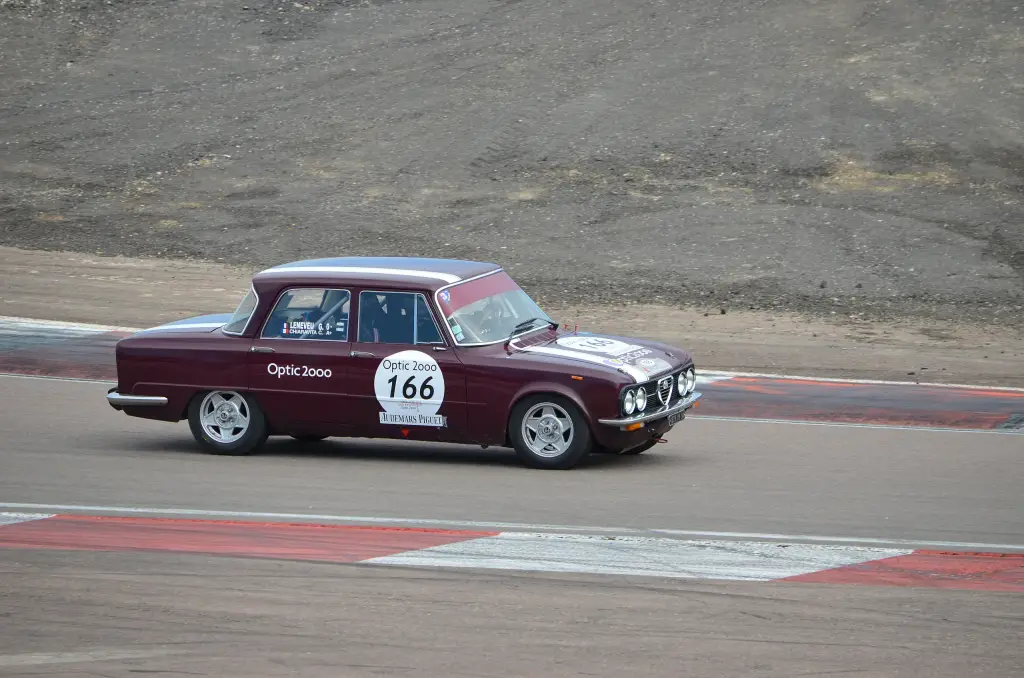
The Giulia TI was the first of the family, unveiled on 27 June 1962 at the Autodromo Nazionale Monza. Its 1,570 cc twin-cam engine with a single twin-choke carburettor produced 92 PS DIN. The name TI came from the Italian touring car racing class “Turismo Internazionale”. Production of the TI ceased in 1967, when the Giulia 1600 S became the entry-level 1.6-litre model. The Giulia TI Super of 1963, with two Weber carburettors and 112 PS DIN, was a limited-production road-going sports model aimed at racing, easily recognised by green quadrifoglios on the wings.
1300, Super and Nuova Super
The Giulia 1300, introduced on 11 May 1964 and built until 1971, entered the crowded 1.3-litre class with simplified trim and a 1,290 cc engine of 78 PS DIN; it was the only Giulia without a five-speed gearbox. The 1300 ti was built from 1965 to 1972, and the 1300 Super followed in 1970 with the engine of the GT 1300 Junior coupé. In 1972 the range was rationalised into the Giulia Super 1.3 and 1.6, and in 1974 the Nuova Super with a black plastic grille and a flat boot lid; production ceased in 1977.
Design and features
- Aerodynamics: a wind tunnel helped designers find a remarkably aerodynamic shape, with Cd 0.34, particularly low for a saloon of the era.
- Styling: a square, boxy three-box shape softened only by the detailing of the front and bonnet, roofline and boot.
- Performance: the Super’s acceleration was better than many sports cars of the late 1960s and early 1970s.
Alfa Romeo Giulia (105) versions
- Giulia TI (1962–1967): the first, 1,570 cc.
- Giulia TI Super (1963): limited-production racing-oriented model.
- Giulia 1300 (1964–1971) and 1300 ti (1965–1972): the 1.3-litre cars.
- Giulia Super (from 1965) and Nuova Super (1974–1977): the main later versions.
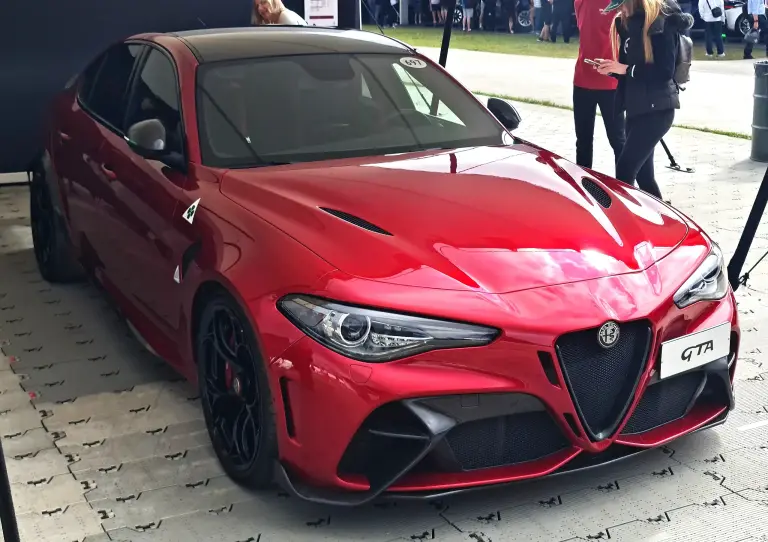
More Alfa Romeo cars of the 1960s are in our Alfa Romeo collection, for example the 105/115 coupés, the Alfa Romeo Spider and the Giulia GTA.
Alfa Romeo Giulia (105) questions and answers
What does TI mean on the Giulia?
Turismo Internazionale, an Italian saloon car racing class.
When was the Giulia (105) built?
From 1962 to 1978.
What engine does it have?
A light-alloy twin-cam four of 1,290 cc or 1,570 cc.
How fast is the Giulia Super?
About 170 km/h (106 mph), and 0–100 km/h in about 12 seconds.
What drag coefficient does it have?
Cd 0.34, particularly low for its era.
Sources
- Alfa Romeo Giulia (105), English Wikipedia: models, engines, performance