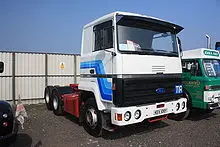
The Ford Transcontinental was a heavy goods vehicle tractor and rigid unit manufactured between 1975 and 1984 by Ford Europe in the Netherlands and Britain. A total of 8,735 units was produced, 8,231 in Amsterdam and another 504 at the Foden VAP works in Sandbach, Cheshire.
Ford Transcontinental at a glance
| Maker | Ford Europe, Amsterdam and Sandbach |
|---|---|
| Production | 1975–1984 |
| Built | 8,735, of which 504 at Foden |
| Cab | Berliet KB 2400 shell, also used by Renault |
| Engine | Cummins 14-litre, 290–350 hp |
| Engine generations | Cummins NTC, then big-cam NTE by 1979 |
| Gearbox | Eaton |
| Chassis | very strong, heavy-duty suspension |
| Dashboard | oil and water meters, unusual at the time |
| Why sales failed | too heavy for the British 32-ton limit |
This page is based on English Wikipedia only.
History of the Ford Transcontinental
Built from bought-in parts
The Transcontinental was assembled almost entirely from bought-in OEM components: the KB 2400 cab shell came from the Berliet GR and TR, a cab also used by Renault for its R-series, the engines from Cummins and the transmission from Eaton. It was introduced to fill a perceived gap in the market in anticipation of the relaxation of weight restrictions on heavy goods vehicles, and therefore had a very strong chassis and heavy-duty suspension.
Ahead of its time
Recognisable by its high cab, the Transcontinental was an advanced vehicle for its time, offering a high standard of driver comfort and high power for the period from the 14-litre Cummins engine, with typical outputs of 290 to 350 hp. The engines were originally of the Cummins NTC generation but were progressively updated to the new big-cam NTE generation, a process completed by 1979. The truck is also noted for having oil and water meters on the dashboard, another example of it being ahead of its time.
Too heavy to sell
Sales did not live up to expectations, mainly because the tractor unit with its heavy-duty construction was too heavy for the 32-ton weight limit in force in Britain at the time, although it was popular with drivers, particularly those on long-distance continental work. The model was updated continuously, with much work done to lighten the chassis. Today the Transcontinental is a rare vehicle, much admired by collectors of vintage commercials, although a few remain in revenue-earning service in Europe.
Design and features
- Mixed parentage: Berliet cab, Cummins engine and Eaton gearbox.
- High cab: a comfortable and powerful truck for its period.
- Unusual instruments: oil and water meters on the dashboard.
- Heavy chassis: strong enough for future weight limits, too heavy for the British 32-ton rule.
Ford Transcontinental versions
- Tractor unit: the long-distance version favoured by drivers.
- Rigid unit: the chassis-cab variant.
- Amsterdam-built trucks: 8,231 of the total.
- Sandbach-built trucks: 504 assembled by Foden.
The Transcontinental was Ford’s heaviest European truck, above the D series and the A series. More Ford vehicles are in the Ford collection.
Sources
- Ford Transcontinental, English Wikipedia: components, engines, production, sales