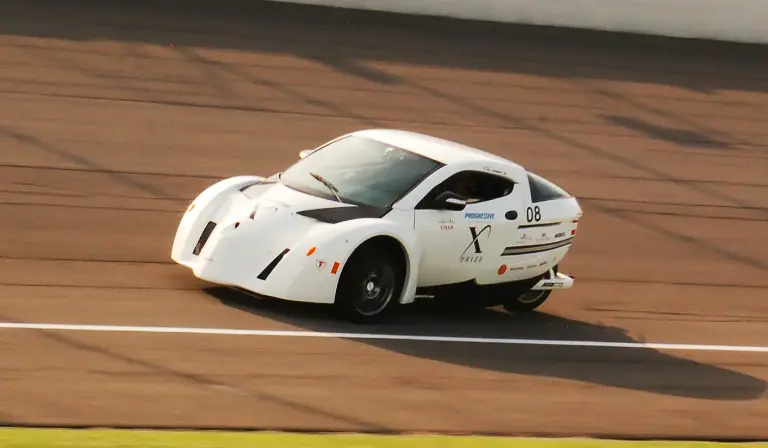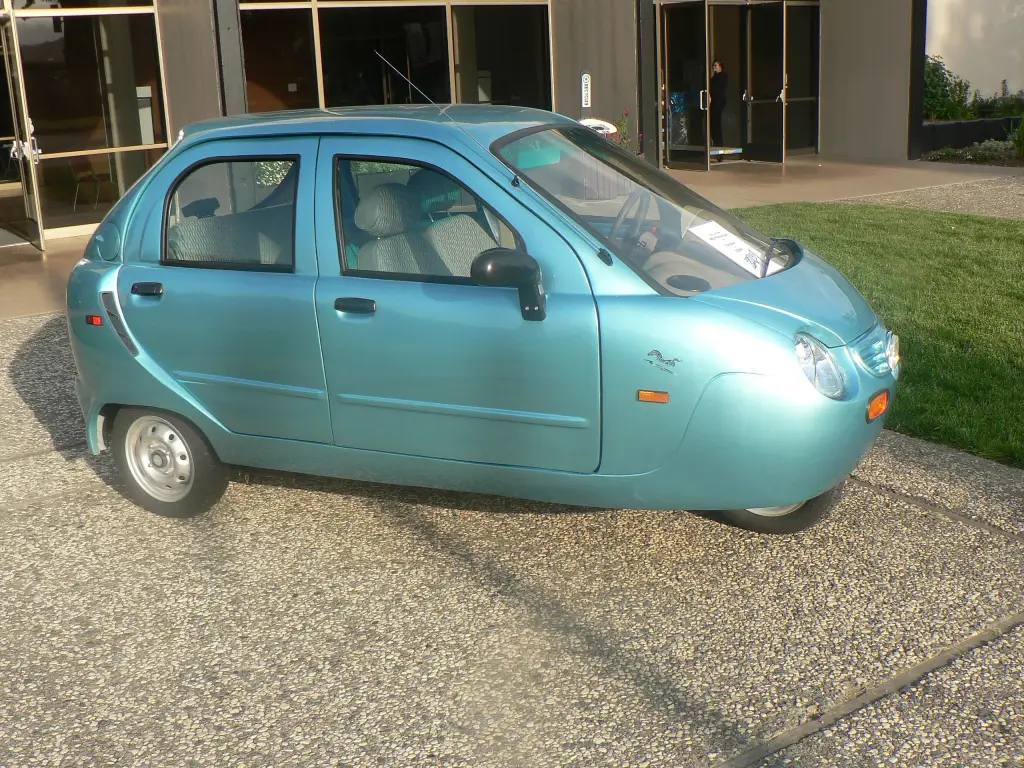
The ZAP Xebra was an electric car launched in May 2006 in the United States by ZAP corporation. Legally classed as a three-wheel motorcycle in many jurisdictions, it came as a four-door sedan (model SD) or a small pickup (model PK), and it was the first production vehicle imported from China to the United States.
ZAP Xebra at a glance
| Maker | ZAP corporation |
|---|---|
| On sale | 2006–2009 |
| Bodies | sedan SD, pickup PK, solar-roof Xero variants |
| Classification | three-wheel motorcycle in some jurisdictions |
| Top speed | 36–40 mph (58–64 km/h) |
| Range | 20–25 miles standard, up to 40 miles with extended batteries |
| Motor | 5 kW (6.7 hp) DC brushed, brushless from 2008 |
| Batteries | six 12-volt lead-acid gel traction batteries, 72 volts in total |
| Length × width × height | 2.90 × 1.42 × 1.54 m |
| Weight | about 1,800 lb |
| Seats | four in the sedan, two in the pickup |
| Brakes | three-wheel discs, no servo, no ABS, no regenerative braking |
| Built in | China |
Based on one source, the English Wikipedia article on the ZAP Xebra.
History of the ZAP Xebra
The Xebra appeared in the US market in May 2006, sold through licensed ZAP and Voltage Vehicle dealers. It was built in China and was the first production vehicle imported from that country to the United States. The pickup version, the PK, arrived late in 2006. The car had seat belts but no regenerative braking, and in many places it was registered as a motorcycle rather than a car.
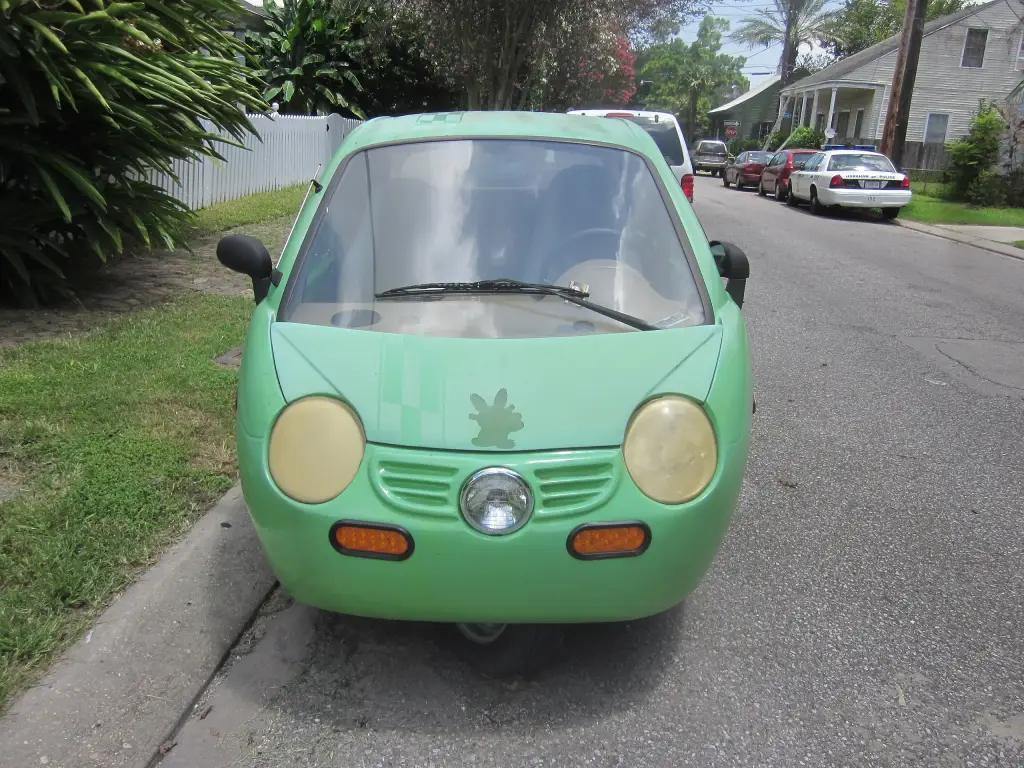
Owners reported that some early 2006 cars suffered from bodywork problems and from DC-to-DC converters, controllers and chargers that were not properly waterproofed and failed when wet. The 2007 cars were sealed against water, and later production brought further improvements as low-quality parts were eliminated and output moved to a more modern line. Even so, some replacement parts were hard to find.
A 2008 “version 6” Xebra sedan with an all-steel body entered production late that year. ZAP listed a price for the 2010 model year, but the Xebra was phased out after 2009. By then the company claimed that 500 sedans and pickups had been ordered by July 2007, while press reports put 2006 sales at more than 150 cars.
The steel-bodied 2008 cars proved troublesome. The extra weight over the fibreglass cars overwhelmed brakes that also lacked a master cylinder and warning lights for low fluid or pressure, and in January 2013 Quingqi Group Motorcycle Co. recalled all 2008 Xebras for a braking fault that could not meet the minimum stopping distance. The same cars had already been recalled in 2012 for the same problem. In 2013 the National Highway Traffic Safety Administration ordered the company to buy back the roughly 700 2008 models sold and have them destroyed or permanently disabled.
The Xebra also had a brief screen career: one was driven by the character Dean Berry, played by Bradley Whitford, in the seventh-season Monk episode “Mr. Monk on Wheels”, with a crudely attached solar panel on the roof.
Design and features
- Two body styles: a four-door, four-seat sedan and a PK pickup with a dump bed whose fold-down sides and tailgate gave access to the batteries, controller, motor and charger.
- Solar option: the Xero variants carried a rooftop solar panel for trickle charging, also offered over the PK load bed.
- Simple running gear: three-wheel disc brakes without servo or ABS, and no regenerative braking.
- Short-range urban transport: about 20–25 miles on the standard batteries, up to 40 miles with the extended pack.
ZAP Xebra versions
- SD sedan: four doors and four seats, limited by a 500 lb (227 kg) weight rating.
- PK pickup: two seats and a 1,000 lb (460 kg) listed cargo capacity, with a dump bed.
- SD Xero and PK Xero: versions with a solar panel on the roof or over the load bed.
- 2008 version 6: all-steel body, brushless DC motor and 140 A·h absorbed glass mat batteries.
The Xebra was ZAP’s volume model; the company’s three-wheeled sports car project is described in the ZAP Alias article. More electric vehicles are in the ZAP collection.
Sources
- ZAP Xebra, English Wikipedia: history, specifications, recall, television appearance