The ZAP Alias Roadster was a proposed plug-in electric three-wheeled sports car from ZAP, the electric vehicle maker based in Santa Rosa, California. Developed with help from Lotus Engineering, it was shown as a running prototype and driven in the Progressive Insurance Automotive X Prize, but the project died with its company before any car reached customers.
ZAP Alias at a glance
| Maker | ZAP, Santa Rosa, California |
|---|---|
| Class | proposed three-wheeled electric sports car |
| Project start | 2007, with Lotus Engineering |
| Planned production | Kentucky, then Zhejiang Jonway in China from 2010 |
| Wheels | three: two at the front, one at the rear |
| Drive | electric wheel-motors in the front wheels |
| Announced 2008 | 0–60 mph in 5.7 s, 156 mph, 100 miles of range |
| Revised 2010 | 216-volt AC induction motor, 0–60 mph in 7.8 s, 75 mph |
| Homologation | as a motorcycle |
| Gearbox | BorgWarner single-speed eGearDrive |
| Outcome | never produced; ZAP collapsed on or before 2017 |
Based on one source, the English Wikipedia article on the ZAP Alias.
History of the ZAP Alias
The Alias was announced in 2007 as a collaboration between ZAP and Lotus Engineering, the British engineering consultancy, which helped to develop the car. The plan was to build it in Kentucky, but that production facility fell through, and in 2010 ZAP said that Zhejiang Jonway Automobile would be contracted to manufacture the car in China. A first pre-production unit was unveiled at the NADA convention in 2009.
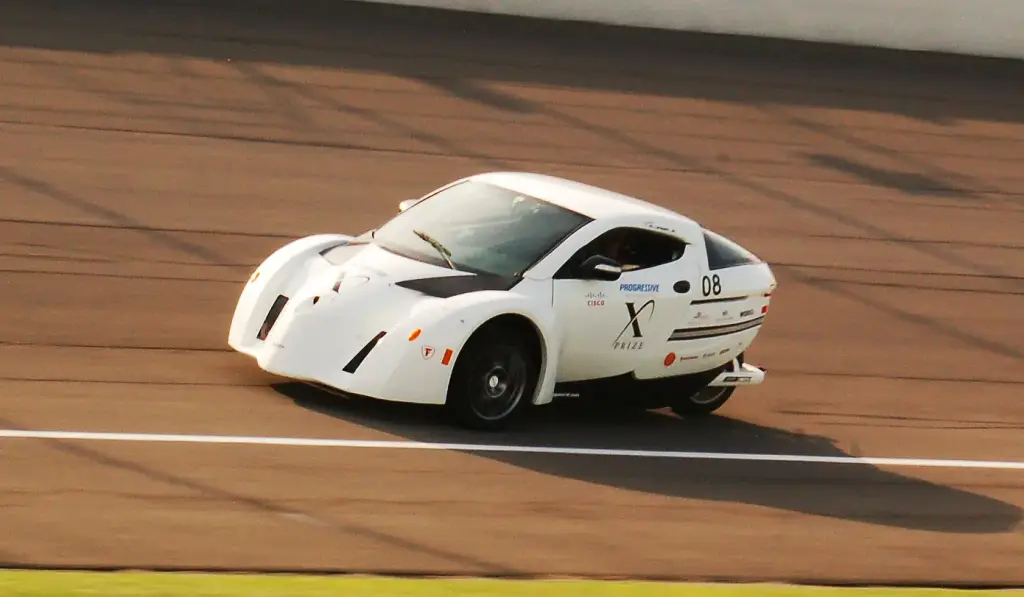
The layout was unusual: three wheels, two at the front and one at the rear, with an electric wheel-motor in each front wheel. The batteries sat underneath the vehicle in a reinforced composite battery box, keeping the centre of gravity low. The figures announced in 2008 were ambitious for the class: 0–60 mph (0–97 km/h) in 5.7 seconds, a top speed of 156 mph (251 km/h) and a range of 100 miles (160 km).
By the time of the 2010 North American International Auto Show in Detroit, the company had published revised specifications for its 216-volt AC induction motor prototype: 0–60 mph in 7.8 seconds, a top speed of 75 mph (121 km/h) and a range of up to 100 miles. The car was to be homologated as a motorcycle. With the collapse of ZAP on or before 2017, the Alias never went into production and the fate of the prototypes is unknown.
The Alias was one of 136 vehicles from 111 teams registered for the Progressive Insurance Automotive X Prize, a competition for clean, production-capable vehicles exceeding 100 mpg energy equivalent. It came through the preliminary stages at Michigan International Speedway and survived the shakedown completed on 13 May 2010, after which 22 teams remained. Driven by Al Unser Jr., it qualified for the finals in July alongside eight other vehicles, but in the efficiency and performance run it stopped at 97 miles of the 100-mile distance when a controller setting triggered the automatic safety system, placing the team fourth in that event.
Design and features
- Three-wheel layout: two front wheels and one rear wheel, with the front pair driven by hub-mounted electric motors.
- Low-mounted battery pack: the cells sit under the floor in a reinforced composite box.
- Lotus involvement: the British engineering firm helped develop the car from 2007.
- X Prize finalist: one of nine vehicles that reached the final stage of the 2010 competition.
- Motorcycle homologation: planned as a three-wheel motorcycle rather than a car.
ZAP Alias versions
- 2008 specification: the original announcement with 0–60 mph in 5.7 s and a 156 mph top speed.
- 2010 prototype: 216-volt AC induction motor, 0–60 mph in 7.8 s, 75 mph limited top speed.
- X Prize racer: the competition car with a BorgWarner single-speed eGearDrive gearbox.
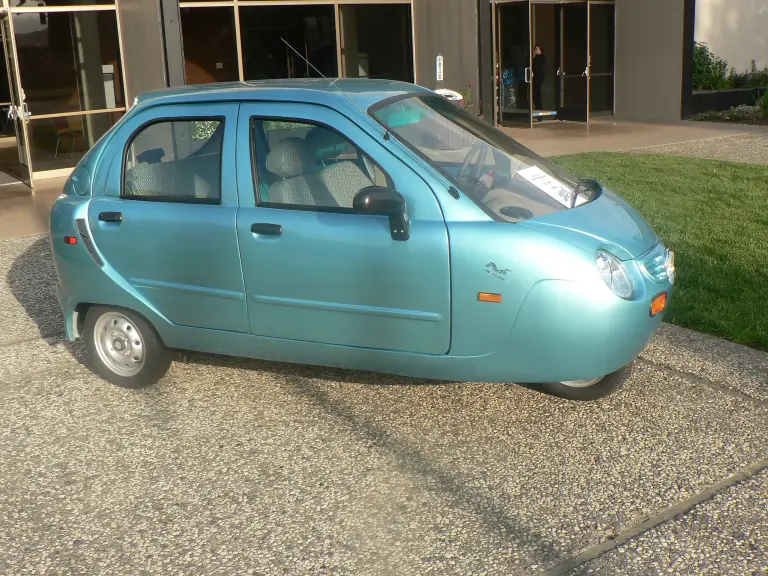
The Alias was the ambitious end of ZAP’s range; the company’s actual production car of the period was the small ZAP Xebra. More electric vehicles are in the ZAP collection.
Sources
- ZAP Alias, English Wikipedia: history, specifications, X Prize results