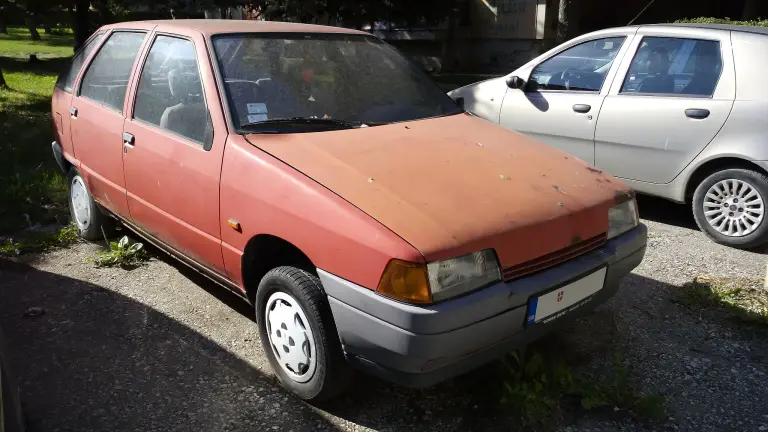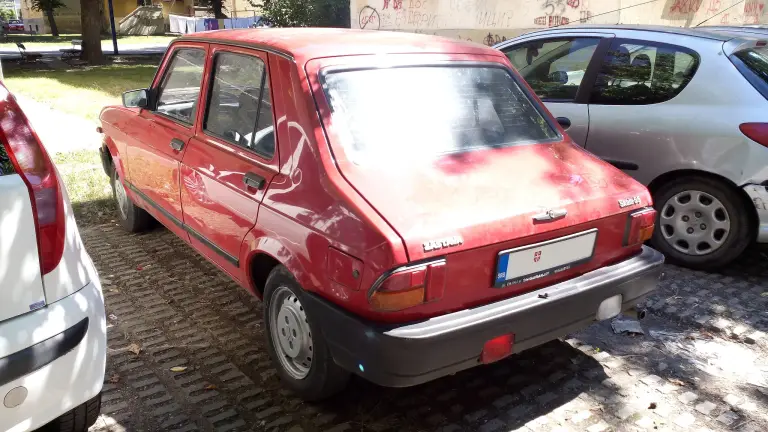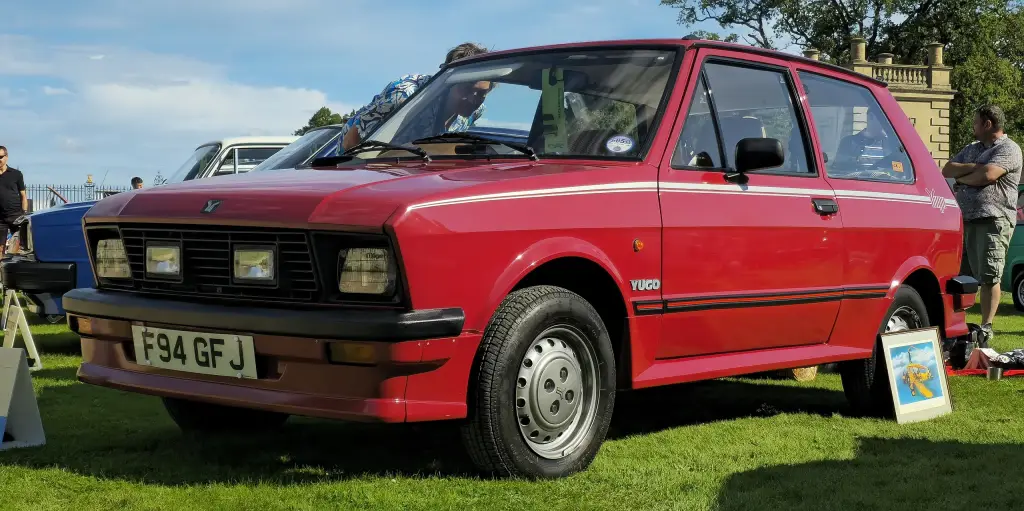
The Yugo Koral, also called the Zastava Koral or simply the Yugo, was a subcompact hatchback built by Zastava Automobiles in Kragujevac from 1980 until 2008. A shortened version of the Fiat 128, it became the best-known Yugoslav car abroad, above all in the United States, where it was sold as the Yugo GV.
Yugo Koral at a glance
| Maker | Zastava Automobiles, Kragujevac |
|---|---|
| Production | 1980–2008 |
| Based on | shortened Fiat 128 |
| Original name | Zastava Jugo 45 |
| Engines | 903 cc 45 hp; 1.1 L 55 or 60 hp; 1.3 L 65 hp |
| US name | Yugo GV and sub-versions |
| US sales | 1985–1992, 141,651 cars |
| Best US year | 1987, 48,812 cars |
| Last US year | 1992, 1,412 cars |
| Facelift | Zastava Koral IN |
| Total built | more than 794,000 |
| Also sold as | Innocenti Koral in Italy |
Based on one source, the English Wikipedia article on the Yugo, which covers the whole Koral range.
History of the Yugo Koral
A shortened Fiat 128
The Koral was designed as a shortened variant of the Fiat 128, which Zastava already built under licence. Series production started in 1980. The car was originally named the Zastava Jugo 45, after its 45-horsepower 903 cc engine, and it was most often marketed as the Yugo 45, 55, 60 or 65, the number always referring to maximum power.
The American years
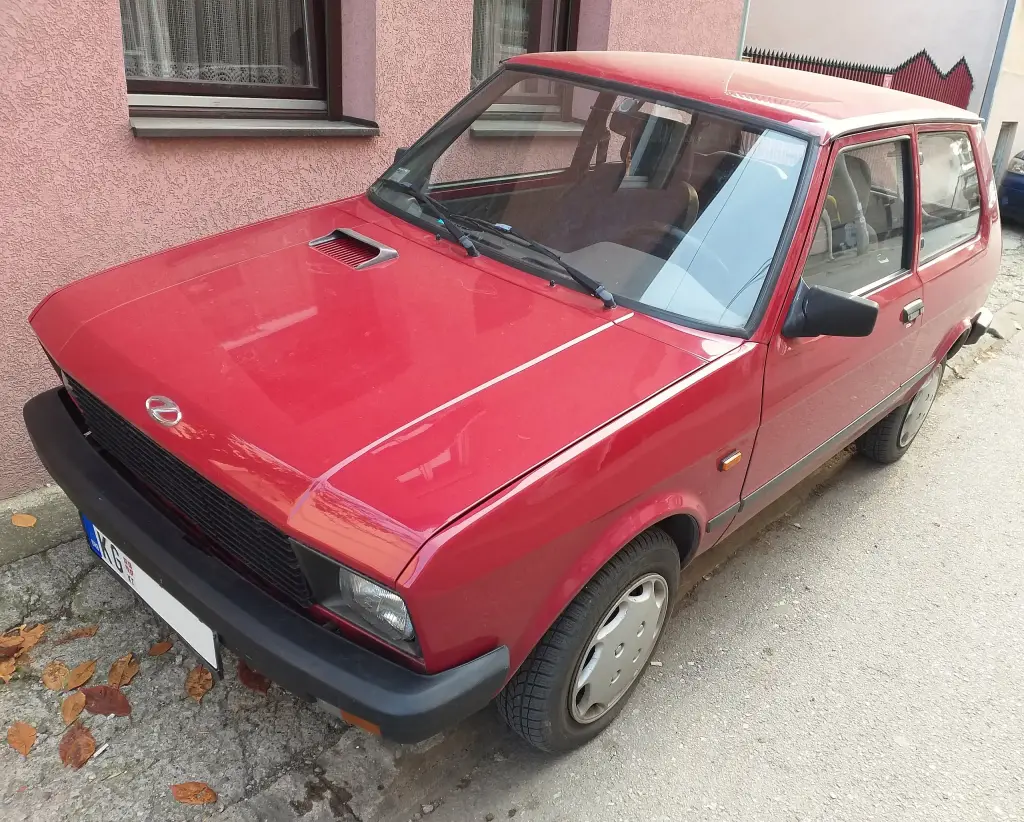
From 1985 to 1992 the car was marketed in the United States by Malcolm Bricklin, who asked Jerry Puchkoff to conceive and produce the market introduction and launch. The American version was called the Yugo GV, with Plus Automatic, Sport, GVC, GVL, GVS and GVX sub-versions. Sales totalled 141,651 cars, peaked at 48,812 in 1987 and fell to 1,412 in 1992. The car was criticised for its design, poor safety and reliability, yet it gained a cult following.
Later models
Near the end of its life Zastava sold an updated Koral IN with central locking, a four-position headlamp leveling switch, a four-speaker audio system, electric windows, folding electro-adjustable mirrors and alloy wheels. Air conditioning and a Renault-designed three-speed automatic were optional. The Koral IN L used a Peugeot 1.1-litre engine of 60 PS and passed a European Union safety test supervised by the German TÜV. Production of all Zastava cars ended in 2008.
Design and features
- Simple mechanical layout: front-wheel drive and a choice of small four-cylinder engines, all built by the Belgrade company 21. Maj.
- Fuel injection late in life: the GVX-EFI used a Motronic MP3.1 system, later upgraded to Bosch Motronic M4.6 multiport injection with a catalytic converter and lambda sensor.
- Many nameplates: the same basic car was sold as Yugo 45, 55, 60, 65, Ciao, CL, Tempo and Innocenti Koral.
- Long production: 28 years in Kragujevac, ending with the facelifted Koral IN.
Yugo Koral versions
- Yugo 45: the original 903 cc, 45 hp model.
- Yugo 55 and 60: 1.1-litre versions with 55 or 60 hp; the 60 hp car used a Weber twin-barrel carburettor.
- Yugo 65: 1.3-litre, 65 hp; the 65A GLX was the top right-hand-drive trim in Britain.
- Yugo GV range: the American versions, from the basic GV to the GVX with a 1.3-litre fuel-injected engine.
- Yugo Cabrio: a convertible with an electric roof and modified bumpers, usually with a 1.1 carburettor or 1.3 injection engine.
- Zastava Koral IN: the final facelift, with restyled bumpers, body parts and interior.
The related Yugo Skala was the larger liftback built on the Fiat 128 saloon, and the Yugo Florida was Zastava’s most advanced model. More cars are in the Yugo collection.
Video: ZASTAVA YUGO KORAL IN 1.1
Video on YouTube.
Sources
- Yugo, English Wikipedia: history, models, US sales, production