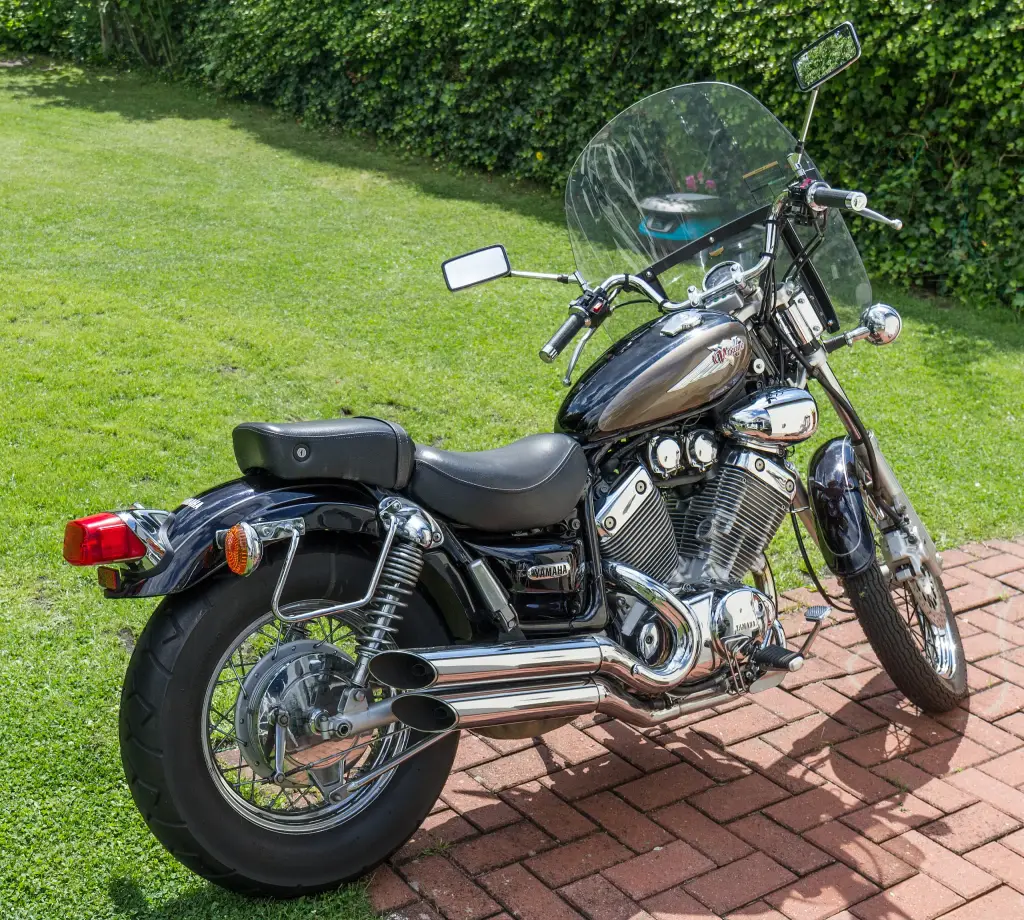
The Yamaha Virago was Yamaha’s first V-twin cruiser and one of the earliest mass-produced motorcycles with a mono-shock rear suspension. It appeared in 1981 with a 750 cc engine and grew into a large family of models.
Yamaha Virago at a glance
| Maker | Yamaha Motor Company |
|---|---|
| Class | Cruiser motorcycle |
| First model | 1981, 750 cc |
| Early additions | 500 cc and 920 cc |
| 1984 redesign | dual rear shocks and tear-drop tank |
| Tariff response | 750 reduced to 699 cc, 920 enlarged to 981 cc |
| Later large engine | 1,063 cc XV1100 |
| 250 cc model | added in 1988 |
| 125 cc model | short production, 1997–2000 |
| Last Virago | 2007 Virago 250 |
| Successors | V-Star and Road Star series |
Based on one source (English Wikipedia).
History of the Yamaha Virago
The Virago was Yamaha’s first V-twin cruiser. It was originally sold in 1981 with a 750 cc engine, and Yamaha soon added 500 cc and 920 cc versions. It was also one of the earliest mass-produced motorcycles to use a mono-shock rear suspension.
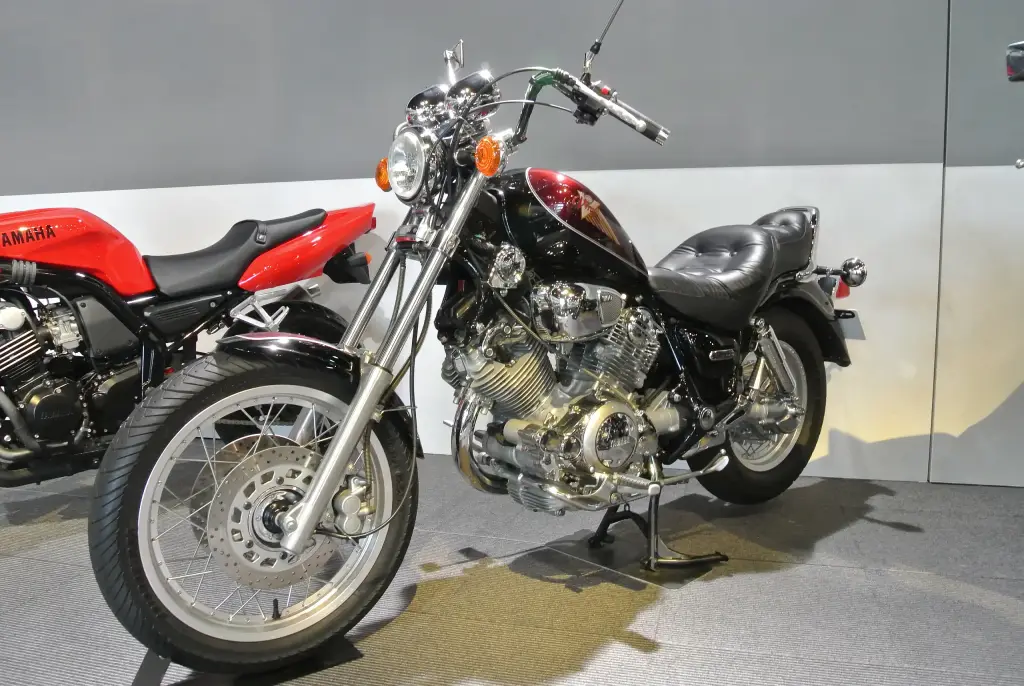
The bike was redesigned in 1984, switching from a rear mono-shock to a dual-shock layout and gaining a tear-drop-shaped fuel tank. That year Harley-Davidson, worried about the inroads made in the United States by the Virago and other Japanese cruisers, pushed for a tariff on imported motorcycles over 700 cc. Yamaha replaced the 750 cc engine with a 699 cc version to avoid the tariff, while the 920 cc engine grew to 981 cc as the XV1000 and later to 1,063 cc as the XV1100. A 250 cc XV250 was added in 1988, and a 125 cc model had a short production run from 1997 to 2000.
Over the years Yamaha built XV125, XV250, XV400, XV500, XV535, XV700, XV750, XV920R, XV1000, XV1600 and XV1900 versions, with the XV400SCLX the rarest. The XV125, XV250, XV920R and XV1000/TR1 were chain driven, while the others used shaft drive. The larger Viragos were eventually phased out and replaced by the V-Star and Road Star series, but their engines lived on: a facelifted XV750/1100 unit powered the V-Star 1100, and a slightly enlarged XV400/535 engine powered the V-Star 650. The last motorcycle to carry the Virago name was the 2007 Virago 250, renamed V-Star 250 for 2008.
Design and features
- First Yamaha V-twin cruiser: the model that established Yamaha in the class.
- Mono-shock rear: unusual for a cruiser when the Virago was launched.
- Many capacities: from 125 to 1,100 cc over the model’s life.
- Engine legacy: Virago engines continued in the V-Star 650 and 1100.
Yamaha Virago versions
- XV750 (1981–): the original 750 cc Virago.
- XV500 and XV535: middleweight versions.
- XV920R, XV1000 and XV1100: larger cruisers, some chain driven.
- XV250 (1988–2007): small Virago, renamed V-Star 250 in 2008.
- XV125 (1997–2000): short-lived 125 cc model.
The Virago was replaced by the DragStar and Road Star lines. More models are in the Yamaha collection.
Sources
- Yamaha Virago, English Wikipedia: history, engines, tariff, model list, successors