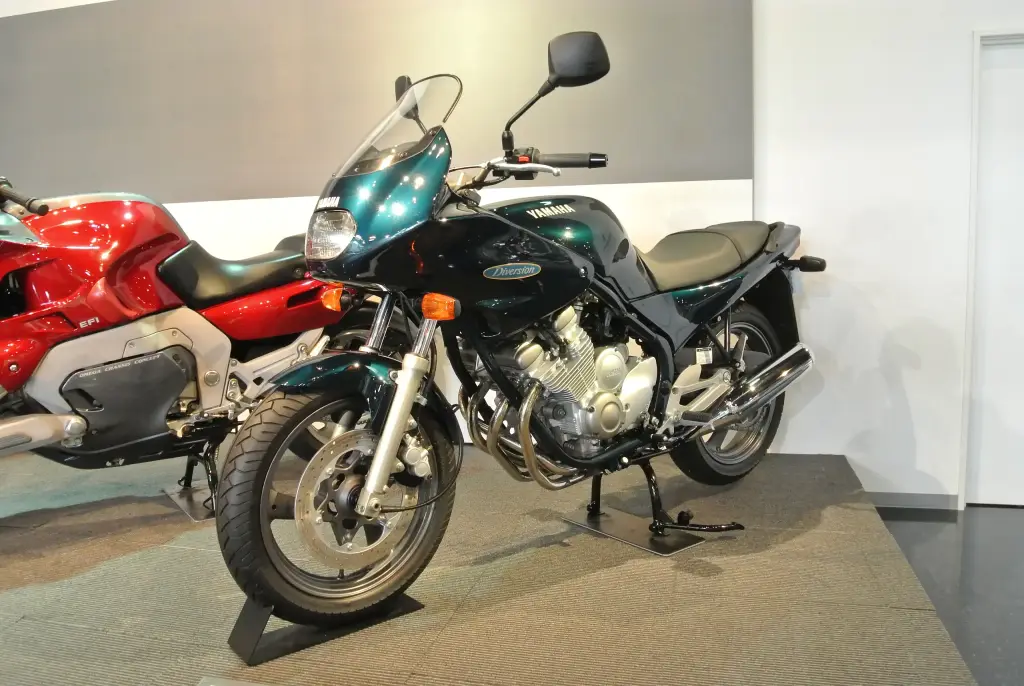
The Yamaha Diversion is a series of practical all-round touring motorcycles descended from Yamaha’s earlier XJ models. It started with the XJ600S in 1992 and was relaunched in 2009 with a new liquid-cooled XJ6 range.
Yamaha Diversion at a glance
| Maker | Yamaha Motor Company |
|---|---|
| Class | All-round touring motorcycle |
| First model | XJ600S Diversion, 1992 |
| XJ600S engine | 598 cc air-cooled 8-valve inline-four |
| XJ600S power | 61 hp (45 kW), 55 N·m |
| 600 production | 1992–2004 |
| US name | Seca II (1992–1998) |
| XJ900 engine | 892 cc air-cooled 8-valve inline-four |
| XJ900 power | 89 hp (66 kW), 85 N·m |
| XJ900 drive | shaft |
| 2009 range | XJ6 Diversion, XJ6 N and XJ6 Diversion F |
| 2009 engine | 600 cc liquid-cooled 16-valve inline-four, 78 hp |
Based on one source (English Wikipedia).
History of the Yamaha Diversion
The Diversion line began with the XJ600S in 1992. Its 598 cc air-cooled eight-valve inline-four produced 61 hp and 55 N·m, tuned for low and mid-range power rather than a high peak. The riding position was more upright than on most 600 cc sport bikes, which made the bike easy to use for commuting. It was sold in North America and Australia as the Seca II, and the 600 cc models remained in production until 2004.
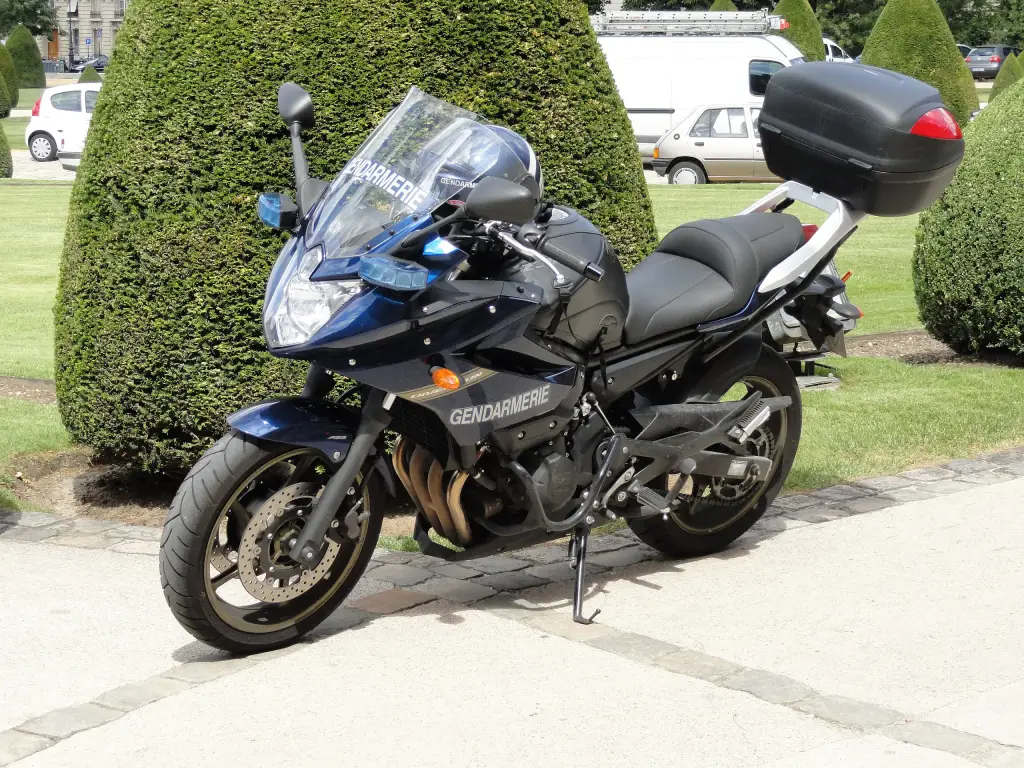
A naked XJ600N followed, almost identical apart from its lack of fairing and a different instrument panel that turned with the handlebars. The larger XJ900S and XJ900GT used an 892 cc air-cooled inline-four with 89 hp and 85 N·m and shaft drive; the GT added a large fairing and two Krauser K2 panniers. Diversions also became police motorcycles around the world, generally the XJ900S and sometimes the XJ600S, commonly called the XJ900P.
In 2009 Yamaha relaunched the line as the XJ6 Diversion, XJ6 N and XJ6 Diversion F. These used a 600 cc liquid-cooled 16-valve inline-four derived from the Fazer engine, tuned to 78 hp and 59.7 N·m. The fully faired FZ6R was the American equivalent of the XJ6 Diversion F, but without ABS or the electronic immobiliser. A YBR125 Diversion was also offered in France around 2005.
Design and features
- Upright comfort: a riding position suited to commuting and touring rather than track use.
- Air-cooled fours: the original 600 and 900 cc engines were simple eight-valve inline-fours.
- Police service: XJ900S and XJ600S models were built to police specifications worldwide.
- 2009 reinvention: the XJ6 range moved to a liquid-cooled 16-valve engine.
Yamaha Diversion versions
- XJ600S Diversion / Seca II (1992–2004): half-faired 600 with a 598 cc air-cooled engine.
- XJ600N: naked version with a handlebar-mounted instrument panel.
- XJ900S and XJ900GT: 892 cc shaft-drive tourers, the GT with fairing and panniers.
- Police XJ900P: factory-built police specification, not a separate model.
- XJ6 Diversion, XJ6 N, XJ6 Diversion F (2009): liquid-cooled relaunch; the FZ6R was the US equivalent of the F.
The Diversion’s 2009 engine came from the FZ6 family, and the range overlapped with the FZ1. More models are in the Yamaha collection.
Sources
- Yamaha Diversion, English Wikipedia: models, engines, production years, police use, XJ6 range