The Wiesmann Roadster was the car that made the small workshop in Dülmen known. The first series model, the MF30, left the workshop in 1993; the improved MF3 used the engine of the BMW M3, and the open MF4 versions followed in 2009. Around 1,600 roadsters were built before production stopped in 2013.
Wiesmann Roadster at a glance
| Maker | Wiesmann GmbH, Dülmen, Germany |
|---|---|
| Class | two-seater roadster |
| First series model | MF30, 1993 |
| MF30 engine | BMW M54B30, 2,979 cc six-cylinder |
| MF30 power | 170 kW (228 hp; 231 PS) at 5,900 rpm |
| MF30 torque | 300 N·m at 3,400 rpm |
| MF30 weight | 1,080 kg dry |
| MF30 acceleration | 0–60 mph in 5.9 s, 230 km/h |
| MF3 engine | BMW S54 from the M3 (E46), 3,246 cc |
| MF3 power | 252 kW (338 hp; 343 PS) at 7,900 rpm |
| MF3 weight and speed | 1,180 kg, 0–60 mph in 5.0 s, 255 km/h |
| Gearbox | five-speed manual, six-speed sequential optional |
| Later open models | Roadster MF4 and MF4-S, Geneva 2009 |
| Roadsters built | around 1,600 between 1993 and 2013 |
The roadster models are described in sections of the English and German articles on the company; there is no separate article for the MF30 or MF3.
History of the Wiesmann Roadster
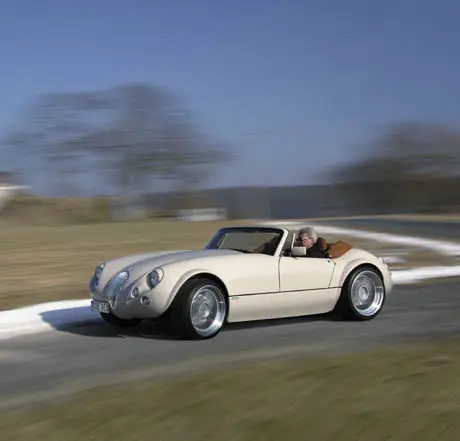
Wiesmann was founded in Dülmen in 1988 by the brothers Martin and Friedhelm Wiesmann, whose parents ran a car dealership in the town. The brothers first made hardtops for convertibles, then built their own car: in 1993 the roadster MF30 became the company’s first series model, an open two-seater with a folding roof and a body of glass-fibre reinforced plastic. The idea behind the gecko badge was that the cars “stick to the road like geckos to a wall”.
The MF30 used BMW’s M54B30 six-cylinder of 2,979 cc, which gave 170 kW (228 hp; 231 PS) at 5,900 rpm and 300 N·m of torque at 3,400 rpm. With a dry weight of 1,080 kg the car reached 60 mph in 5.9 seconds and a top speed of 230 km/h.
The MF3 replaced it with the same chassis but a stronger engine: the BMW S54 from the M3 (E46), of 3,246 cc, with 252 kW (338 hp; 343 PS) at 7,900 rpm and 365 N·m at 4,900 rpm. The weight rose to 1,180 kg, but acceleration to 60 mph fell to 5.0 seconds and the top speed to 255 km/h. A five-speed manual gearbox was standard, a six-speed sequential unit was optional, and 20-inch rims with 235/30/20 tyres in front and 285/25/20 at the rear could be ordered as well. Further variants of the roadster family were the MF25-4, the MF28 and the MF35.
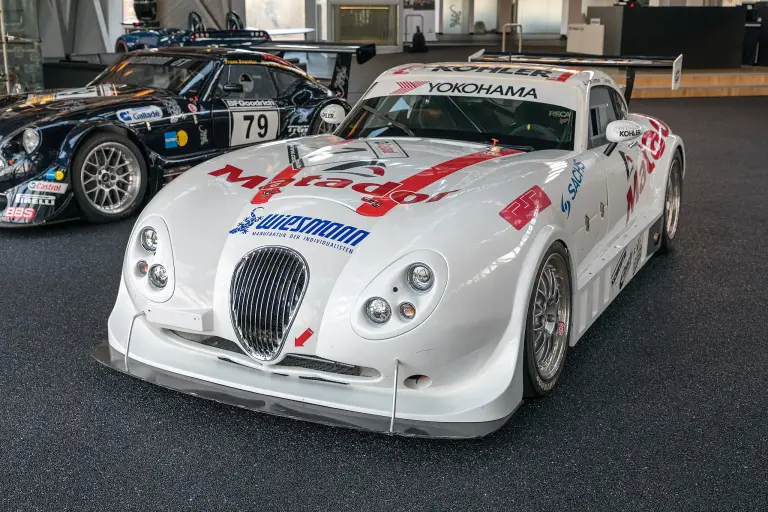
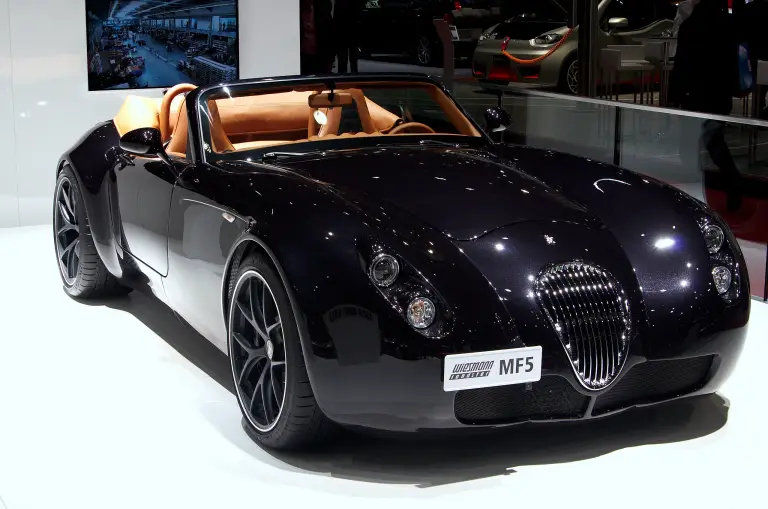
After twelve years of open cars only, Wiesmann added a coupé, the GT MF4, in 2003. At the Geneva Motor Show in 2009 the company showed the Roadster MF4 and Roadster MF4-S, with facelifted bodywork and an updated choice of engines, and the open MF5 followed at the Frankfurt IAA the same year. By the time production stopped in 2013, around 1,600 roadster series models had been built since 1993.
Design and features
- BMW engines: first the M54B30 six-cylinder, then the S54 from the M3, both mounted in a light glass-fibre body.
- Classic shape: a long bonnet, a short tail and a folding roof, in the style of 1950s British roadsters.
- Light weight: 1,080 kg for the MF30 and 1,180 kg for the MF3.
- Choice of gearboxes: five-speed manual as standard, six-speed sequential as an option on the MF3.
Wiesmann Roadster versions
- MF30 (from 1993): the first series roadster, 231 PS, 230 km/h.
- MF3: same chassis with the 343 PS engine of the BMW M3 and 255 km/h.
- MF25-4, MF28, MF35: further roadster variants of the same period.
- Roadster MF4 and MF4-S (2009): facelifted open cars with updated engines.
- Roadster MF5 (2009): the V10 version, limited to 55 cars, of which 43 were built.
The closed members of the family are described in the articles on the GT MF4 and the GT MF5. More cars from Dülmen are in the Wiesmann collection.
Sources
- Wiesmann GmbH, English Wikipedia: MF30 and MF3 engines, performance, MF4 roadsters
- Wiesmann (Unternehmen), German Wikipedia: founding, first series model, production total