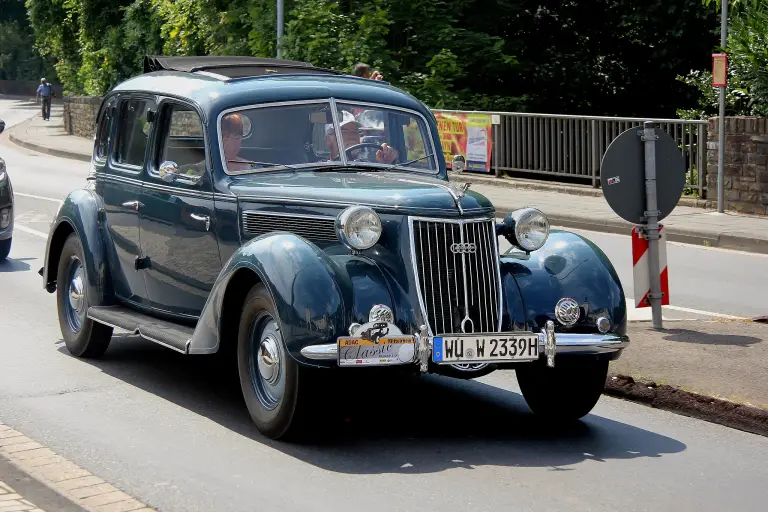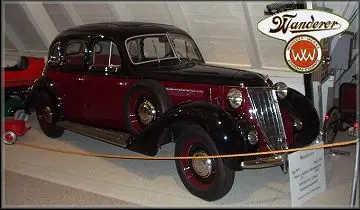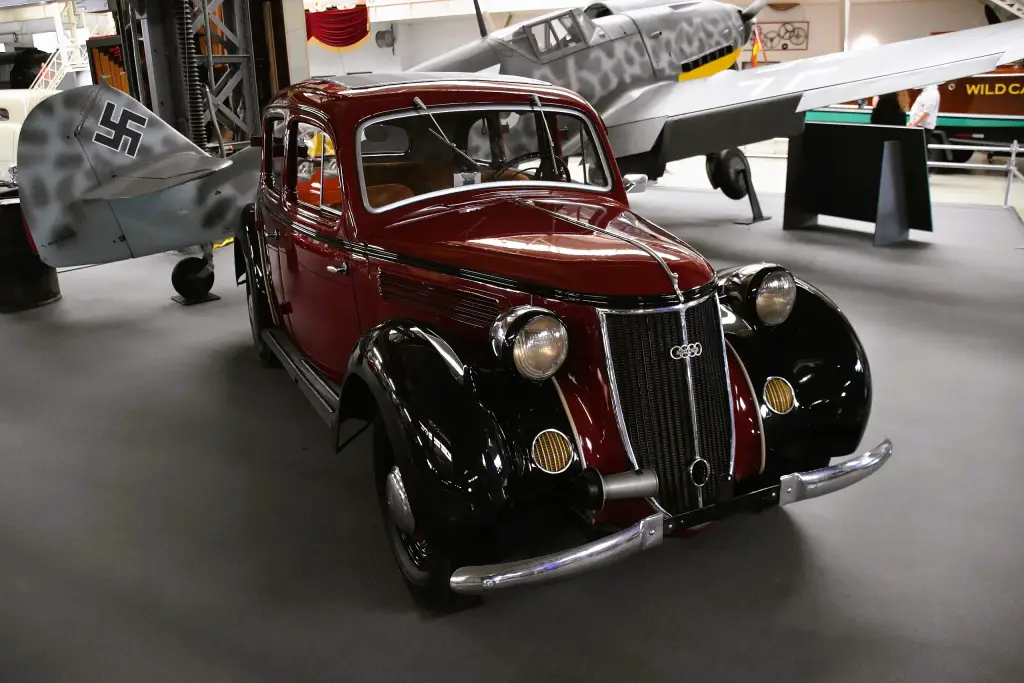
The Wanderer W24 was a middle class car introduced by Auto Union in 1937 as the successor to the Wanderer W35. Its 1.8-litre four-cylinder engine and DKW-derived rear suspension made it the most widely built Wanderer passenger car.
Wanderer W24 at a glance
| Maker | Auto Union AG, Wanderer works at Siegmar near Chemnitz |
|---|---|
| Production | 1937–1940 |
| Class | middle class car |
| Engine | 1,767 cc four-cylinder in line, side-valve |
| Power | 42 PS at 3,400 rpm |
| Drive | rear wheels through a four-speed gearbox with a central gear lever |
| Chassis | box frame, double wishbones at the front |
| Rear axle | swing axle of the type used by DKW |
| Wheelbase | 2.6 m |
| Electrical system | 6 volts |
| Bodies | two- and four-door saloons, four-door cabrio-limousine, four-seat touring car, two-door cabriolet |
| Built | 22,488 by 1940, of them 3,571 four-door cabrio-limousines |
History of the Wanderer W24
The W24 followed the W35 in 1937. Auto Union described it as a middle class car; its four-cylinder engine was, in effect, the six-cylinder W23 unit shortened by two cylinders. The side-valve engine displaced 1,767 cc and gave 42 PS at 3,400 rpm, driving the rear wheels through a four-speed gearbox with a central lever.
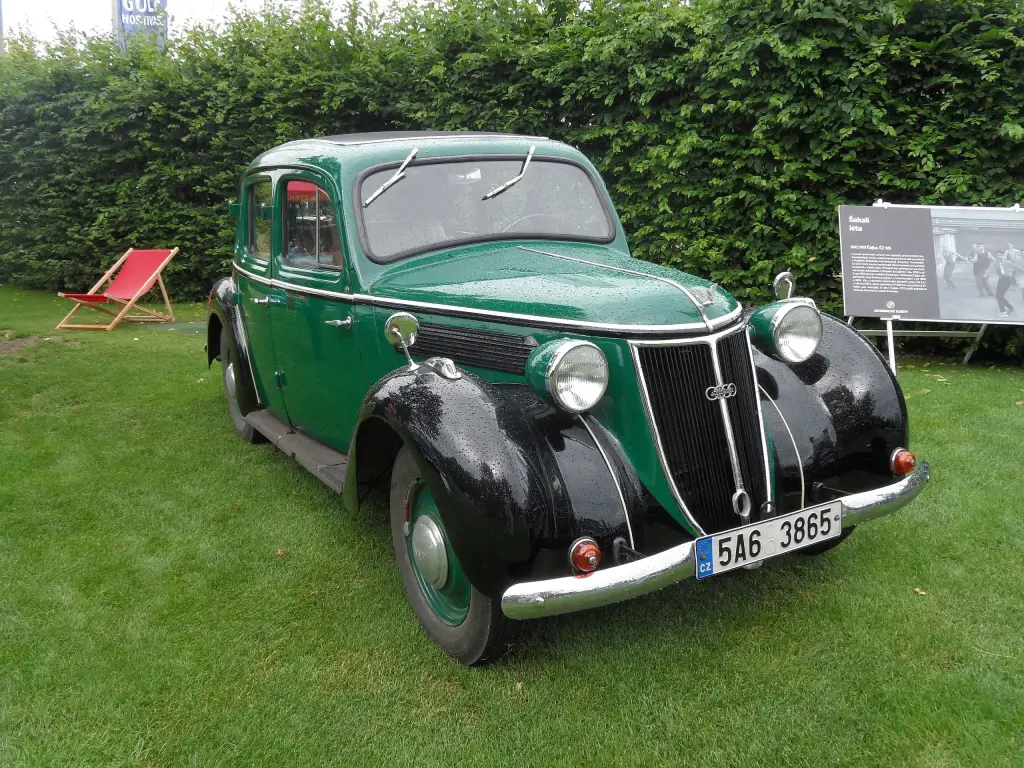
Under the body sat a box frame chassis. The front wheels were carried on double wishbones, while at the back the car used the swing axle arrangement of the small DKW models, a sister brand within Auto Union. The wheelbase measured 2.6 m and the electrical system stayed at 6 volts even though some larger models of the group had moved to 12.
The range was broad for a middle class car: saloons with two or four doors, a four-door cabrio-limousine, a four-seat touring car and a two-door cabriolet with four windows. The cabriolet was produced in small numbers – about 300 according to the English Wikipedia, while the German article gives 1,064. The same chassis and body were also used by the DKW “Sonderklasse”, which had a four-cylinder two-stroke V-engine.
By 1940, when the war put an end to passenger car production, 22,488 W24s had been built at Siegmar, including 3,571 four-door cabrio-limousines. That made it the most-produced Wanderer car. One W24 belonged to Sisir Kumar Bose, a nephew of the Indian nationalist Subhas Chandra Bose, who used the car when he escaped from house arrest and made his way to Germany.
Design and features
- Four-cylinder economy: the 1,767 cc side-valve engine gave 42 PS, and the car was cheaper to run than the six-cylinder W23.
- DKW rear axle: the swing axle came from Auto Union’s small car brand and gave modern rear suspension for the class.
- Wide body range: saloons, a cabrio-limousine, a touring car and a rare two-door cabriolet.
- Shared with DKW: the chassis and body also served the DKW “Sonderklasse”.
- Most-built Wanderer: 22,488 cars by 1940.
Wanderer W24 versions
- Two-door saloon: the simplest closed body.
- Four-door saloon: the standard family car.
- Four-door cabrio-limousine: 3,571 built, a semi-open body with a folding roof.
- Four-seat touring car: an open body without fixed side windows.
- Two-door cabriolet: the rarest version, with four windows.
The W24 was the four-cylinder stablemate of the six-cylinder Wanderer W23; the group’s other six-cylinder middle class model of the same year was the Wanderer W52. More cars are in the Wanderer collection.
Sources
- Wanderer W24, English Wikipedia: engine, chassis, bodies, the Bose car
- Wanderer W 24, German Wikipedia: production figures, body styles, DKW connection