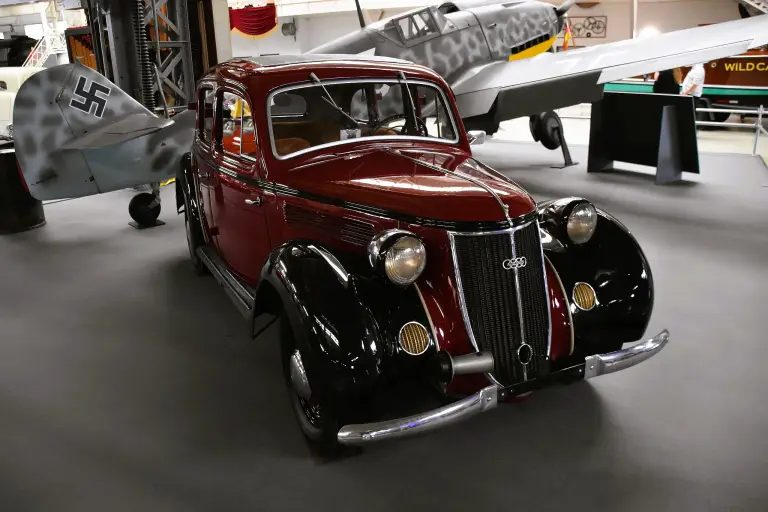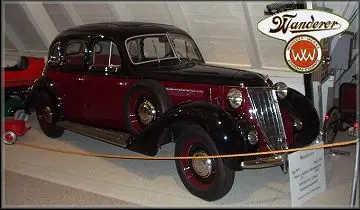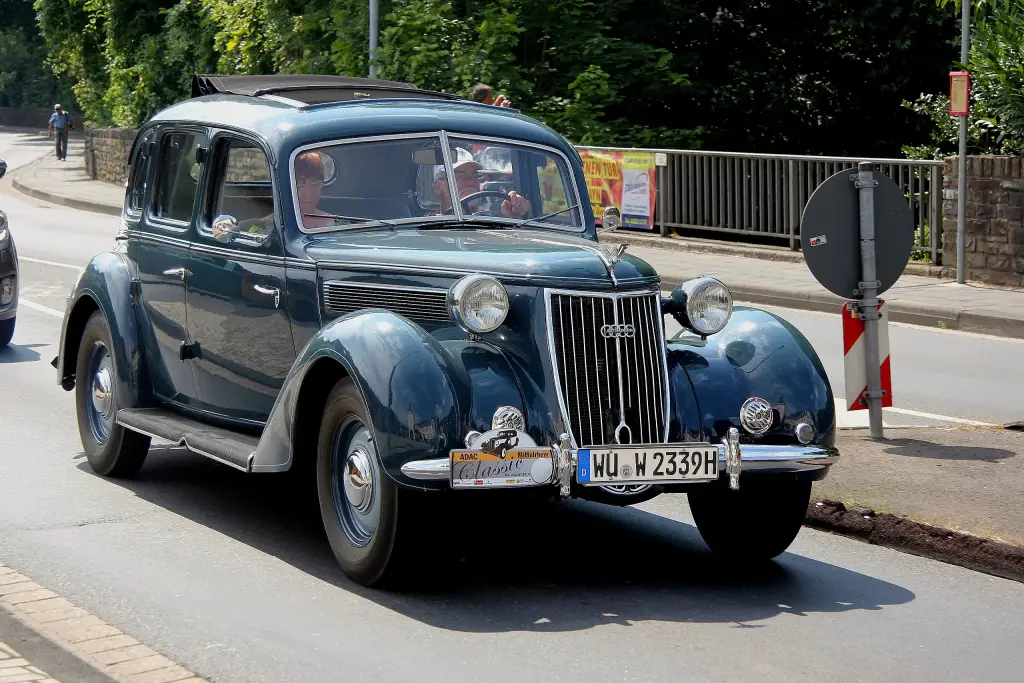
The Wanderer W23 was a middle class car of the upper bracket, built by Auto Union from 1937 to 1940. It replaced the W45 and W51 with a newly designed 2.65-litre six-cylinder engine and a shortened chassis.
Wanderer W23 at a glance
| Maker | Auto Union AG, Wanderer works at Siegmar near Chemnitz |
|---|---|
| Production | 1937–1940; a last batch of 100 cabriolets at the end of 1941 and the start of 1942 |
| Class | upper middle class car |
| Engine | 2,651 cc six-cylinder in line, side-valve |
| Power | 62 PS at 3,300 rpm |
| Drive | rear wheels through a four-speed gearbox with a central gear lever |
| Wheelbase | 2.9 m, 10 cm shorter than its predecessor |
| Rear axle | live axle with a high transverse leaf spring |
| Electrical system | 6 volts, reduced from 12 |
| Bodies | four-door saloon, two-door cabriolet, estate with external wood framing |
| Cabriolet bodies by | Gläser of Dresden |
| Sold | about 7,900 |
This page is based on one source, the German Wikipedia article on the Wanderer W 23.
History of the Wanderer W23
The W23 appeared in 1937 as the successor to the Wanderer W45 and W51. It was built at the Auto Union works at Siegmar near Chemnitz. The new engine was designed for the model: 2,651 cc from six cylinders, rated at 62 PS at 3,300 rpm. Compared with the earlier overhead-valve units it had side valves, yet it gave seven horsepower more.
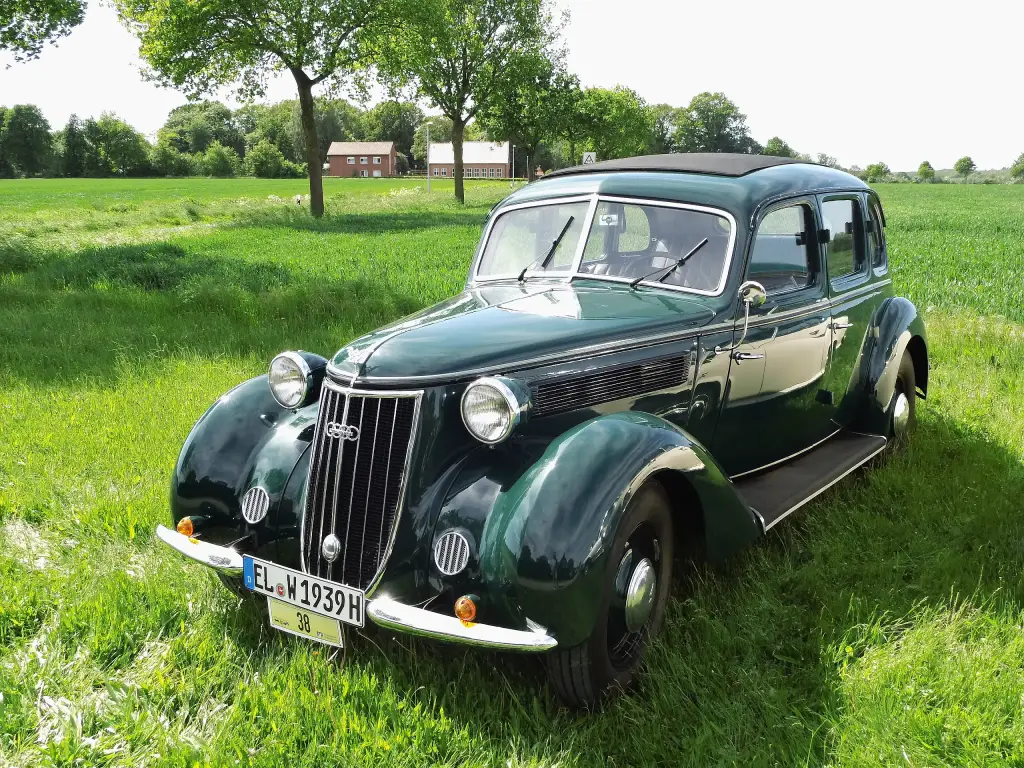
The chassis was shortened by 10 cm to a 2.9 m wheelbase, and the rear was changed from the costly swing axle to a live axle with a high transverse leaf spring. At the same time the electrical system dropped from 12 to 6 volts. Both changes were technical steps backwards, but they were needed to keep the price down. The cabriolet bodies were supplied by Gläser of Dresden on chassis delivered from Siegmar.
Alongside the W23 Auto Union built the Wanderer W26 with the same engine and a longer 3.15 m wheelbase as a touring car and a Pullman saloon, each with six seats; the W26 kept the swing axle of the earlier W50. The sister model W52 used the same engine, a 3 m wheelbase and the modern swing axle, but found only about 1,400 buyers. Passenger car production at Wanderer ended because of the war in 1941 and was not taken up again afterwards. At the end of 1941 and the start of 1942 a further 100 W23 cabriolets were built for the Reichsarbeitsdienst.
Design and features
- New six-cylinder engine: 2,651 cc and 62 PS, side-valve and seven horsepower stronger than the old overhead-valve units.
- Price-driven chassis: a shorter 2.9 m wheelbase, a simple live rear axle and a 6-volt electrical system replaced more expensive engineering.
- Three body styles: a four-door saloon, a two-door cabriolet and an estate with visible wood framing.
- Coachbuilt cabriolets: the open bodies were made by Gläser in Dresden.
Wanderer W23 versions
- Four-door saloon: the standard closed body.
- Two-door cabriolet: with a Gläser body, built in small numbers and again for the Reichsarbeitsdienst in 1941–1942.
- Estate with wood framing: a woody-style body with wood strips outside the panels.
- Wanderer W26: the related long-wheelbase six-seater with the same engine.
- Wanderer W52: the sister model with a 3 m wheelbase and a swing rear axle.
The W23 shared its six-cylinder engine with the Wanderer W52, while the smaller four-cylinder model of the same years was the Wanderer W24. More cars are in the Wanderer collection.
Sources
- Wanderer W 23, German Wikipedia: history, engine, chassis, bodies, production