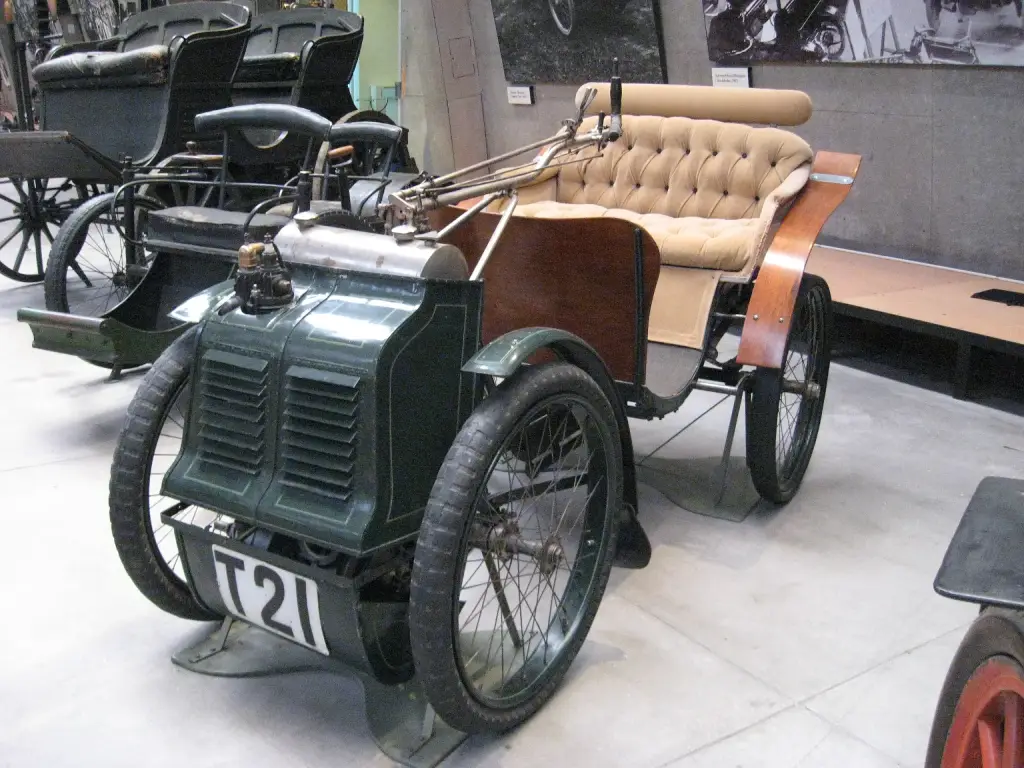
The Victoria Combination was the first motor vehicle of the Paris firm Société Parisienne E. Couturier et Cie. Introduced in 1899, it was a light two-seater with front-wheel drive, sold with a choice of Aster or De Dion-Bouton engines, and it remained in production until 1901, when conventional cars took its place.
Victoria Combination at a glance
| Maker | Société Parisienne E. Couturier et Cie, Paris |
|---|---|
| Production | 1899–1901 |
| Engine options | Aster or De Dion-Bouton |
| De Dion-Bouton engine | single cylinder, 239 cc, 66 x 70 mm |
| Power | 3.5 hp |
| Body | two-seater |
| Weight | 150 kg |
| Fuel tank | 5 litres |
| Range | about 100 km |
| Drive | front-wheel drive |
| Steering | worked over the whole front floor |
| Price | 2,900 francs |
| Built | about 400 |
Based on one source, the French Wikipedia article on the maker Société Parisienne; the car is described in its production section. No free photographs of the Victoria Combination were found, so the page keeps the previous cover image.
History of the Victoria Combination
The company behind the Victoria Combination grew out of a bicycle business. M. Renard had founded a bicycle factory in Paris in 1876 under the Parisienne name, and in 1899 the firm, now Société Parisienne E. Couturier et Cie, began to build motor vehicles and components as well. The first of them was the Victoria Combination, a voiturette aimed at buyers who wanted a light and simple machine rather than a full-sized automobile.
The car could be ordered with engines supplied by Aster or by De Dion-Bouton. In the De Dion-Bouton version the single cylinder measured 239 cc, with a bore of 66 mm and a stroke of 70 mm, and produced a maximum of 3.5 hp. The two-seater weighed only 150 kg. A 5-litre tank gave a range of about 100 km, and the complete vehicle sold for 2,900 francs.
Its most unusual feature was the transmission: the Victoria Combination had front-wheel drive, an arrangement still rare at the end of the nineteenth century. The steering was not a wheel or a tiller but a system that worked over the whole front floor, which the driver operated with the feet. Between 1899 and 1901 about four hundred cars were produced. From 1901 the company turned to conventional vehicles, and motor vehicle production ended in 1903.
Design and features
- Front-wheel drive: unusual in 1899, when most light cars drove the rear wheels.
- Light weight: the two-seater scaled 150 kg, which suited its small single-cylinder engine.
- Engine choice: Aster or De Dion-Bouton units could be specified.
- Floor steering: the steering system covered the whole front floor rather than using a wheel.
- Modest running costs: 5 litres of petrol was enough for about 100 km.
Victoria Combination versions
- De Dion-Bouton version: 239 cc single of 3.5 hp, the version described in the sources.
- Aster-engined version: offered as an alternative to the De Dion-Bouton engine.
- Later conventional models: from 1901 the firm built more ordinary cars instead.
The Victoria Combination was the first product of a firm that later built conventional cars. The Victoria KR 25 is a very different machine from a German namesake. More vehicles are in the Victoria collection.
Sources
- Société Parisienne E. Couturier et Cie, French Wikipedia: engine, weight, price, production