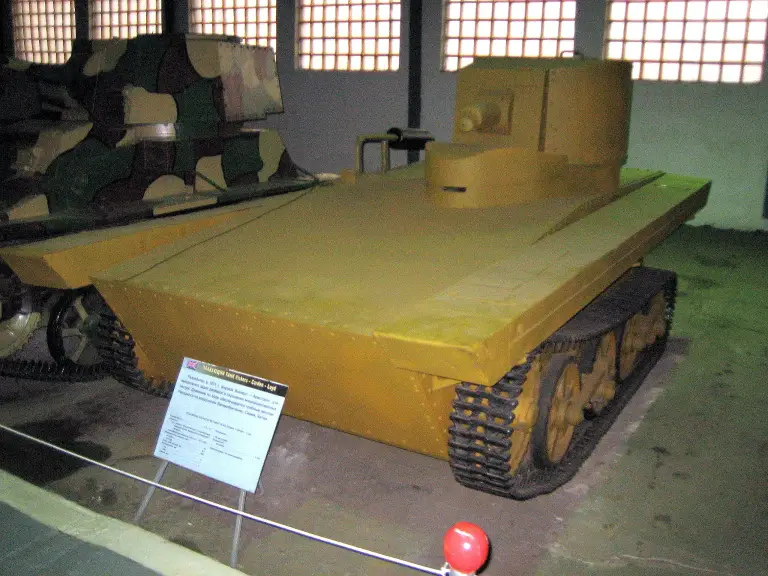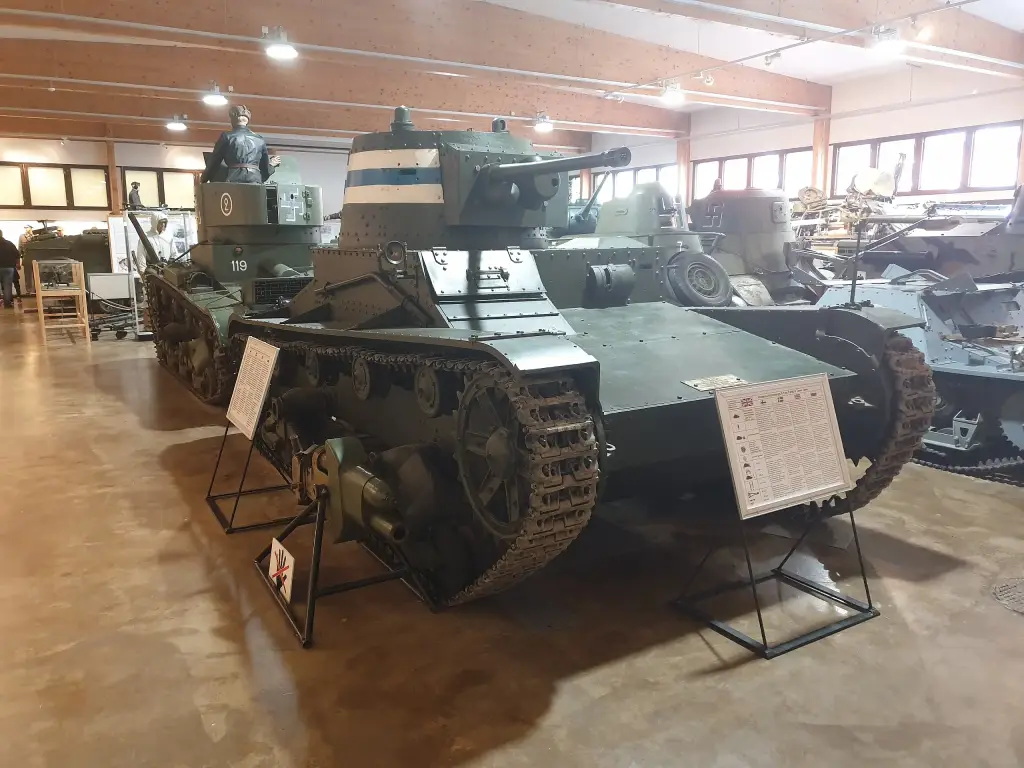
The Vickers 6-ton tank, also known as the Vickers Mark E or the “Six-tonner”, was a British light tank designed in 1928 as a private project at Vickers. The British Army did not adopt it, but several other armed forces did, and the Soviet Union licensed it as the T-26. It was also the direct predecessor of the Polish 7TP.
Vickers 6-ton at a glance
| Type | Light tank, private venture |
|---|---|
| Designation | Vickers Mark E, the “Six-tonner” |
| Designed | 1928 |
| Design team | John Valentine Carden and Vivian Loyd |
| Armour | 25.4 mm at the front and over the turrets, 19 mm at the rear |
| Engine | Armstrong Siddeley, 80–95 hp (60–71 kW) by version |
| Top speed | 35 km/h (22 mph) on roads |
| Suspension | Carden bogie suspension with a leaf spring |
| Type A | Two turrets, each with a Vickers machine gun |
| Type B | Two-man turret with a machine gun and a 47 mm OQF 3-pdr gun |
| Built by Vickers | 153 Mark Es |
| Buyers | USSR, Poland, Greece, Bolivia, Siam, Finland, Portugal, China, Bulgaria |
Based on one source: the English Wikipedia article on the Vickers 6-ton.
History of the Vickers 6-ton
The first Mark E was built in 1928 by a design team that included the tank designers John Valentine Carden and Vivian Loyd. The hull was made of riveted steel plates, one inch (25.4 mm) thick at the front and over most of the turrets, and about three quarters of an inch (19 mm) thick at the rear. Power came from an Armstrong Siddeley engine of 80 to 95 horsepower depending on the version, which gave a top speed of 22 mph (35 km/h) on roads.
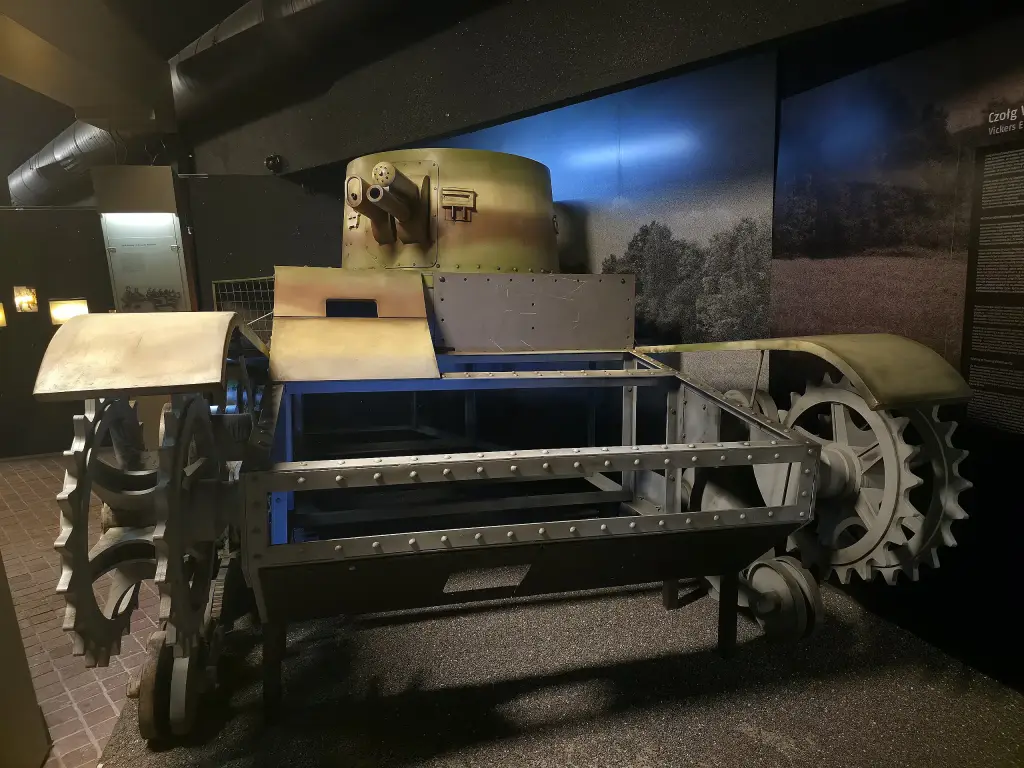
The suspension used two axles, each carrying a two-wheel bogie to which a second set of bogies was connected through a leaf spring. Carden patented it in 1929, and it appears to have been derived from a similar but simpler suspension on the Light Tank Mk I which he had patented a year earlier. Upward movement of either set of bogies forced the other down through the spring; it was considered a fairly good system for the time and gave better than normal cross-country performance, although it could not compare with the contemporary Christie suspension. High-strength steel tracks gave over 3,000 miles (4,800 km) of life, considerably better than most designs of the era.
The tank was built in two versions. Type A had two turrets, each mounting a Vickers machine gun. Type B had a single two-man turret mounting a machine gun and a short-barrelled 47 mm OQF 3-pdr gun, and its duplex mounting proved a real innovation: the two-man turret dramatically increased the rate of fire of either weapon while still allowing both to be fired at the same time. That arrangement became common on almost all tanks designed after the Mark E.
The British Army evaluated the Mark E but rejected it, seeing no tactical niche for such a vehicle and preferring a combination of medium tanks and tankettes. Vickers then advertised the design to all buyers and soon received a trickle of orders, eventually including the USSR, Greece, Poland, Bolivia, Siam, Finland, Portugal, China and Bulgaria. Thailand bought 36 Vickers Medium Dragon Mark IVs, and QF 2-pounder naval guns were added to turn them into self-propelled guns used in the 1940–41 Franco-Thai War. Vickers built a total of 153 Mark Es, the most commonly cited figure.
Experience with the Polish machines showed that the air-cooled engine tended to overheat because of poor airflow, which was addressed by adding large air vents on either side of the hull. For a new Belgian order the design was modified to take a Rolls-Royce Phantom II water-cooled engine; it would not fit at the rear, so it was mounted along the left side of the tank and the turret moved to the right and rearward. One example of the resulting Mark F was tested by Belgium and rejected, but the new hull was used, with the older engine, in sales to Finland and Siam. The Mark E was also developed as a cargo vehicle and bought by the British Army in small numbers as artillery tractors.
In 1939, during the Soviet-Finnish Winter War, the Finnish armoured forces still had around thirty-two obsolete Renault FT tanks, some Vickers-Carden-Lloyd Mk. IVs and Model 33s, and 26 Vickers Armstrongs 6-ton tanks. The type also lived on through its licence derivatives: the Soviets sent their T-26s to the Republican Army in the Spanish Civil War, and after the battle of Guadalajara in 1937 the Italians captured some of these tanks and used them as models for their M11/39 and M13/40 medium tanks.
Design and features
- Carden suspension: linked bogies on a leaf spring, patented in 1929 and good for its time off the road.
- Duplex turret: the two-man Type B turret let the gunner and machine gunner fire together.
- Long-life tracks: high-strength steel tracks were rated for more than 3,000 miles (4,800 km).
- Easy export: a simple, private-venture design that Vickers could sell to any buyer.
Vickers 6-ton versions
- Type A: twin turrets with Vickers machine guns; 38 bought by Poland.
- Type B: single two-man turret with a machine gun and a 47 mm gun.
- Mark F: Belgian trial version with a Rolls-Royce Phantom II water-cooled engine mounted along the left side of the hull, rejected after testing.
- Dragon, Medium Mark IV: cargo and artillery-tractor version; twelve bought by the British Army to haul BL 60-pounder guns, 23 by China and 18 by India.
- Polish 7TP: Polish development with a diesel engine, better armour, a 37 mm Bofors-based gun and two-way radios, nearly ten tons in weight.
- Soviet T-26: licensed production of more than 12,000 vehicles in many versions.
The later Vickers light amphibious tank is described in the article on the Vickers-Carden-Loyd light amphibious tank, and more vehicles are in the Vickers collection.
Sources
- Vickers 6-ton, English Wikipedia: design, versions, exports, derivatives